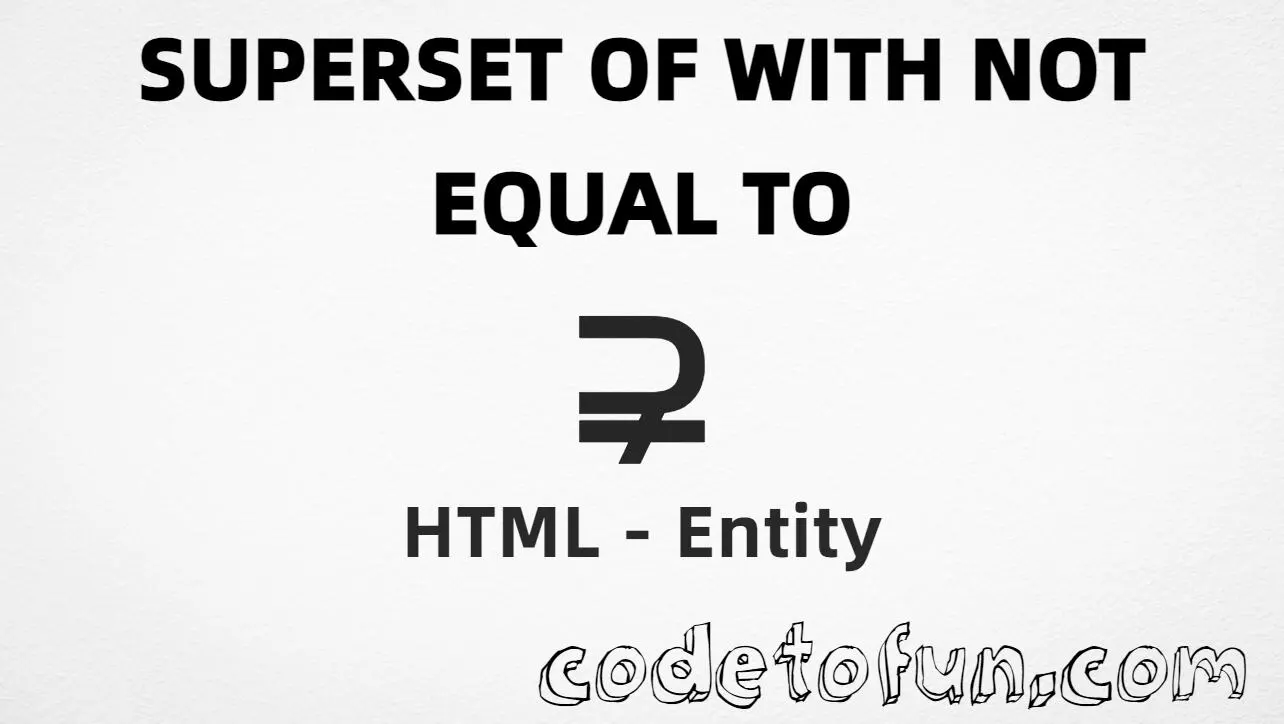
Superset with not equal to (⊋) is the Unicode character at U+228B in Mathematical Operators. Official name: SUPERSET OF WITH NOT EQUAL TO. It marks a proper superset: A ⊋ B means every element of B is in A, but the sets are not equal. HTML5 provides the named entities ⊋ and ⊋.
Remember
Character     ⊋
Unicode       U+228B
Named entity  ⊋  (also ⊋)
Hex entity    ⊋
Decimal       ⊋
CSS escape    \228B
All of these produce the same glyph: ⊋. Prefer ⊋ for readable HTML; paste ⊋ in UTF-8 when convenient.
Using Named Entity: ⊋
Using Hex Code: ⊋
Using HTML Code: ⊋
Using CSS Entity: ⊋
Typed directly: ⊋
Example: A ⊋ B
How It Works
1. Named:⊋ (or ⊋) is the clearest HTML form for U+228B.
2. Hex:U+228B → ⊋ in HTML. Same glyph as the named form.
3. Decimal: same code point as 8843 → ⊋. Same result as hex.
4. CSS: use \228B in content (not an HTML entity). #point::after appends that ⊋ after the paragraph text.
5. Typed / example: paste ⊋ in UTF-8, or write A ⊋ B for a short proper-superset example.
Pitfalls & Tips
Common mistakes when working with Superset With Not Equal To.
⊃
Not plain superset
⊃ (U+2283) does not carry the “not equal” mark. Prefer ⊋ when a proper superset is required.
⊇
Not superset or equal to
⊇ is U+2287. Prefer ⊋ when the sets must be unequal.
Alias
⊋ = ⊋
Both named forms map to U+228B. Pick one style and stay consistent.
Fonts
Math font coverage
Some UI fonts omit Mathematical Operators. Prefer a math-capable font for display.
CSS vs HTML
Do not mix escapes
\228B belongs in CSS. ⊋ / ⊋ / ⊋ belong in HTML.
Semicolon
End entity references
Always finish with ; — write ⊋, not &supne.
Compatibility
Browser Support
Superset with not equal to (U+228B) and its entity forms (⊋, ⊋, ⊋, CSS \\228B) are supported in all mainstream browsers. Glyph availability depends on the font.
✓ Universal support
Superset With Not Equal To (⊋)
Prefer ⊋, or encode with hex, decimal, or CSS escape — same glyph everywhere.
100%Browser coverage
Google ChromeSupported
Yes
Microsoft EdgeSupported
Yes
Mozilla FirefoxSupported
Yes
Apple SafariSupported
Yes
OperaSupported
Yes
Internet ExplorerAll versions
Yes
U+228B / entitiesFull support
Bottom line: Prefer ⊋ (or ⊋) in HTML. Use ⊋ / ⊋ when a numeric form is required, and \\228B only inside CSS content.
Remember
Key Takeaways
Unicode: this mark is U+228B (decimal 8843) — glyph ⊋.
HTML: prefer ⊋ (alias ⊋), or ⊋ / ⊋.
CSS: use \228B inside content for generated text.
Meaning:A ⊋ B means a proper superset — not plain ⊃, not ⊇.
Use ⊋ or ⊋ (named), ⊋ (hex), ⊋ (decimal), type ⊋ directly in UTF-8, or the CSS escape \228B in content.
U+228B (SUPERSET OF WITH NOT EQUAL TO). Hex 228B, decimal 8843. It belongs to Mathematical Operators (U+2200–U+22FF).
Yes. HTML5 defines ⊋ and the alias ⊋ for this character. They are equivalent to ⊋ and ⊋.
Use it for a proper superset: A contains every element of B, but A is not equal to B. Prefer ⊇ when equality is allowed (U+2287) and ⊃ for plain superset of (U+2283).
HTML entities (⊋, ⊋, or ⊋) go in markup. The CSS escape \228B goes in stylesheet strings (usually content on ::before/::after).
No. ⊋ is superset with not equal to (U+228B). ⊃ is plain superset of (U+2283). ⊇ is superset or equal to (U+2287).
🤔
Did you know?
Superset with not equal to (⊋) is Unicode U+228B (decimal 8843) — SUPERSET OF WITH NOT EQUAL TO in Mathematical Operators. HTML5 provides ⊋ (also ⊋). It denotes a proper superset: A ⊋ B means every element of B is in A, but A ≠ B. Superset or equal is U+2287 (⊇); the reverse is U+228A (⊊).