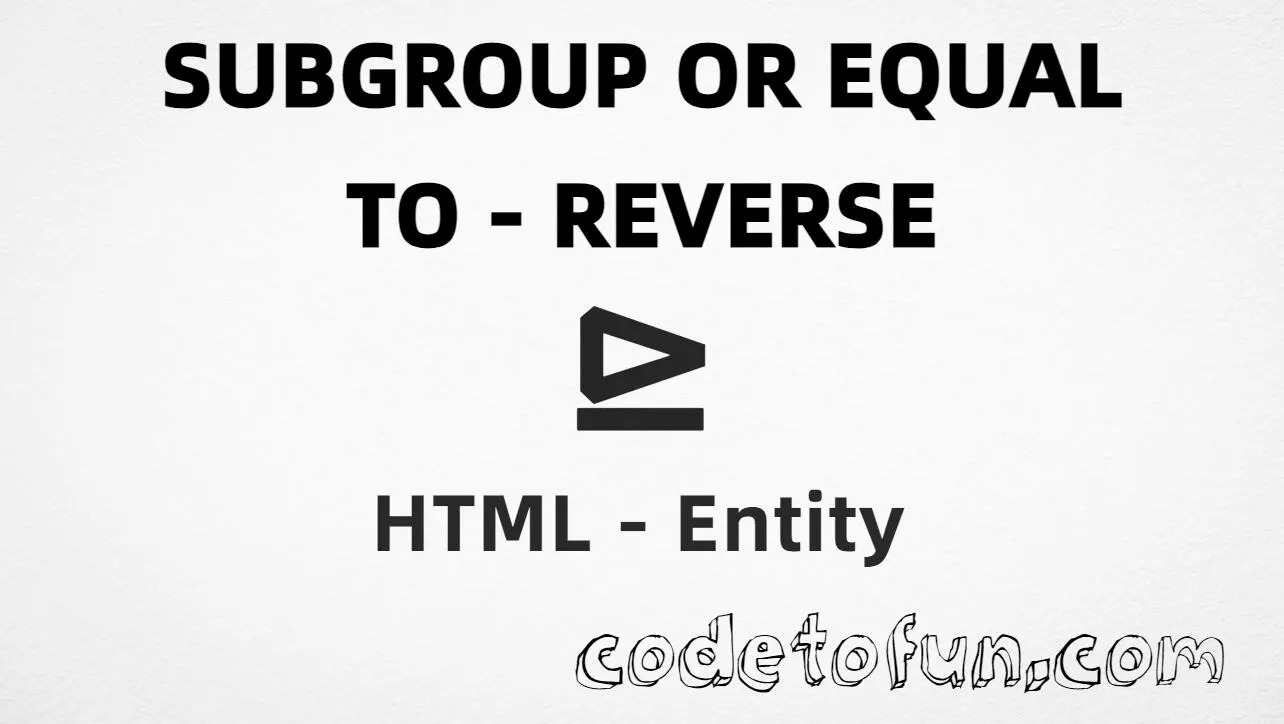
Subgroup or equal to reverse (⊵) is the Mathematical Operators character at Unicode U+22B5 (CONTAINS AS NORMAL SUBGROUP OR EQUAL TO). In group theory, G ⊵ H means G contains H as a normal subgroup or equal. HTML5 provides the named entities ⊵ and ⊵.
Remember
Character     ⊵
Unicode       U+22B5
Named entity  ⊵  (also ⊵)
Hex entity    ⊵
Decimal       ⊵
CSS escape    \22B5
All of these produce the same glyph: ⊵. Prefer ⊵ for readable HTML; paste ⊵ in UTF-8 when convenient.
Using Named Entity: ⊵
Using Hex Code: ⊵
Using HTML Code: ⊵
Using Direct Character: ⊵
Using CSS Entity: ⊵
Example: G ⊵ H
How It Works
1. Named:⊵ (or ⊵) is the clearest HTML form for U+22B5.
2. Hex:U+22B5 → ⊵ in HTML. Reliable numeric form.
3. Decimal: same code point as 8885 → ⊵. Same glyph.
4. Direct: paste ⊵ in a UTF-8 file with <meta charset="UTF-8">.
5. CSS: use \22B5 in content (not an HTML entity). #point::after appends that ⊵ after the paragraph text.
Pitfalls & Tips
Common mistakes when working with Subgroup Or Equal To Reverse.
Direction
⊵ vs ⊴
G ⊵ H means G contains H as a normal subgroup or equal. The reverse symbol is ⊴ (U+22B4).
Not ⊳
Not without “or equal”
⊳ (U+22B3) is contains as normal subgroup without the bar under the triangle.
Not superset
Not ⊇
Superset or equal ⊇ is set inclusion. This entity is a group-theory relation — different meaning.
Aliases
⊵ = ⊵
Both named forms map to U+22B5. Pick one and stay consistent.
CSS vs HTML
Do not mix escapes
\22B5 belongs in CSS. ⊵ / ⊵ / ⊵ belong in HTML.
Semicolon
End references
Always finish with ; — write ⊵, not &rtrie.
Compatibility
Browser Support
Subgroup or equal to reverse (U+22B5) and its entity forms (⊵, ⊵, ⊵, CSS \\22B5) are supported in all mainstream browsers. Glyph availability depends on the font.
✓ Universal support
Subgroup Or Equal To Reverse (⊵)
Prefer ⊵, or encode with hex, decimal, or CSS escape — same glyph everywhere.
100%Browser coverage
Google ChromeSupported
Yes
Microsoft EdgeSupported
Yes
Mozilla FirefoxSupported
Yes
Apple SafariSupported
Yes
OperaSupported
Yes
Internet ExplorerAll versions
Yes
U+22B5 / entitiesFull support
Bottom line: Prefer ⊵ (or ⊵) in HTML. Use ⊵ / ⊵ when a numeric form is required, and \\22B5 only inside CSS content.
Remember
Key Takeaways
Unicode: this mark is U+22B5 (decimal 8885) — glyph ⊵.
HTML: prefer ⊵ (alias ⊵), or ⊵ / ⊵.
Use ⊵ (named), ⊵ (hex), ⊵ (decimal), type ⊵ directly in UTF-8, or the CSS escape \22B5 in content. Alias: ⊵.
U+22B5 (CONTAINS AS NORMAL SUBGROUP OR EQUAL TO). Hex 22B5, decimal 8885. It belongs to Mathematical Operators (U+2200–U+22FF).
Yes. HTML5 defines ⊵ and ⊵ for this character. Both are equivalent to ⊵ and ⊵.
Use it in group theory when G contains H as a normal subgroup or equal (G ⊵ H). Prefer ⊴ for the reverse relation (U+22B4) and ⊳ for contains as normal subgroup without “or equal” (U+22B3).
HTML entities (⊵, ⊵, or ⊵) go in markup. The CSS escape \22B5 goes in stylesheet strings (usually content on ::before/::after).
No. ⊵ is U+22B5 (contains as normal subgroup or equal). ⊴ is U+22B4 (normal subgroup of or equal). ⊇ is U+2287 (superset of or equal to) — set theory, not the same relation.
🤔
Did you know?
Subgroup or equal to reverse (⊵) is Unicode U+22B5 (decimal 8885) — CONTAINS AS NORMAL SUBGROUP OR EQUAL TO in Mathematical Operators. HTML5 provides ⊵ (also ⊵). In group theory, G ⊵ H means G contains H as a normal subgroup or equal. The reverse relation is U+22B4 (⊴).