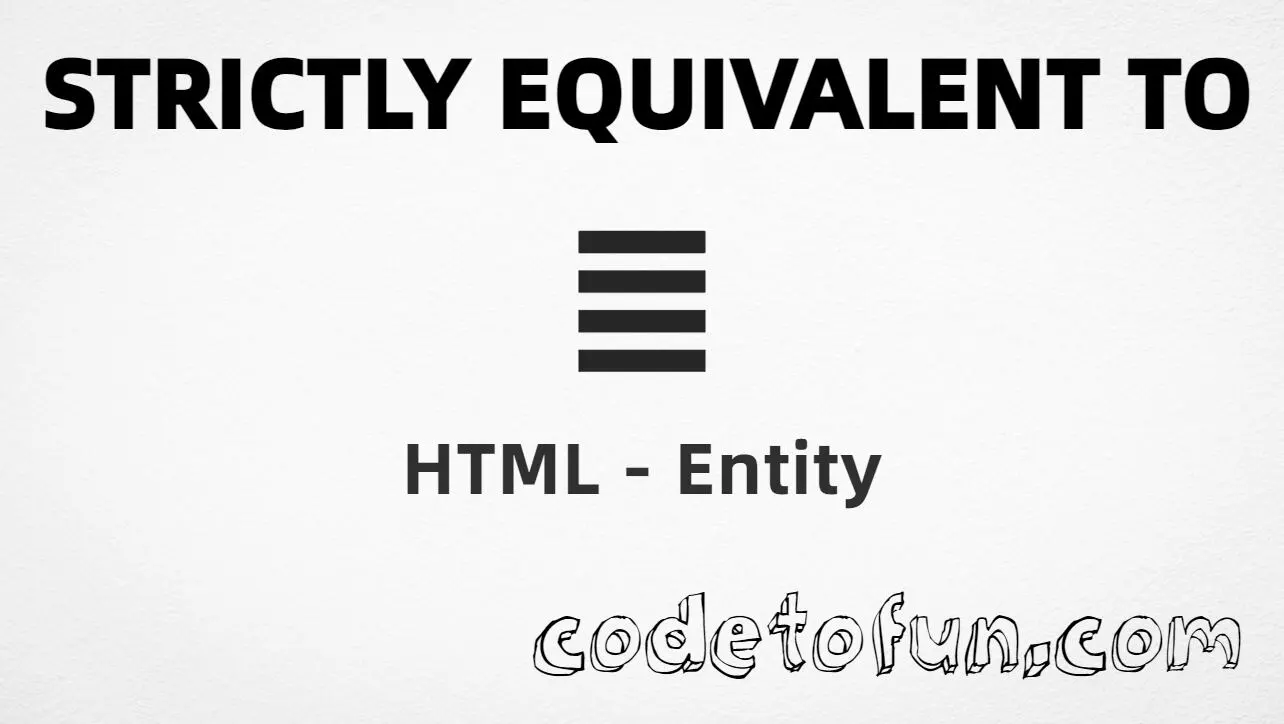
Strictly equivalent to (≣) is the Unicode character at U+2263 in Mathematical Operators. Official name: STRICTLY EQUIVALENT TO. It is a relation symbol used in logic, algebra, and formal proofs.
Remember
Character     ≣
Unicode       U+2263
Hex entity    ≣
Decimal       ≣
CSS escape    \2263
Named entity  (none)
Not the same  = · ≡ · ≍
Prefer ≣ or ≣ in HTML markup. You can also type ≣ in UTF-8. There is no named entity.
Using Hex Code: ≣
Using HTML Code: ≣
Using CSS Entity: ≣
Typed directly: ≣
Relation: A ≣ B
How It Works
1. Hex:U+2263 → ≣ in HTML. The browser turns it into ≣.
2. Decimal: same code point as 8803 → ≣. Same result as hex.
3. CSS: use \2263 in content (not an HTML entity). #point::after appends that ≣ after the paragraph text.
4. Typed / relation: paste ≣ in UTF-8, or write A ≣ B for a short logic/math example.
Pitfalls & Tips
Common mistakes when working with Strictly Equivalent To.
Named?
No named entity
HTML5 does not define a named entity for U+2263. Use ≣ or ≣.
≡
Not ≡
≡ is identical to (≡, U+2261). Strictly equivalent to is a different code point (U+2263).
=
Not ordinary equals
Typing = is U+003D. Prefer U+2263 when the strictly-equivalent relation is required.
Fonts
Math font coverage
Some UI fonts omit Mathematical Operators. Prefer a math-capable font for display.
CSS vs HTML
Do not mix escapes
\2263 belongs in CSS strings. ≣ / ≣ belong in HTML.
Semicolon
End numeric references
Always finish with ; — write ≣, not ≣.
Compatibility
Browser Support
Strictly equivalent to (U+2263) and its entity forms (≣, ≣, CSS \\2263) are supported in all mainstream browsers. Visible glyphs depend on math font coverage.
✓ Universal support
Strictly Equivalent To (≣)
Encode with hex, decimal, CSS escape, or type the character — same code point everywhere encoding is supported.
100%Browser coverage
Google ChromeSupported
Yes
Microsoft EdgeSupported
Yes
Mozilla FirefoxSupported
Yes
Apple SafariSupported
Yes
OperaSupported
Yes
Internet ExplorerAll versions
Yes
U+2263 / entitiesFull support
Bottom line: Prefer ≣ or ≣ in HTML. Use \\2263 only inside CSS content. There is no named entity.
Remember
Key Takeaways
Unicode: this mark is U+2263 (decimal 8803) — glyph ≣.
HTML: use ≣ or ≣ — no named entity; typing ≣ also works.
CSS: use \2263 inside content for generated text.
Meaning:≣ = strictly equivalent — not =, not ≡, not ≍.
One line:U+2263 → ≣ / ≣ / CSS \2263.
Frequently Asked Questions
Use ≣ (hex), ≣ (decimal), type ≣ directly in UTF-8, or the CSS escape \2263 in content. There is no named HTML entity for U+2263.
U+2263 (STRICTLY EQUIVALENT TO). Hex 2263, decimal 8803. It belongs to Mathematical Operators (U+2200–U+22FF).
No. HTML5 does not define a named entity for this character. Use numeric forms ≣ or ≣. Related: ≡ is identical to (U+2261).
Use it in logic, algebra, and formal proofs when you need the strictly-equivalent relation. Prefer = for ordinary equality, ≡ for identical/congruent, and ≍ for equivalent to (U+224D).
HTML entities (≣ or ≣) go in markup. The CSS escape \2263 goes in stylesheet strings (usually content on ::before/::after).
No. ≣ is U+2263 (strictly equivalent to). ≡ is ≡ (U+2261, identical to). = is U+003D (equals sign).
🤔
Did you know?
Strictly equivalent to is Unicode U+2263 (decimal 8803) — glyph ≣ in Mathematical Operators. Official name: STRICTLY EQUIVALENT TO. HTML5 has no named entity — use ≣ or ≣. Identical to is ≡ (U+2261); equivalent to is ≍ (U+224D).