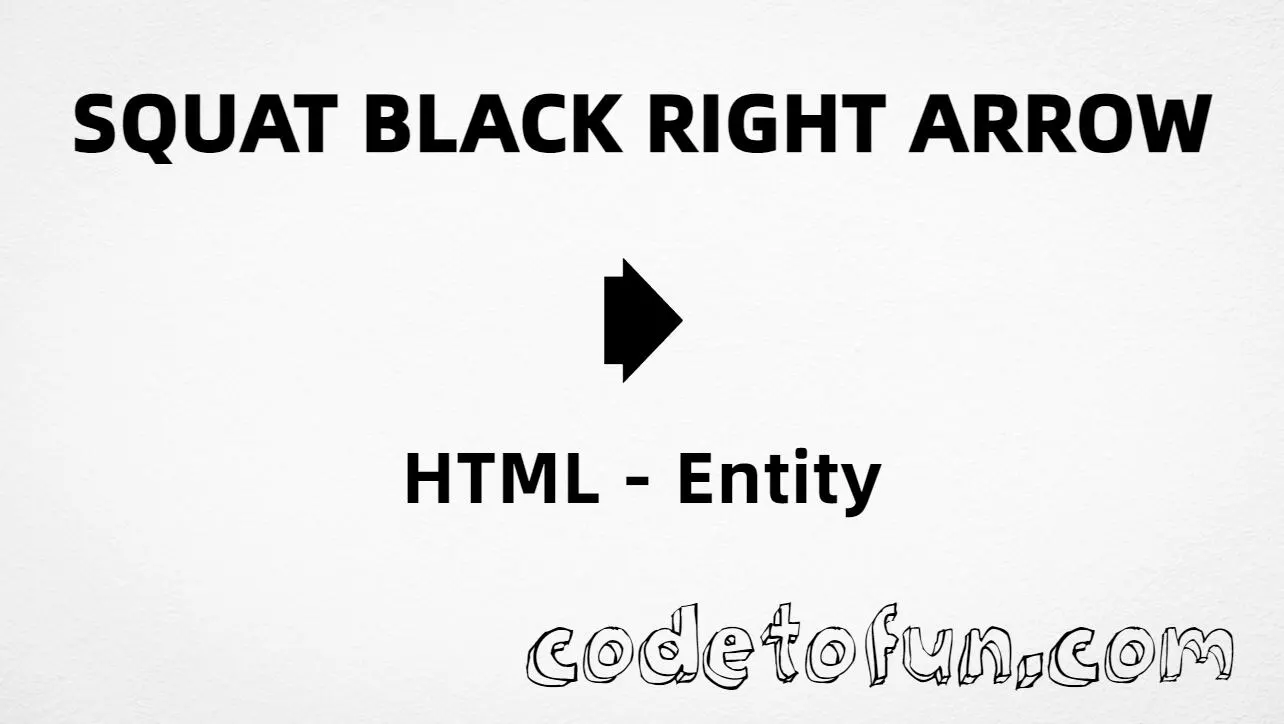
Squat black rightwards arrowhead (➧) is the Unicode character at U+27A7 in Dingbats. Official name: SQUAT BLACK RIGHTWARDS ARROWHEAD. It is a filled, short right-pointing arrowhead often used for UI and decorative navigation.
Remember
Character     ➧
Unicode       U+27A7
Named entity  (none)
Hex entity    ➧
Decimal       ➧
CSS escape    \27A7
Not the same  → · ➤ · ➡
Prefer ➧ or ➧ in HTML markup. You can also type ➧ in UTF-8. For a common text arrow, use → (→) instead.
Using Hex Code: ➧
Using HTML Code: ➧
Using CSS Entity: ➧
Typed directly: ➧
Notation: Next ➧
How It Works
1. Hex:U+27A7 → ➧ in HTML. Preferred numeric form when you need an entity.
2. Decimal: same code point as 10151 → ➧. Same glyph as hex.
3. CSS: use \27A7 in content (not an HTML entity). #point::after appends that ➧ after the paragraph text.
4. Typed / notation: paste ➧ in UTF-8, or write Next ➧ for a short label.
5. No named entity: HTML5 does not define a name for U+27A7 — use numeric references or type the character.
Pitfalls & Tips
Common mistakes when working with U+27A7.
vs →
Not the common right arrow
U+2192 (→, →) is the everyday text/math arrow. U+27A7 is a Dingbats arrowhead.
vs ➤
Not black rightwards arrowhead
➤ (U+27A4) is a related Dingbats arrowhead with a different shape. Do not treat them as identical.
Fonts
Needs Dingbats coverage
Some fonts omit decorative Dingbats. Prefer a stack that includes emoji or symbol fonts if the glyph must always show.
Named
No named HTML entity
There is no &squatrarr; for U+27A7. Use ➧ or ➧.
CSS vs HTML
Do not mix escapes
\27A7 belongs in CSS strings. ➧ / ➧ belong in HTML.
A11y
Do not rely on the glyph alone
Screen readers may skip or misname decorative arrows. Prefer visible text like “Next” plus the glyph, or an accessible name on controls.
Compatibility
Browser Support
Squat black rightwards arrowhead (U+27A7) and its entity forms (➧, ➧, CSS \\27A7) are supported in all mainstream browsers. Visible glyphs depend on Dingbats font coverage.
✓ Universal support
Squat Black Right Arrow (➧)
Encode with hex, decimal, CSS escape, or type the character — same code point everywhere encoding is supported.
100%Browser coverage
Google ChromeSupported
Yes
Microsoft EdgeSupported
Yes
Mozilla FirefoxSupported
Yes
Apple SafariSupported
Yes
OperaSupported
Yes
Internet ExplorerAll versions
Yes
U+27A7 / entitiesFull support
Bottom line: Prefer ➧ or ➧ in HTML. Use \\27A7 only inside CSS content. There is no named entity.
Remember
Key Takeaways
Unicode: this arrow is U+27A7 (decimal 10151) — glyph ➧.
HTML: no named entity — use ➧ / ➧ / type ➧.
CSS: use \27A7 inside content for generated text.
Meaning:➧ is a Dingbats arrowhead — not → (→), not ➤.
One line:U+27A7 → ➧ / ➧ / CSS \27A7 (no named entity).
Frequently Asked Questions
Use ➧ (hex), ➧ (decimal), type ➧ directly in UTF-8, or the CSS escape \27A7 in content. There is no named HTML entity.
U+27A7 (SQUAT BLACK RIGHTWARDS ARROWHEAD). Hex 27A7, decimal 10151. It belongs to Dingbats (U+2700–U+27BF).
No. Use numeric references ➧ or ➧, or type ➧ in UTF-8.
No. ➧ is U+27A7 (squat black rightwards arrowhead). → is U+2192 (→). ➤ is U+27A4 (black rightwards arrowhead).
Use it for decorative or UI-style right arrows in Dingbats style — not as a substitute for the common math/text arrow →.
HTML entities (➧ or ➧) go in markup. The CSS escape \27A7 goes in stylesheet strings (usually content on ::before/::after).
🤔
Did you know?
Squat black rightwards arrowhead is Unicode U+27A7 (decimal 10151) — glyph ➧ in Dingbats (U+2700–U+27BF). Official name: SQUAT BLACK RIGHTWARDS ARROWHEAD. HTML5 has no named entity — use ➧ or ➧. Do not confuse with rightwards arrow U+2192 (→, →) or black rightwards arrowhead U+27A4 (➤).