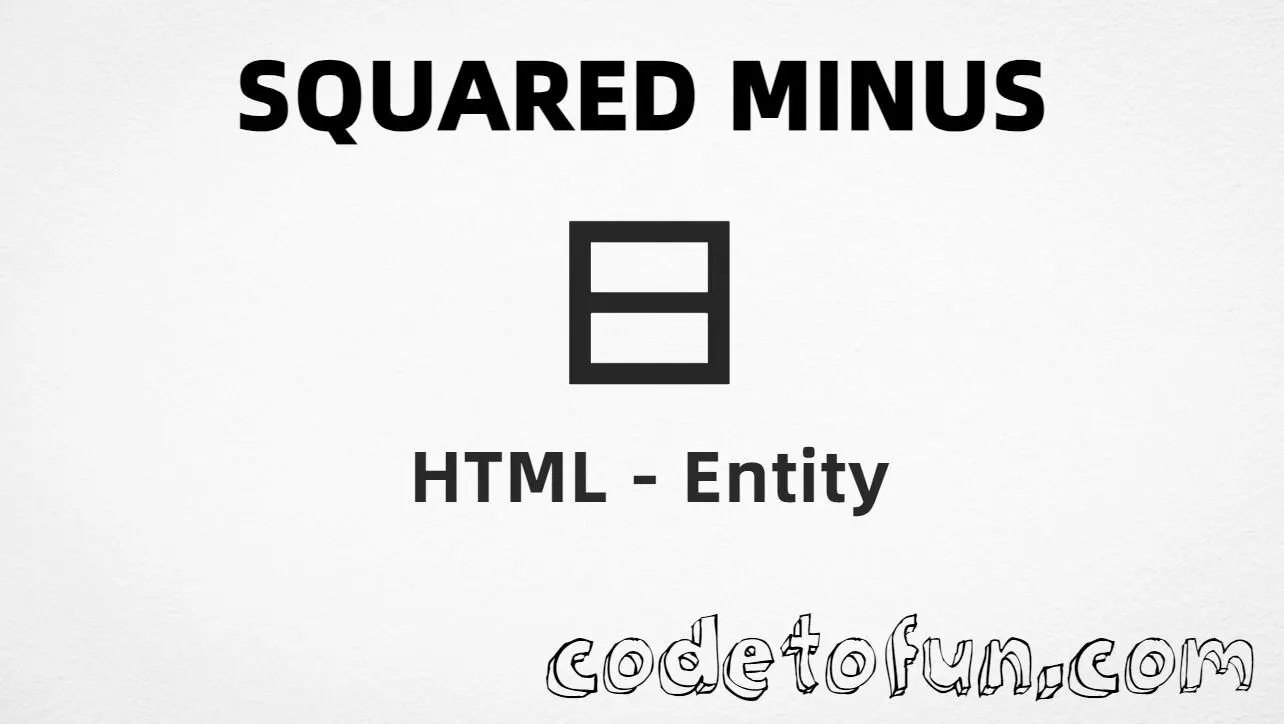
Squared minus (⊟) is the Unicode character at U+229F in Mathematical Operators. Official name: SQUARED MINUS. It is a boxed (square) minus operator used in specialized math notation.
Remember
Character     ⊟
Unicode       U+229F
Named entity  ⊟
Hex entity    ⊟
Decimal       ⊟
CSS escape    \229F
Not the same  − · ⊞ · ⊠
Prefer ⊟ in HTML markup (&BoxMinus; is an alias). You can also type ⊟ in UTF-8, or use numeric forms when needed. For an ordinary minus, use − (−) instead.
Using Named Entity: ⊟
Using Hex Code: ⊟
Using HTML Code: ⊟
Using CSS Entity: ⊟
Typed directly: ⊟
Notation: A ⊟ B
How It Works
1. Named:⊟ is the HTML5 name for U+229F → ⊟. Best default in markup.
2. Hex:U+229F → ⊟ in HTML. Same glyph as the named form.
3. Decimal: same code point as 8863 → ⊟. Same result as hex and named.
4. CSS: use \229F in content (not an HTML entity). #point::after appends that ⊟ after the paragraph text.
5. Typed / notation: paste ⊟ in UTF-8, or write A ⊟ B for a short expression.
Pitfalls & Tips
Common mistakes when working with ⊟.
vs −
Not an ordinary minus
U+2212 (−, −) is the common mathematical minus. U+229F is the squared (boxed) form.
vs ⊞
Not squared plus
⊞ (U+229E, ⊞) is the plus counterpart. Do not swap them.
Name
Remember ⊟
The named entity is ⊟ — not − (that is U+2212).
CSS vs HTML
Do not mix escapes
\229F belongs in CSS strings. ⊟ / ⊟ / ⊟ belong in HTML.
Semicolon
End named entities
Always finish with ; — write ⊟, not &minusb.
A11y
Name the operator in context
Screen readers may announce this symbol unevenly. Prefer nearby words like “squared minus” when the glyph carries meaning alone.
Compatibility
Browser Support
Squared minus (U+229F) and its entity forms (⊟, ⊟, ⊟, CSS \\229F) are supported in all mainstream browsers. Visible glyphs depend on Mathematical Operators font coverage.
✓ Universal support
Squared Minus (⊟)
Encode with named, hex, decimal, CSS escape, or type the character — same code point everywhere encoding is supported.
100%Browser coverage
Google ChromeSupported
Yes
Microsoft EdgeSupported
Yes
Mozilla FirefoxSupported
Yes
Apple SafariSupported
Yes
OperaSupported
Yes
Internet ExplorerAll versions
Yes
U+229F / entitiesFull support
Bottom line: Prefer ⊟ in HTML. Use ⊟ / ⊟ when numeric form is required, and \\229F only inside CSS content.
Remember
Key Takeaways
Unicode: squared minus is U+229F (decimal 8863) — glyph ⊟.
HTML: prefer ⊟ — also ⊟ / ⊟ / type ⊟.
CSS: use \229F inside content for generated text.
Meaning:⊟ is boxed minus — not − (−), not ⊞.
Use ⊟ (named), ⊟ (hex), ⊟ (decimal), type ⊟ directly in UTF-8, or the CSS escape \229F in content. Prefer ⊟ in normal HTML.
U+229F (SQUARED MINUS). Hex 229F, decimal 8863. It belongs to Mathematical Operators (U+2200–U+22FF).
Yes. Use ⊟ (or the alias &BoxMinus;). Numeric forms ⊟ and ⊟ also work.
No. ⊟ is U+229F (⊟). − is U+2212 (−). ⊞ is U+229E (⊞, squared plus).
Use it for boxed-minus / squared-minus math notation in technical and academic pages — not as a substitute for an ordinary minus −.
HTML entities (⊟, ⊟, or ⊟) go in markup. The CSS escape \229F goes in stylesheet strings (usually content on ::before/::after).
🤔
Did you know?
Squared minus is Unicode U+229F (decimal 8863) — glyph ⊟ in Mathematical Operators (U+2200–U+22FF). HTML5 names it ⊟ (also &BoxMinus;). Official name: SQUARED MINUS. Do not confuse with minus sign U+2212 (−, −) or squared plus U+229E (⊞, ⊞).