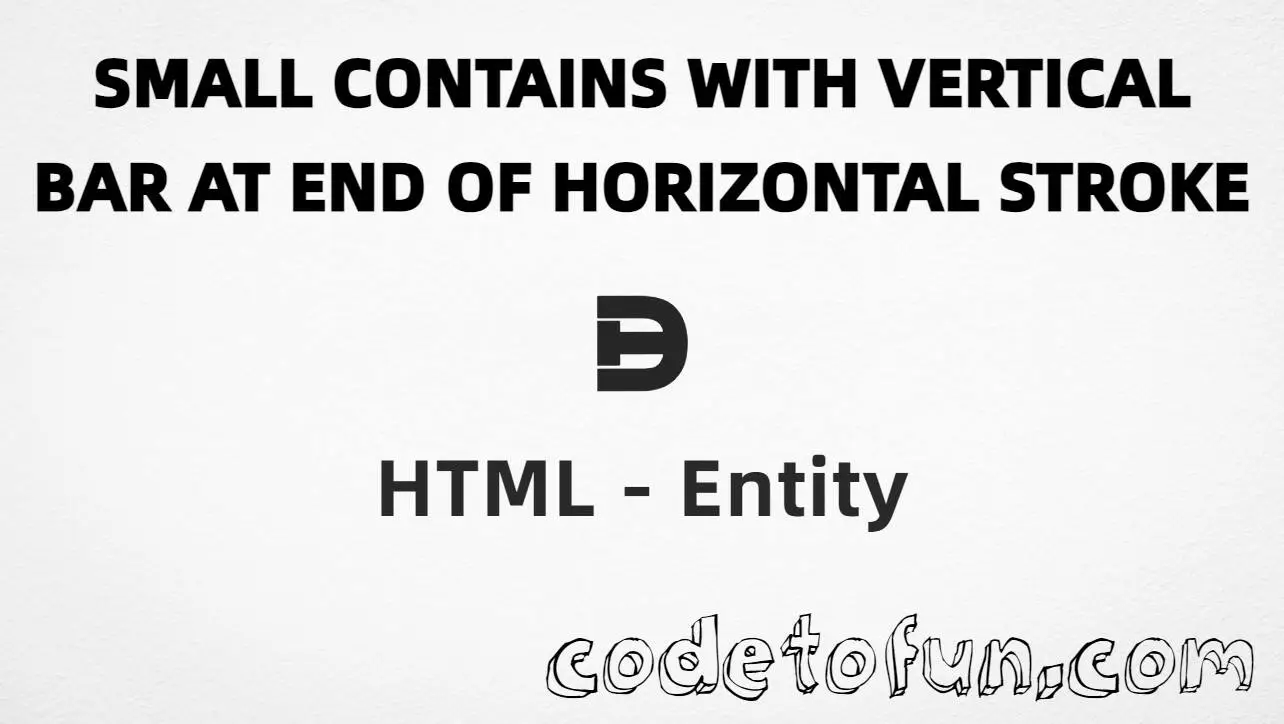
HTML Entity for Small Contains Vertical Bar At End Horizontal Stroke (⋼)
Beginner
5 min read
Updated: Sep 2026
1 example
Unicode U+22FC
Definition
What Is Small Contains Vertical Bar At End Horizontal Stroke?
Small contains with vertical bar (⋼) is the Unicode character at U+22FC in Mathematical Operators. Official name: SMALL CONTAINS WITH VERTICAL BAR AT END OF HORIZONTAL STROKE. It is a set-theory style relation used in mathematical notation.
Remember
Character     ⋼
Unicode       U+22FC
Named entity  ⋼
Hex entity    ⋼
Decimal       ⋼
CSS escape    \22FC
Not the same  ⋻ · ⋾ · ∍
Prefer ⋼ in HTML markup. You can also type ⋼ in UTF-8, or use numeric forms when needed. Use a math-capable font for the clearest glyph.
Using Named Entity: ⋼
Using Hex Code: ⋼
Using HTML Code: ⋼
Using CSS Entity: ⋼
Typed directly: ⋼
Set theory: A ⋼ B
How It Works
1. Named:⋼ is the HTML5 name for U+22FC → ⋼. Best default in markup.
2. Hex:U+22FC → ⋼ in HTML. Same glyph as the named form.
3. Decimal: same code point as 8956 → ⋼. Same result as hex and named.
4. CSS: use \22FC in content (not an HTML entity). #point::after appends that ⋼ after the paragraph text.
5. Typed / math: paste ⋼ in UTF-8, or write A ⋼ B for a simple relation example.
Pitfalls & Tips
Common mistakes when working with ⋼.
vs ⋻
Not the full-size form
U+22FB (⋻, ⋻) is contains with vertical bar. U+22FC is the small form — different characters.
vs ⋾
Not small contains overbar
⋾ (U+22FE, ⋾) uses an overbar, not a vertical bar stroke. Do not swap them.
Name
Remember ⋼
The named entity is ⋼ — not ⋻ (that is U+22FB).
CSS vs HTML
Do not mix escapes
\22FC belongs in CSS strings. ⋼ / ⋼ / ⋼ belong in HTML.
Semicolon
End named entities
Always finish with ; — write ⋼, not &nis.
Fonts
Use a math font
Some UI fonts omit U+22FC. Prefer Cambria Math, STIX, or similar for readable operators.
Compatibility
Browser Support
Small contains with vertical bar (U+22FC) and its entity forms (⋼, ⋼, ⋼, CSS \\22FC) are supported in all mainstream browsers. Visible glyphs depend on Mathematical Operators font coverage.
✓ Universal support
Small Contains Vertical Bar (⋼)
Encode with named, hex, decimal, CSS escape, or type the character — same code point everywhere encoding is supported.
100%Browser coverage
Google ChromeSupported
Yes
Microsoft EdgeSupported
Yes
Mozilla FirefoxSupported
Yes
Apple SafariSupported
Yes
OperaSupported
Yes
Internet ExplorerAll versions
Yes
U+22FC / entitiesFull support
Bottom line: Prefer ⋼ in HTML. Use ⋼ / ⋼ when numeric form is required, and \\22FC only inside CSS content.
Remember
Key Takeaways
Unicode: small contains with vertical bar is U+22FC (decimal 8956) — glyph ⋼.
HTML: prefer ⋼ — also ⋼ / ⋼ / type ⋼.
CSS: use \22FC inside content for generated text.
Meaning:⋼ is the small vertical-bar form — not ⋻ (⋻), not ⋾.
Use ⋼ (named), ⋼ (hex), ⋼ (decimal), type ⋼ directly in UTF-8, or the CSS escape \22FC in content. Prefer ⋼ in normal HTML.
U+22FC (SMALL CONTAINS WITH VERTICAL BAR AT END OF HORIZONTAL STROKE). Hex 22FC, decimal 8956. It belongs to the Mathematical Operators block (U+2200–U+22FF).
Yes. Use ⋼. Numeric forms ⋼ and ⋼ also work. Do not confuse with ⋻ (U+22FB).
No. ⋼ is U+22FC (⋼). Related but different: U+22FB (contains with vertical bar, ⋻), U+22FE (small contains with overbar, ⋾), and U+220D (small contains as member).
Use it in set theory and math documentation when you need the small contains-with-vertical-bar operator. Prefer a math-capable font for clear glyphs.
HTML entities (⋼, ⋼, or ⋼) go in markup. The CSS escape \22FC goes in stylesheet strings (usually content on ::before/::after).
🤔
Did you know?
Small contains with vertical bar is Unicode U+22FC (decimal 8956) — glyph ⋼ in Mathematical Operators. HTML5 names it ⋼. Official name: SMALL CONTAINS WITH VERTICAL BAR AT END OF HORIZONTAL STROKE. Do not confuse with contains vertical bar U+22FB (⋻, ⋻) or small contains overbar U+22FE (⋾, ⋾).