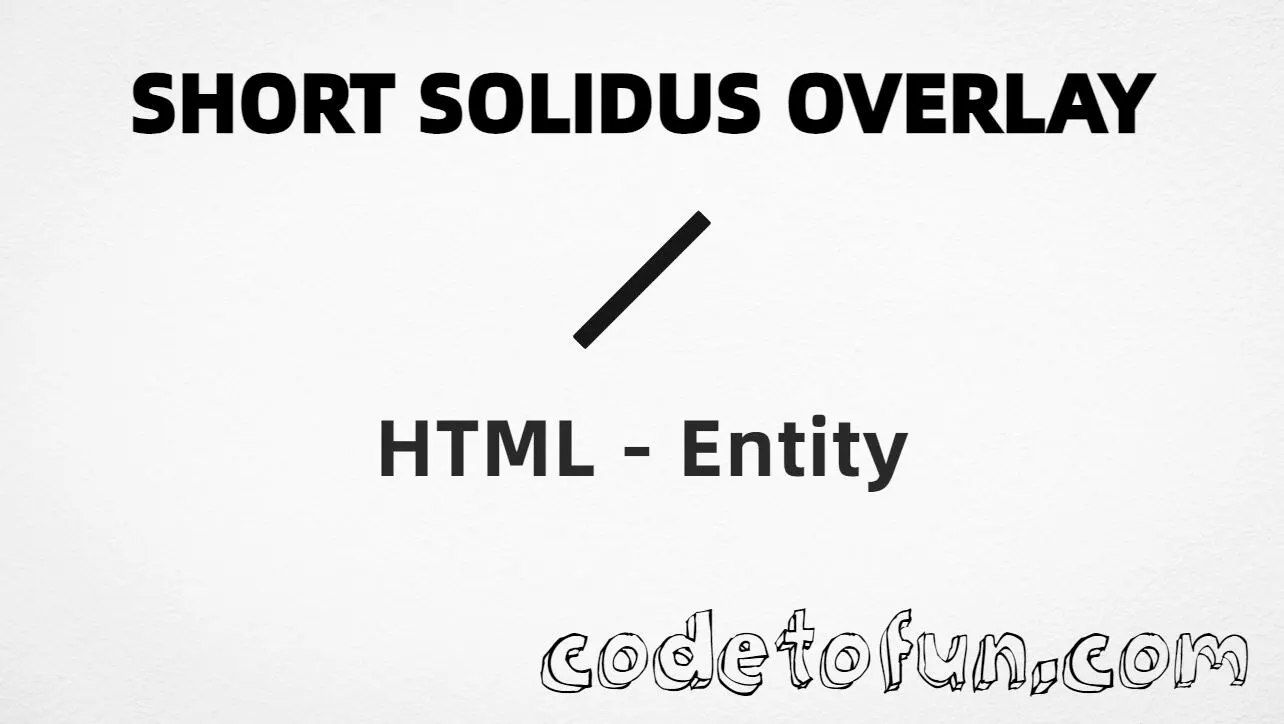
Short Solidus Overlay is the Combining Diacritical Marks character at Unicode U+0337 (COMBINING SHORT SOLIDUS OVERLAY). It is a non-spacing mark — it overlays a short diagonal slash on the character that comes before it (for example A̷ → A̷).
Remember
Example       A̷
Unicode       U+0337
Hex entity    ̷
Decimal       ̷
Named entity  (none)
CSS escape    \0337
Not the same  A̸ (long solidus) · A̵ (short stroke)
Always place the entity after a base character. Prefer ̷ when you want an explicit combining entity. For a longer slash overlay, see Long Solidus Overlay (U+0338).
Using Hex Code: A̷
Using HTML Code: A̷
Using CSS Entity: A̷
Sample: o̷
How It Works
1. Hex: write a base letter, then ̷. The mark overlays that letter → A̷.
2. Decimal: same code point as 823 → A̷. Same result as hex.
3. Named: HTML5 does not define a named entity for U+0337 — use hex or decimal instead.
4. CSS: use \0337 in content. Here #point ends with A, and ::after appends the combining mark so it overlays that letter.
Pitfalls & Tips
Common mistakes when working with Short Solidus Overlay.
Combining
Needs a base letter
Do not use ̷ alone. Write A̷, o̷, etc.
Order
Base first, mark second
Wrong: ̷A. Right: A̷.
Look-alikes
̷ ≠ ̸ ≠ ̵
U+0337 is a short solidus. U+0338 is longer (often for math negation). U+0335 is a short horizontal stroke — not a slash.
Named
No &…; name
Do not invent a name. Use ̷ or ̷.
Fonts
Glyph coverage
Combining marks need good font support. Test stacking on your target devices — some fonts omit U+0337.
CSS vs HTML
Do not mix escapes
\0337 belongs in CSS. ̷ / ̷ belong in HTML after a base letter.
Compatibility
Browser Support
Short Solidus Overlay (U+0337) and its entity forms (̷, ̷, CSS \\0337) are supported in all modern browsers when placed after a base letter. Glyph coverage depends on the font.
✓ Universal encoding
Short Solidus Overlay (A̷)
Encode with hex, decimal, or CSS escape after a base letter. No named entity for U+0337.
100%Browser coverage
Google ChromeSupported
Yes
Microsoft EdgeSupported
Yes
Mozilla FirefoxSupported
Yes
Apple SafariSupported
Yes
OperaSupported
Yes
Internet ExplorerIE 9+
Yes*
U+0337Full support
Bottom line: Prefer A̷ for readable HTML. Use \\0337 only inside CSS content after a base letter.
Remember
Key Takeaways
Unicode: this mark is U+0337 (decimal 823) — combining short solidus overlay.
HTML: prefer A̷ — or use A̷. No named entity.
CSS: use \0337 in content after a base letter.
Watch out: never use the mark alone — and do not confuse it with long solidus (U+0338).
One line: base + U+0337 → A̷ / A̷ / CSS \0337 (no named entity).
Frequently Asked Questions
Place ̷ (hex) or ̷ (decimal) immediately after a base character (e.g. A̷). Or use CSS \0337 in content after a base letter. There is no named HTML entity for U+0337.
U+0337 (COMBINING SHORT SOLIDUS OVERLAY). Hex 0337, decimal 823. It belongs to Combining Diacritical Marks (U+0300–U+036F). It overlays a short diagonal slash on the preceding character.
No. HTML5 does not define a named entity for U+0337. Use numeric references like ̷ or ̷ after a base letter.
U+0337 is COMBINING SHORT SOLIDUS OVERLAY. U+0338 is COMBINING LONG SOLIDUS OVERLAY — a longer slash often used for negated math symbols. Related overlays, different characters.
Use it in typography, linguistics, or phonetic work that needs a short diagonal slash through a letter. Always pair it with a base character.
U+0337 is combining — it modifies the preceding character. Write A̷, not ̷ alone. Alone it may appear invisible or misplaced.
🤔
Did you know?
Short Solidus Overlay is Unicode U+0337 (decimal 823) — COMBINING SHORT SOLIDUS OVERLAY. HTML5 has no named entity — use ̷ or ̷after a base letter (e.g. A̷ → A̷). Alone, the mark may look invisible or misaligned. Do not confuse it with Long Solidus Overlay (U+0338).