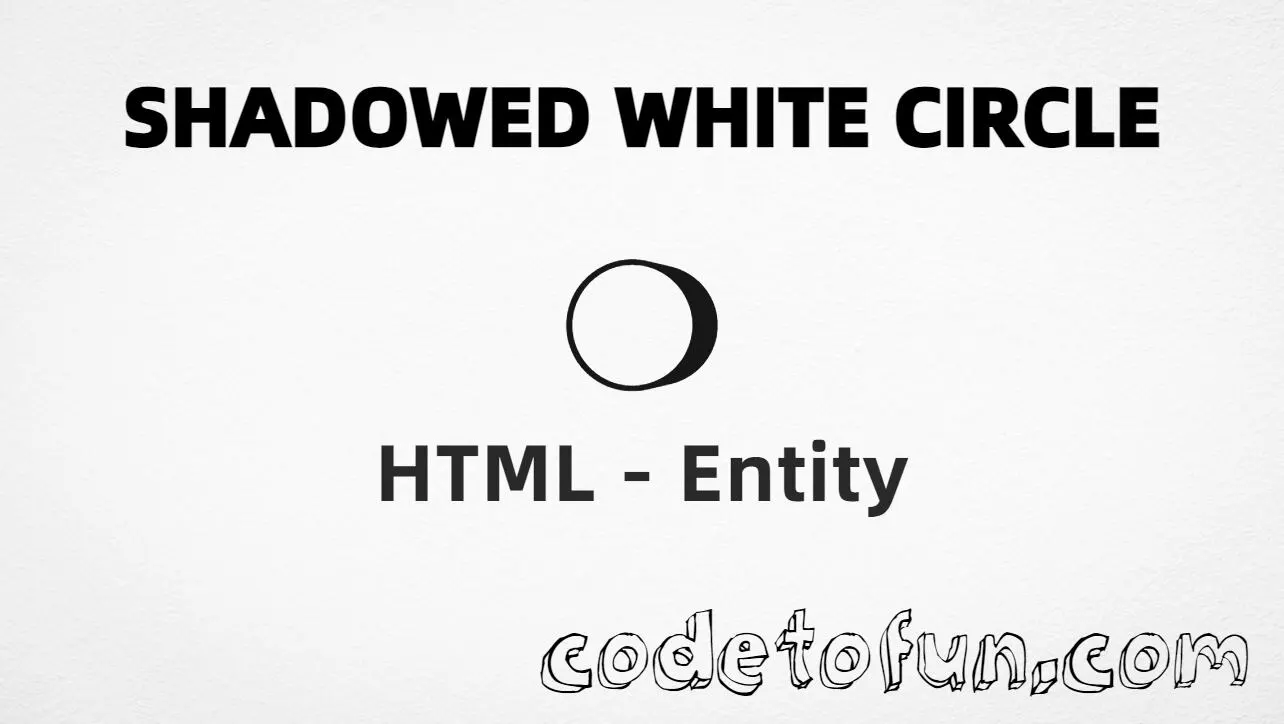
Shadowed White Circle (❍) is the Dingbats character at Unicode U+274D (LOWER RIGHT SHADOWED WHITE CIRCLE). It is a decorative circle with a shadow — popular for ornamental bullets.
Remember
Character     ❍
Unicode       U+274D
Hex entity    ❍
Decimal       ❍
Named entity  (none)
CSS escape    \274D
Not the same  ○ (white circle) · ⚪ (medium white circle)
Hex, decimal, CSS, and a typed character all produce the same glyph: ❍. Prefer ❍ when you want an explicit entity. For reusable bullets, CSS content: "\274D" on ::before or ::marker works well.
Using Hex Code: ❍
Using HTML Code: ❍
Using CSS Entity: ❍
Bullet: ❍ Decorative list item
How It Works
1. Hex:U+274D → ❍ in HTML. The browser turns it into ❍.
2. Decimal: same code point as 10061 → ❍. Same result as hex.
3. Named: HTML5 does not define a named entity for this character — use hex or decimal instead.
4. CSS: use \274D in content (not an HTML entity). #point::after appends that ❍ after the paragraph text.
Pitfalls & Tips
Common mistakes when working with Shadowed White Circle.
Look-alikes
❍ ≠ ○ ≠ ⚪
U+274D has a shadow. Plain and medium white circles are different Dingbat / Geometric shapes.
Named
No &…; name
Do not invent a name. Use ❍ or ❍.
A11y
Keep real lists
Use <ul>/<li> for structure. Style markers with CSS — do not fake lists with glyphs alone.
Fonts
Glyph coverage
Dingbats coverage varies. Test on mobile and provide a fallback bullet if ❍ is missing.
CSS vs HTML
Do not mix escapes
\274D belongs in CSS. ❍ / ❍ belong in HTML.
Semicolon
End references
Always finish with ; — write ❍, not ❍.
Compatibility
Browser Support
Shadowed White Circle (U+274D) and its entity forms (❍, ❍, CSS \\274D) are supported in all modern browsers. Glyph coverage depends on the font.
✓ Universal encoding
Shadowed White Circle (❍)
Encode with hex, decimal, or CSS escape — or type ❍ directly in UTF-8 HTML. No named entity.
100%Browser coverage
Google ChromeSupported
Yes
Microsoft EdgeSupported
Yes
Mozilla FirefoxSupported
Yes
Apple SafariSupported
Yes
OperaSupported
Yes
Internet ExplorerIE 9+
Yes*
U+274DFull support
Bottom line: Prefer ❍ for readable HTML. Use \\274D only inside CSS content. Keep semantic lists for accessibility.
Remember
Key Takeaways
Unicode: this symbol is U+274D (decimal 10061) — shadowed white circle.
HTML: prefer ❍ — or use ❍. No named entity.
CSS: use \274D inside content for custom bullets.
Watch out: not the same as plain ○ or medium ⚪ circles.
One line:U+274D → ❍ / ❍ / CSS \274D (no named entity).
Frequently Asked Questions
Use ❍ (hex), ❍ (decimal), or the CSS escape \274D in the content property. All render ❍ when the font supports Dingbats. There is no named HTML entity.
U+274D (LOWER RIGHT SHADOWED WHITE CIRCLE). Hex 274D, decimal 10061. It belongs to Dingbats (U+2700–U+27BF).
No. HTML5 does not define a named entity for U+274D. Use numeric references like ❍ or ❍.
Use it for decorative bullets, ornamental accents, and custom list markers. Keep real lists in <ul>/<li> for accessibility — do not rely on the glyph alone for structure.
HTML entities (❍ or ❍) go in markup. The CSS escape \274D is used in stylesheets (usually in the content property of ::before/::after or ::marker). Both render ❍.
U+274D is a shadowed white circle (Dingbat). U+25CB is a plain white circle. U+26AA is a medium white circle. Similar shapes, different Unicode meanings and styles.
🤔
Did you know?
Shadowed White Circle is Unicode U+274D (decimal 10061) — LOWER RIGHT SHADOWED WHITE CIRCLE in Dingbats. HTML5 has no named entity — use ❍ or ❍. Do not confuse it with plain white circle (U+25CB) or medium white circle (U+26AA).