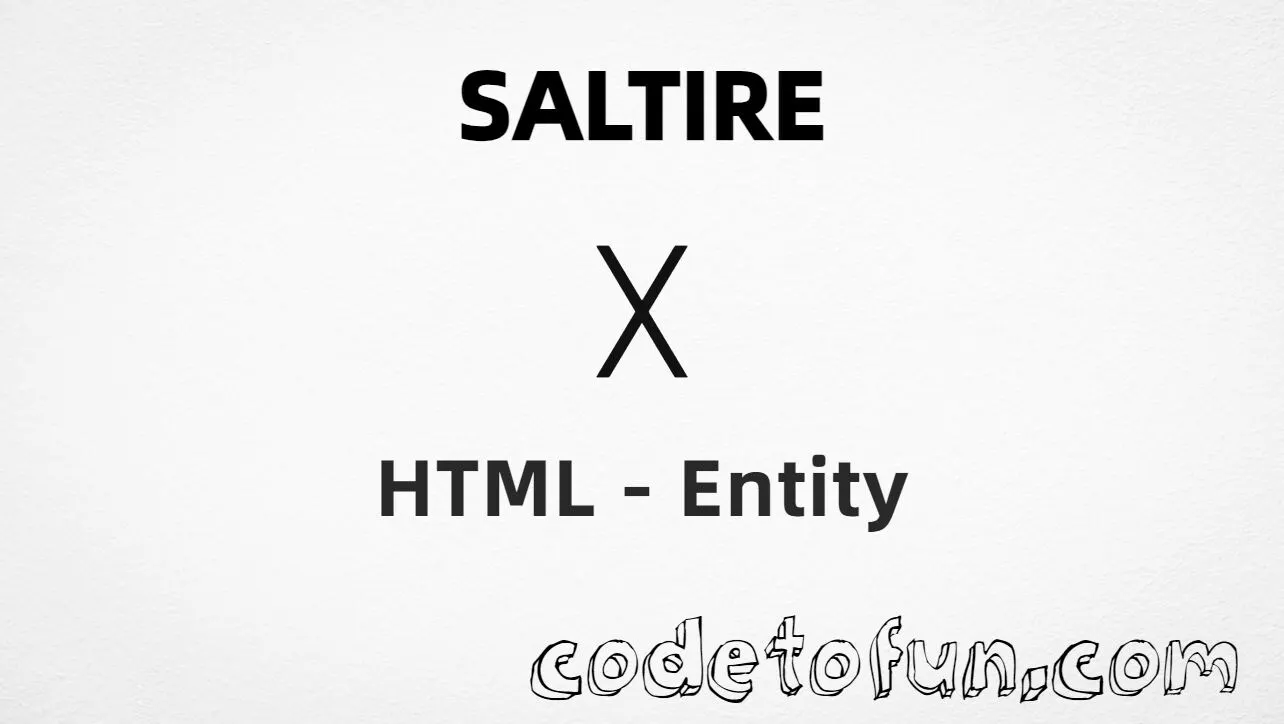
Saltire (☓) is the Miscellaneous Symbols character at Unicode U+2613 (SALTIRE). It is an X-shaped cross — also called St. Andrew’s cross — used in heraldry, flags, and as a cancel mark.
Remember
Character     ☓
Unicode       U+2613
Hex entity    ☓
Decimal       ☓
Named entity  (none)
CSS escape    \2613
Not the same  ✗ (ballot X) · ✘ (heavy ballot X) · × (×)
Hex, decimal, CSS, and a typed character all produce the same glyph: ☓. Prefer ☓ when you want an explicit entity. For a simple UI “X” mark, consider ballot X instead.
Using Hex Code: ☓
Using HTML Code: ☓
Using CSS Entity: ☓
Status: Invalid ☓
How It Works
1. Hex:U+2613 → ☓ in HTML. The browser turns it into ☓.
2. Decimal: same code point as 9747 → ☓. Same result as hex.
3. Named: HTML5 does not define a named entity for this character — use hex or decimal instead.
4. CSS: use \2613 in content (not an HTML entity). #point::after appends that ☓ after the paragraph text.
Pitfalls & Tips
Common mistakes when working with Saltire.
Look-alikes
☓ ≠ ✗ ≠ ×
U+2613 is saltire. U+2717 is ballot X. U+00D7 is multiplication — pick the code point that matches your meaning.
Named
No &…; name
Do not invent a name. Use ☓ or ☓.
A11y
Label meaningful marks
If ☓ means “cancelled” or “invalid,” add text or aria-label so screen readers are not left with only a glyph.
Fonts
Glyph coverage
Most modern fonts include U+2613. Still test small sizes — X crosses can look muddy at 12px.
CSS vs HTML
Do not mix escapes
\2613 belongs in CSS. ☓ / ☓ belong in HTML.
Semicolon
End references
Always finish with ; — write ☓, not ☓.
Compatibility
Browser Support
Saltire (U+2613) and its entity forms (☓, ☓, CSS \\2613) are supported in all modern browsers. Glyph coverage depends on the font.
✓ Universal encoding
Saltire (☓)
Encode with hex, decimal, or CSS escape — or type ☓ directly in UTF-8 HTML. No named entity.
100%Browser coverage
Google ChromeSupported
Yes
Microsoft EdgeSupported
Yes
Mozilla FirefoxSupported
Yes
Apple SafariSupported
Yes
OperaSupported
Yes
Internet ExplorerIE 9+
Yes*
U+2613Full support
Bottom line: Prefer ☓ for readable HTML. Use \\2613 only inside CSS content. Do not confuse with ballot X or ×.
Remember
Key Takeaways
Unicode: this symbol is U+2613 (decimal 9747) — saltire / St. Andrew’s cross.
HTML: prefer ☓ — or use ☓. No named entity.
CSS: use \2613 inside content for generated text.
Watch out: not the same as ballot X (U+2717) or ×.
One line:U+2613 → ☓ / ☓ / CSS \2613 (no named entity).
Frequently Asked Questions
Use ☓ (hex), ☓ (decimal), or the CSS escape \2613 in the content property. All render ☓ when the font supports Miscellaneous Symbols. There is no named HTML entity.
U+2613 (SALTIRE). Hex 2613, decimal 9747. It belongs to Miscellaneous Symbols (U+2600–U+26FF). It is an X-shaped cross, also called St. Andrew’s cross.
No. HTML5 does not define a named entity for U+2613. Use numeric references like ☓ or ☓.
Use it for heraldry, Scottish/flag themes, historical notes, cancel marks, or decorative X-cross notation. Prefer a ballot X (U+2717) for simple UI “wrong/no” marks when that meaning fits better.
HTML entities (☓ or ☓) go in markup. The CSS escape \2613 is used in stylesheets (usually in the content property of ::before/::after). Both render ☓.
U+2613 is SALTIRE (St. Andrew’s cross / cancel-style X). U+2717 is BALLOT X for voting and simple UI. U+00D7 is the multiplication sign (×). Same family of shapes, different Unicode meanings.
🤔
Did you know?
Saltire is Unicode U+2613 (decimal 9747) — SALTIRE, an X-shaped cross also called St. Andrew’s cross. HTML5 has no named entity — use ☓ or ☓. Do not confuse it with the ballot X (U+2717) or multiplication sign (×).