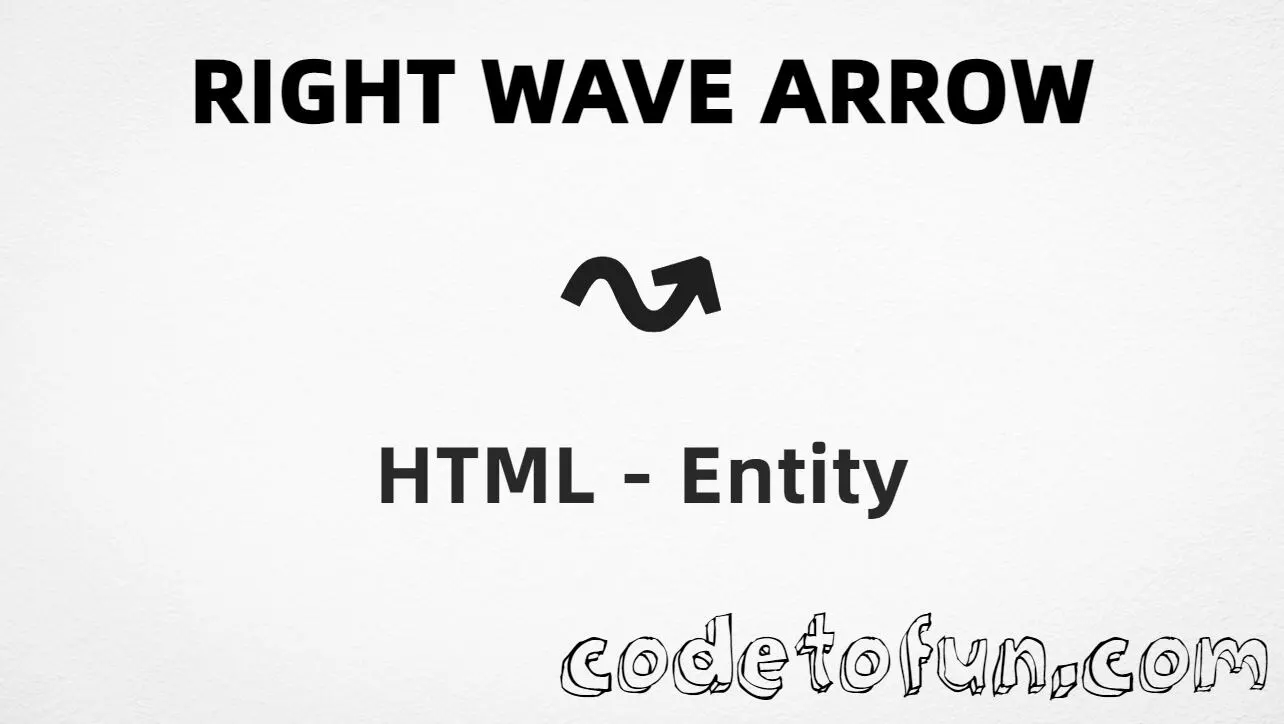
HTML Entity for Right Wave Arrow (↝)

Beginner
⏱️ 5 min read
📚 Updated: Jun 2026
🎯 1 Code Example
Unicode U+219D

What You'll Learn

How to display the Right Wave Arrow (↝) in HTML using the named entity, hexadecimal, decimal, and CSS escape methods. This symbol is U+219D (RIGHTWARDS WAVE ARROW) in the Arrows block (U+2190–U+21FF)—a wavy arrow pointing right, used for navigation, flowcharts, diagrams, and directional emphasis.

Render it with ↝ (named), ↝, ↝, or CSS \219D. Do not confuse ↝ with U+2192 (→, simple right arrow / →) or U+219C (↜, left wave arrow / &larrw;).

⚡ Quick Reference — Right Wave Arrow

Unicode U+219D

Arrows block

Hex Code ↝

Hexadecimal reference

HTML Code ↝

Decimal reference

Named Entity ↝

Most readable option

Reference Table
Name           Value
────────────   ──────────
Unicode        U+219D
Hex code       ↝
HTML code      ↝
Named entity   ↝
CSS code       \219D
Meaning        Wavy arrow pointing right
Related        U+2192 = rightwards arrow (→ / →)
               U+219C = leftwards wave arrow (↜ / &larrw;)
               U+2910 = two headed triple dash arrow (⤐ / ⤐)
1

Complete HTML Example

A simple example showing the Right Wave Arrow (↝) using the named entity, hexadecimal code, decimal HTML code, and a CSS content escape:

html
<!DOCTYPE html>
<html>
<head>
 <style>
  #point:after{
   content: "\219D";
  }
 </style>
</head>
<body>
<p>Symbol (named): &rarrw;</p>
<p>Symbol (hex): &#x219D;</p>
<p>Symbol (decimal): &#8605;</p>
<p id="point">Symbol (CSS): </p>
</body>
</html>
Try it Yourself

🌐 Browser Support

The Right Wave Arrow (↝) is universally supported in all modern browsers when the font includes Arrows block glyphs:

Chrome 1+
Firefox 1+
Safari 1+
Edge 12+
Opera 4+
Android 4.4+
iOS Safari 1+

👀 Live Preview

See the Right Wave Arrow (↝) rendered live in different contexts:

Inline navigation Continue ↝ to the next section.
Large glyph
Flow notation Step 1 ↝ Step 2
Arrow comparison ↜ → ↝
Numeric refs &rarrw; &#x219D; &#8605; \219D
Diagrams Use ↝ for wavy or curved rightward paths in flowcharts.

🧠 How It Works

1

Named Entity

&rarrw; is the semantic named entity for U+219D—the easiest to read in source HTML.

HTML markup
2

Hexadecimal Code

&#x219D; uses the Unicode hexadecimal value 219D for the right wave arrow.

HTML markup
3

Decimal HTML Code

&#8605; uses the decimal Unicode value 8605 to display the same character.

HTML markup
4

CSS Entity

\219D is used in CSS stylesheets in the content property of pseudo-elements like ::after.

CSS stylesheet
=

Same visual result

All four methods produce . Unicode U+219D is in the Arrows block. Previous: Right Two Headed Triple Dash Arrow (U+2910).

Use Cases

The Right Wave Arrow (↝) is commonly used in:

➡ Directional Indicators

Show wavy or curved rightward movement in guides and wayfinding.

🔍 Navigation Elements

Use in menus, breadcrumbs, and flows that need a wave-style arrow.

📊 Flowcharts

Indicate non-linear or curved transitions between steps.

📄 Technical Diagrams

Include in architecture diagrams with wavy path notation.

🛠 Process Flows

Document workflows with curved or indirect rightward transitions.

🎨 Graphic Design

Add wavy directional accents in infographics and visual content.

💡 Best Practices

Do

  • Prefer &rarrw; for readable source markup
  • Distinguish ↝ from → (&rarr;) and ↜ (&larrw;)
  • Add aria-label or surrounding text for accessibility
  • Verify your font supports the Arrows block (U+219D)
  • Keep one entity style per project for consistency

Don’t

  • Confuse &rarrw; (wave) with &rarr; (straight arrow)
  • Use CSS \219D inside HTML text nodes
  • Rely on the arrow alone without context for screen readers
  • Mix entity styles randomly in one file
  • Assume all fonts render wave arrow glyphs identically
  • Use HTML entities in JS (use \u219D instead)

Key Takeaways

1

Four methods all render ↝

&rarrw; &#x219D; &#8605;
2

For CSS, use \219D in the content property

3

Unicode U+219D — RIGHTWARDS WAVE ARROW (Arrows block)

4

Prefer &rarrw;—not to be confused with &rarr; (U+2192)

❓ Frequently Asked Questions

Use &rarrw; (named), &#x219D; (hex), &#8605; (decimal), or \219D in CSS content. All four methods render ↝ correctly.
U+219D (RIGHTWARDS WAVE ARROW). Arrows block (U+2190–U+21FF). Hex 219D, decimal 8605.
In directional indicators, navigation elements, flowcharts, diagrams, process flows, and graphic design where wavy or curved rightward movement is needed.
&rarrw; is more readable in markup. Numeric references (&#8605; or &#x219D;) are explicit. CSS escape \219D belongs in stylesheets. All produce ↝.
Yes. &rarrw; is the named HTML entity for U+219D. Do not confuse it with &rarr; (U+2192, simple right arrow) or &larrw; (U+219C, left wave arrow).

Explore More HTML Entities!

Discover 1500+ HTML character references — arrows, symbols, math operators, and more.

All HTML Entities →

About the author

Mari Selvan M P
Mari Selvan M P 🔗

Developer, cloud engineer, and technical writer

  • Experience 12 years building web and cloud systems
  • Focus Full Stack Development, AWS, and Developer Education

I write practical tutorials so students and working developers can learn by doing—from databases and APIs to deployment on AWS.

8 people found this page helpful