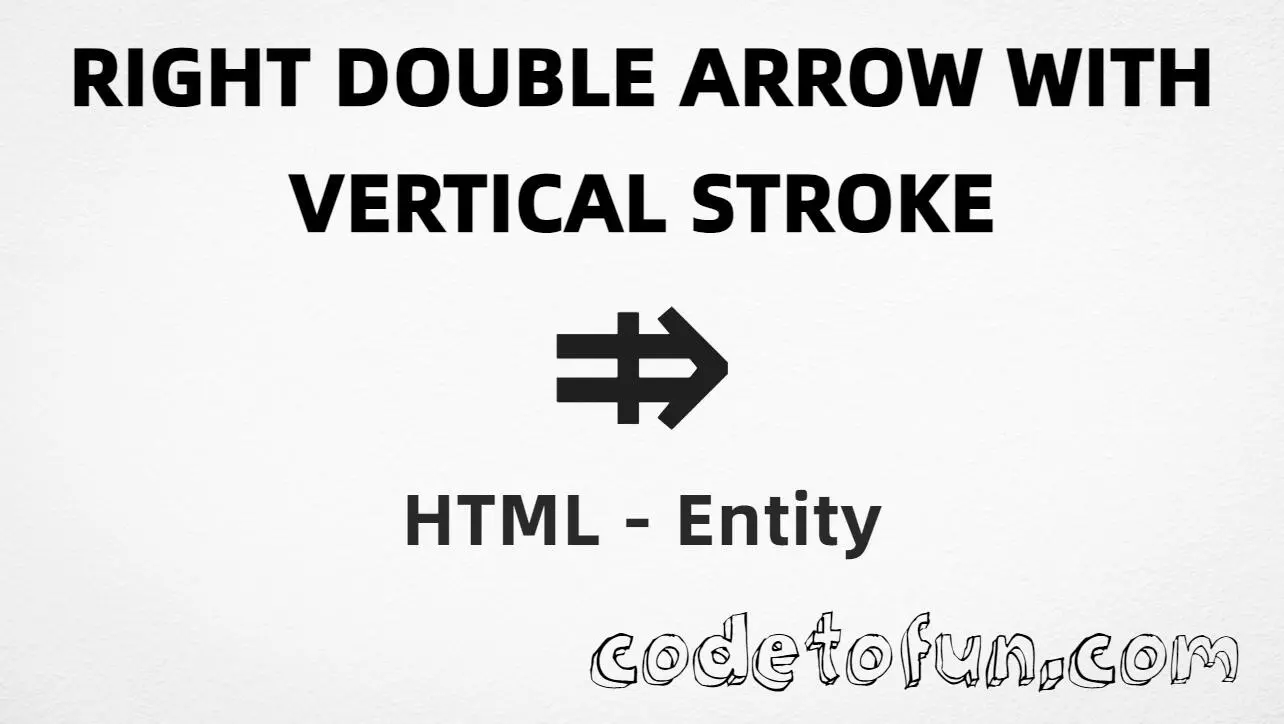
HTML Entity for Right Double Arrow Vertical Stroke (⤃)
Beginner
5 min read
Updated: Sep 2026
1 example
Unicode U+2903
Definition
What Is the Right Double Arrow Vertical Stroke Entity?
Right Double Arrow Vertical Stroke (⤃) is the Supplemental Arrows-B character at Unicode U+2903 (RIGHTWARDS DOUBLE ARROW WITH VERTICAL STROKE). It is a double rightwards arrow crossed by a vertical bar.
Remember
Character     ⤃
Unicode       U+2903
Hex entity    ⤃
Decimal       ⤃
Named entity  ⤃
CSS escape    \2903
Not the same  ⇏ (⇏) · ⇻ (U+21FB)
All of these produce the same glyph: ⤃. Prefer ⤃ when you want an explicit entity.
Using Hex Code: ⤃
Using HTML Code: ⤃
Using Named Entity: ⤃
Using CSS Entity: ⤃
Skip forward ⤃
How It Works
1. Hex:U+2903 → ⤃ in HTML. The browser turns it into ⤃.
2. Decimal: same code point as 10499 → ⤃. Same result as hex.
3. Named:⤃ is the HTML5 name for this character.
4. CSS: use \2903 in content (not an HTML entity). #point::after appends that ⤃ after the paragraph text.
Pitfalls & Tips
Common mistakes when working with Right Double Arrow Vertical Stroke.
Look-alikes
⤃ ≠ ⇏ ≠ ⇻
Vertical stroke on a double arrow, diagonal stroke (⇏), and double vertical strokes on a single arrow (U+21FB) are different points.
Case
Capital A in ⤃
Named entities are case-sensitive. Use ⤃ exactly as written.
Fonts
Glyph may be missing
Supplemental Arrows-B coverage varies. Test on your target devices or provide a fallback font.
CSS vs HTML
Do not mix escapes
\2903 belongs in CSS. ⤃ / ⤃ / ⤃ belong in HTML.
A11y
Add nearby words
Pair the glyph with text like “Skip forward”, or use aria-label on icon-only controls.
Semicolon
End references
Always finish with ; — write ⤃, not &nvrArr.
Compatibility
Browser Support
Right Double Arrow Vertical Stroke (U+2903) and its entity forms (⤃, ⤃, ⤃, CSS \\2903) are supported in all modern browsers. Glyph coverage depends on the font.
✓ Universal encoding
Right Double Arrow Vertical Stroke (⤃)
Encode with named, hex, decimal, or CSS escape — or type ⤃ directly in UTF-8 HTML.
100%Browser coverage
Google ChromeSupported
Yes
Microsoft EdgeSupported
Yes
Mozilla FirefoxSupported
Yes
Apple SafariSupported
Yes
OperaSupported
Yes
Internet ExplorerIE 9+
Yes*
U+2903 / ⤃Full support
Bottom line: Prefer ⤃ for readable HTML. Use \\2903 only inside CSS content.
Remember
Key Takeaways
Unicode: this symbol is U+2903 (decimal 10499).
HTML: prefer ⤃ — or use ⤃ / ⤃.
Use ⤃ (named), ⤃ (hex), ⤃ (decimal), or the CSS escape \2903 in the content property. You can also type ⤃ directly in UTF-8 HTML.
U+2903 (RIGHTWARDS DOUBLE ARROW WITH VERTICAL STROKE). Hex 2903, decimal 10499. It belongs to the Supplemental Arrows-B block (U+2900–U+297F).
Yes. ⤃ is the HTML5 named entity. You can also use ⤃ or ⤃.
Use it for skip-forward style navigation, logic diagrams, and UI that needs a double rightwards arrow blocked by a vertical stroke. Prefer ⤃ for readable HTML; add nearby words or aria-label for accessibility.
HTML entities (⤃, ⤃, or ⤃) go in markup. The CSS escape \2903 is used in stylesheets (usually in the content property of ::before/::after). Both render ⤃.
⇏ (U+21CF) is a double right arrow with a diagonal stroke. U+21FB (⇻) is a single right arrow with double vertical strokes. U+2903 is a double right arrow with one vertical stroke.
🤔
Did you know?
Right Double Arrow Vertical Stroke is Unicode U+2903 (decimal 10499) — RIGHTWARDS DOUBLE ARROW WITH VERTICAL STROKE. HTML5 provides ⤃. Prefer it for readable source. Do not confuse it with U+21FB (⇻, rightwards arrow with double vertical stroke on a single shaft) or with ⇏ (U+21CF, diagonal stroke).