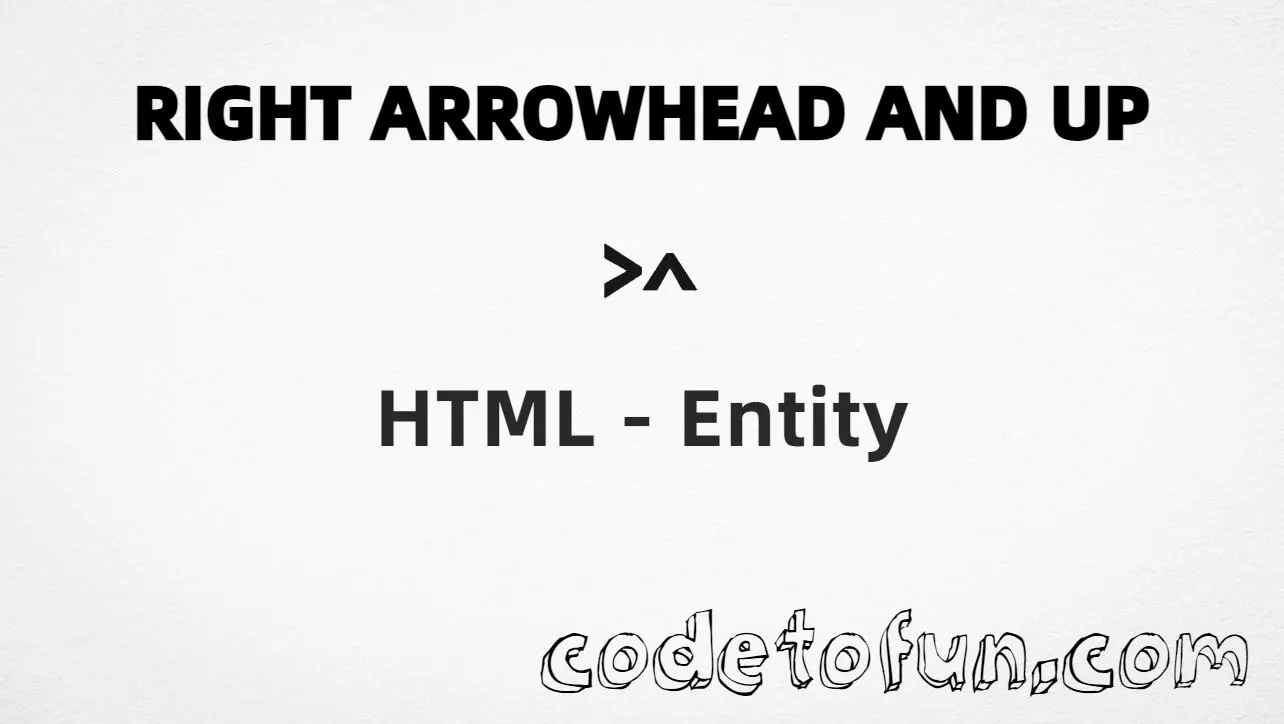
Right Arrowhead Up is the combining diacritic at Unicode U+0356 (COMBINING RIGHT ARROWHEAD AND UP ARROWHEAD). It sits below a base letter as a double mark — used in phonetic and linguistic transcription (e.g. o͖).
Remember
Mark          combining right arrowhead and up arrowhead
Unicode       U+0356
Hex entity    ͖
Decimal       ͖
CSS escape    \0356
Named entity  (none)
Order         base letter + mark  →  o͖
Combining marks are not standalone letters. Write the base character first, then the entity (e.g. o͖ → o͖).
Reference
Quick Reference
One table for every form you will actually use.
Form
Code
Where it goes
Hex entity
͖
HTML after the base letter
Decimal entity
͖
HTML after the base letter
CSS escape
\0356
Stylesheet content (often ::after)
Direct character
base + U+0356
UTF-8 HTML text
Named entity
—
Not defined in HTML5
When to Use Which
Situation
Use
Need an entity in HTML source
o͖ or o͖
Generated mark via ::after
content: "\0356" on an element that ends with the base letter
Using Hex Code: o͖
Using HTML Code: o͖
Using CSS Entity: o͖
Typed directly: o͖
How It Works
1. Hex:U+0356 → ͖ after the base letter. The browser combines them into o͖.
2. Decimal: same code point as 854 → ͖. Same result as hex.
3. CSS: use \0356 in content (not an HTML entity). #point::after appends the mark below the letter o.
4. Typed: in UTF-8 you can type the base letter and the combining mark directly — same visual result.
Pitfalls & Tips
Common mistakes when working with combining Right Arrowhead Up.
Order
Base letter first
Write o͖, not ͖o. Combining marks follow the base.
Named?
No named entity
HTML5 does not define a named entity for U+0356. Use numeric forms.
Shape
Double diacritic
U+0356 combines a right arrowhead with an up arrowhead. It is not the same as U+0350 or U+0355 alone.
Position
Sits below
Despite “Up” in the common title, the official mark sits below the letter (Unicode combining class Below).
A11y
Explain the mark
Screen readers may skip or misname combining marks. Add a note or aria-label when the diacritic carries meaning.
CSS vs HTML
Do not mix escapes
\0356 belongs in CSS. ͖ / ͖ belong in HTML after the base letter.
Fonts
Diacritic coverage
Some fonts omit U+0356. Prefer Charis SIL, Noto Sans, or another phonetics-capable face.
Compatibility
Browser Support
Right Arrowhead Up (U+0356) and its entity forms (͖, ͖, CSS \\0356) are supported in modern browsers when the font includes Combining Diacritical Marks.
✓ Universal support
Right Arrowhead Up (U+0356)
Encode with hex, decimal, or CSS escape after a base letter — same combining mark when the font supports U+0356. No named HTML entity.
100%Browser coverage
Google ChromeSupported
Yes
Microsoft EdgeSupported
Yes
Mozilla FirefoxSupported
Yes
Apple SafariSupported
Yes
OperaSupported
Yes
Internet ExplorerAll versions
Yes
U+0356Full support
Bottom line: Use o͖ or o͖ in HTML. Use \\0356 only inside CSS content. Always put the base letter first.
Remember
Key Takeaways
Unicode: this mark is U+0356 (decimal 854).
HTML: use o͖ or o͖ — no named entity.
CSS: use \0356 inside content (often on ::after).
Watch out: base letter first; U+0356 ≠ U+0350 ≠ U+0355.
One line: base + U+0356 → o͖ / o͖ / CSS \0356.
Frequently Asked Questions
Use ͖ (hex), ͖ (decimal), or the CSS escape \0356 in the content property. There is no named HTML entity. Place the mark immediately after the base letter (e.g. o͖).
U+0356 (COMBINING RIGHT ARROWHEAD AND UP ARROWHEAD). Hex 0356, decimal 854. It belongs to the Combining Diacritical Marks block (U+0300–U+036F).
No. HTML5 does not define a named entity for this combining mark. Use numeric references like ͖ or ͖.
Use it in phonetic and linguistic transcription when you need the combined right-and-up arrowhead diacritic below a letter. Always write base letter first, then the combining mark.
HTML entities (͖ or ͖) go in markup after the base character. The CSS escape \0356 is used in stylesheets (usually in the content property of ::after). Both apply the combining mark below the letter.
U+0356 is a double diacritic (right arrowhead + up arrowhead) that sits below. U+0350 is a single right arrowhead above. U+0355 is a single right arrowhead below.
🤔
Did you know?
Right Arrowhead Up is Unicode U+0356 (decimal 854) — official name COMBINING RIGHT ARROWHEAD AND UP ARROWHEAD. It sits below the base letter as a double diacritic. HTML5 has no named entity. Place it after the base letter (e.g. o͖). Do not confuse it with Right Arrowhead Above (U+0350) or Right Arrowhead Below (U+0355).