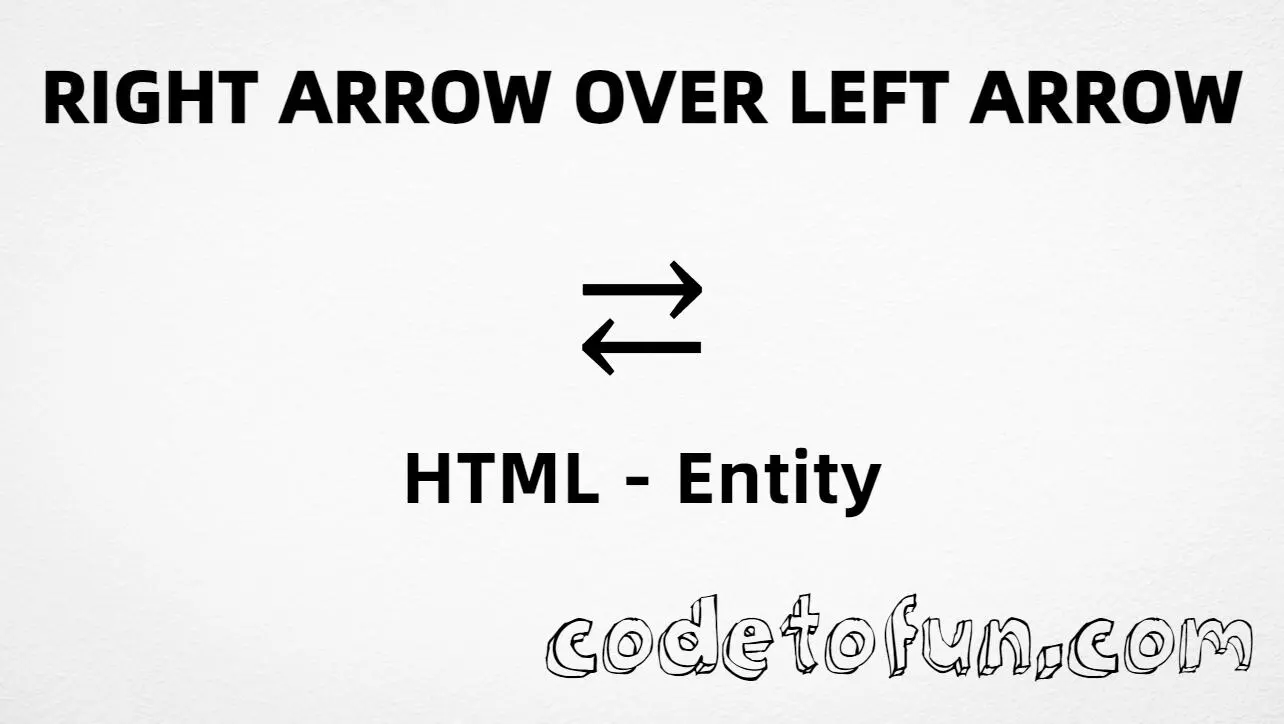
Right arrow over left arrow (⇄) is Unicode U+21C4 in the Arrows block. Official name: RIGHTWARDS ARROW OVER LEFTWARDS ARROW — a right arrow stacked above a left arrow. HTML provides the named entity ⇄.
Remember
Character     ⇄
Unicode       U+21C4
Hex entity    ⇄
Decimal       ⇄
Named entity  ⇄
CSS escape    \21C4
Not the same  ⇆ U+21C6 · ↔ U+2194 · → U+2192
All of these produce the same glyph: ⇄. Prefer ⇄ in hand-written HTML; type ⇄ in UTF-8 when you can; use numeric or CSS forms for generated content.
Right arrow over left arrow in common study contexts.
InlineA ⇄ B
Large glyph⇄
UI / swap cueSwap columns ⇄
vs. related arrows⇄ right-over-left · ⇆ left-over-right · ↔ left-right
With entitiesNamed: ⇄ | Hex: ⇄ | Decimal: ⇄
Code
Complete HTML Example
One page that shows ⇄ with hex, decimal, named entity, CSS escape, and a typed character. Use View Output or open the live editor.
Hex + Decimal + Named + CSS + Typed
Five ways to produce ⇄ in a single document.
html
<!DOCTYPE html>
<html lang="en">
<head>
<meta charset="UTF-8">
<title>Right Arrow Over Left Arrow (⇄) in HTML</title>
<style>
#point::after {
content: "\21C4";
}
</style>
</head>
<body>
<p>Right over left using Hex Code: ⇄</p>
<p>Right over left using HTML Code: ⇄</p>
<p>Right over left using Named Entity: ⇄</p>
<p id="point">Right over left using CSS Entity: </p>
<p>Typed directly: ⇄</p>
</body>
</html>
Right over left using Hex Code: ⇄
Right over left using HTML Code: ⇄
Right over left using Named Entity: ⇄
Right over left using CSS Entity: ⇄
Typed directly: ⇄
How It Works
1. Hex:U+21C4 → ⇄ in HTML. The browser turns it into ⇄.
2. Decimal: same code point as 8644 → ⇄. Same result as hex.
3. Named:⇄ is the standard HTML name for U+21C4 — clear in source.
4. CSS: use \21C4 in content (not an HTML entity). #point::after appends that ⇄ after the paragraph text.
5. Typed ⇄: fine in UTF-8 source. All five lines show the same glyph.
Pitfalls & Tips
Common mistakes when working with right arrow over left arrow (⇄).
⇆
Not left-over-right
⇆ (U+21C6) stacks left over right. Use ⇄ only when you need right over left.
↔
Not a single ↔
↔ is one double-headed arrow. ⇄ is two arrows stacked — a different glyph.
Name
Prefer ⇄
The named entity is easiest to read in source. Numeric forms are fine for generators.
CSS vs HTML
Do not mix escapes
\21C4 belongs in CSS. ⇄ / ⇄ / ⇄ belong in HTML.
Encoding
Declare UTF-8
If you type ⇄ directly, keep <meta charset="UTF-8"> so the file is not misread.
Semicolon
End references
Always finish with ; — write ⇄, not &rlarr.
Compatibility
Browser Support
Right arrow over left arrow (U+21C4) and its entity forms (⇄, ⇄, ⇄, CSS \\21C4) are supported in all modern browsers.
✓ Universal encoding
Right Arrow Over Left Arrow (⇄)
Encode with named, hex, decimal, or CSS escape — or type ⇄ directly in UTF-8 HTML.
100%Browser coverage
Google ChromeSupported
Yes
Microsoft EdgeSupported
Yes
Mozilla FirefoxSupported
Yes
Apple SafariSupported
Yes
OperaSupported
Yes
Internet ExplorerIE 9+
Yes*
U+21C4 / ⇄Full support
Bottom line: Prefer ⇄ in HTML. Use \\21C4 only inside CSS content.
Use ⇄ (hex), ⇄ (decimal), ⇄ (named), or the CSS escape \21C4 in the content property. All render ⇄. You can also paste ⇄ directly if your file is UTF-8.
U+21C4 (hex 21C4, decimal 8644). Unicode names it RIGHTWARDS ARROW OVER LEFTWARDS ARROW. It belongs to the Arrows block.
Yes. ⇄ maps to U+21C4. Prefer it in hand-written HTML; numeric forms are useful in generated markup.
⇄ (U+21C4, ⇄) is right arrow over left arrow. ⇆ (U+21C6) is left arrow over right arrow — the opposite stack. ↔ (U+2194, ↔) is a single horizontal double-headed arrow. Do not substitute them blindly.
HTML entities (⇄, ⇄, or ⇄) go in markup. The CSS escape \21C4 is used in stylesheets (usually in the content property of ::before/::after). Both render ⇄.
Use it for bidirectional relationships, swap/exchange UI cues, logic or math diagrams, and any notation that needs a right arrow stacked over a left arrow. Prefer ⇄ for readable HTML source.
🤔
Did you know?
Right arrow over left arrow is Unicode U+21C4 (decimal 8644) in the Arrows block — official name RIGHTWARDS ARROW OVER LEFTWARDS ARROW. HTML’s named reference is ⇄. It is not the same as left arrow over right arrow (U+21C6 ⇆) or the single left-right arrow (U+2194 ↔).