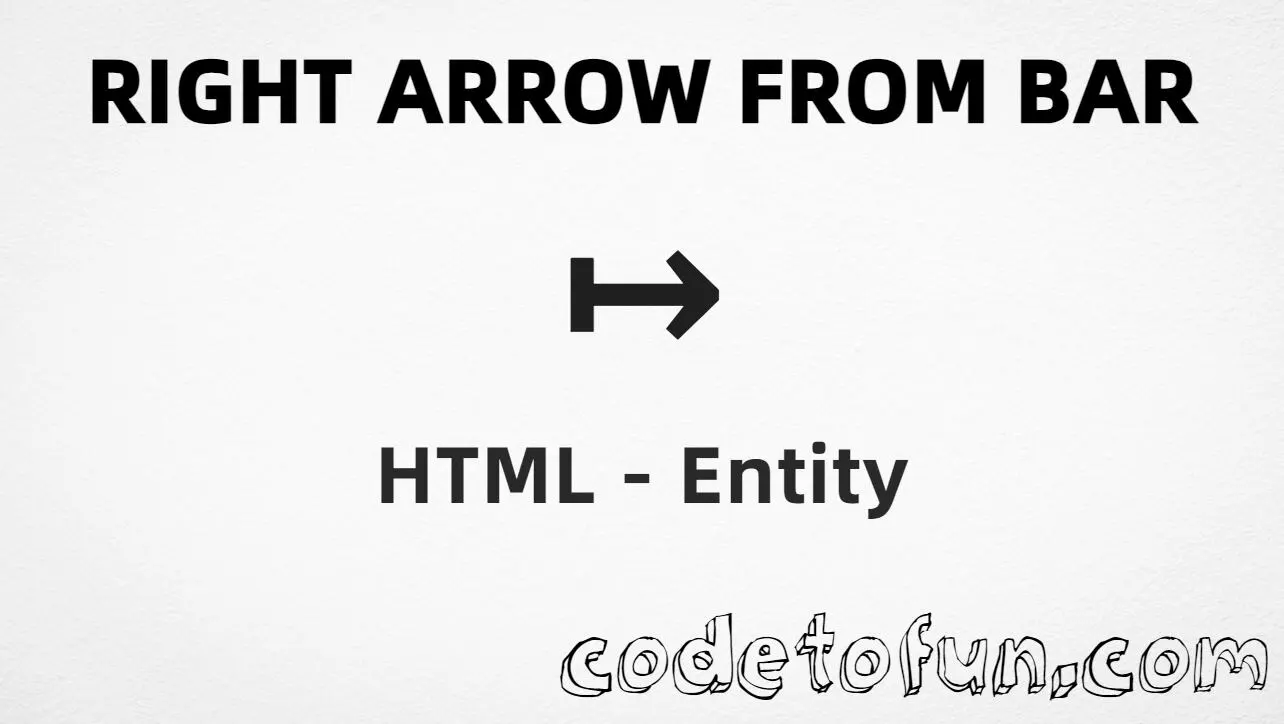
Right arrow from bar (↦) is the Unicode character at U+21A6 in the Arrows block. Official name: RIGHTWARDS ARROW FROM BAR. It is the classic “maps to” arrow used in function notation (e.g. x ↦ f(x)).
Remember
Character     ↦
Unicode       U+21A6
Named entity  ↦
Hex entity    ↦
Decimal       ↦
CSS escape    \21A6
Not the same  → · ⟼ · ⇥
Prefer ↦ in HTML markup. You can also type ↦ in UTF-8, or use numeric forms when needed.
Prefer ↦ (named). You can also use ↦ (hex), ↦ (decimal), type ↦ in UTF-8, or the CSS escape \21A6 in content.
U+21A6 (RIGHTWARDS ARROW FROM BAR). Hex 21A6, decimal 8614. It belongs to the Arrows block (U+2190–U+21FF).
Yes. Use ↦. Numeric forms ↦ and ↦ also work. Prefer the named form for readable math markup.
Use it for function mapping and “maps to” notation (x ↦ f(x)), and in diagrams that need a rightwards arrow starting from a bar. Prefer → for a plain right arrow, and ⟼ when you need the long maps-to form.
HTML entities (↦, ↦, or ↦) go in markup. The CSS escape \21A6 goes in stylesheet strings (usually content on ::before/::after).
No. ↦ is ↦ (U+21A6, from bar). → is → (U+2192, plain right arrow). ⟼ is ⟶ (U+27FC, long rightwards arrow from bar).
🤔
Did you know?
Right arrow from bar is Unicode U+21A6 (decimal 8614) — glyph ↦ in the Arrows block. Official name: RIGHTWARDS ARROW FROM BAR. HTML5 names it ↦ — the classic “maps to” arrow in math (e.g. x ↦ f(x)). The long form is ⟼ (U+27FC).