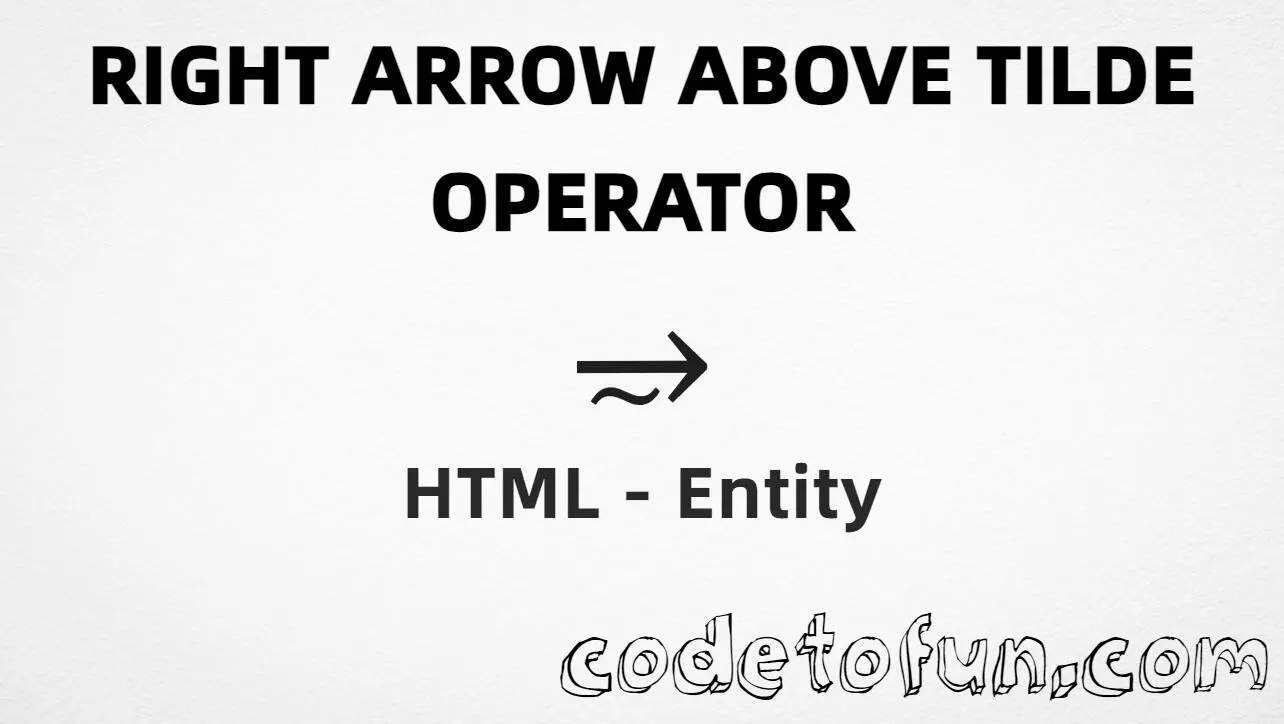
HTML Entity for Right Arrow Above Tilde Operator (⥴)
Beginner
5 min read
Updated: Sep 2026
1 example
Unicode U+2974
Definition
What Is Right Arrow Above Tilde Operator?
Right arrow above tilde operator (⥴) is the Unicode character at U+2974 in Supplemental Arrows-B. Official name: RIGHTWARDS ARROW ABOVE TILDE OPERATOR. It is a single math/logic arrow that combines a rightwards arrow with a tilde (similarity) mark.
Remember
Character     ⥴
Unicode       U+2974
Named entity  ⥴
Hex entity    ⥴
Decimal       ⥴
CSS escape    \2974
Not the same  → · ∼ · ⥳ · ⥵
Prefer ⥴ in HTML markup. You can also type ⥴ in UTF-8, or use numeric forms when needed.
Right arrow above tilde operator rendered alone and next to related marks.
ExampleA ⥴ B
Large glyph⥴
Compared⥴ ⥳ → ⥵
With entitiesNamed: ⥴ | Hex: ⥴ | Decimal: ⥴
Code
Complete HTML Example
One page that shows Right Arrow Above Tilde Operator with named, hex, decimal, CSS escape, and a typed character. Use View Output or open the live editor.
Named + Hex + Decimal + CSS + Typed
Five ways to produce ⥴, plus a short relation example.
Using Named Entity: ⥴
Using Hex Code: ⥴
Using HTML Code: ⥴
Using CSS Entity: ⥴
Typed directly: ⥴
Relation: A ⥴ B
How It Works
1. Named:⥴ is the HTML5 name for U+2974 → ⥴. Best default in markup.
2. Hex:U+2974 → ⥴ in HTML. Same glyph as the named form.
3. Decimal: same code point as 10612 → ⥴. Same result as hex and named.
4. CSS: use \2974 in content (not an HTML entity). #point::after appends that ⥴ after the paragraph text.
5. Typed / relation: paste ⥴ in UTF-8, or write A ⥴ B for a short math/logic example.
Pitfalls & Tips
Common mistakes when working with Right Arrow Above Tilde Operator.
Stack
Do not stack → + ∼
Two separate characters are not the same as one U+2974 glyph. Prefer ⥴.
⥳
Not ⥳
⥳ is the leftwards form (U+2973). Use ⥴ for rightwards.
→
Not a plain right arrow
→ is → only. Use ⥴ when the tilde / similarity component matters.
Fonts
Supplemental Arrows coverage
Some UI fonts omit U+2974. Prefer a math-capable font for display.
CSS vs HTML
Do not mix escapes
\2974 belongs in CSS strings. ⥴ / ⥴ / ⥴ belong in HTML.
Semicolon
End named entities
Always finish with ; — write ⥴, not &rarrsim.
Compatibility
Browser Support
Right arrow above tilde operator (U+2974) and its entity forms (⥴, ⥴, ⥴, CSS \\2974) are supported in all mainstream browsers. Visible glyphs depend on Supplemental Arrows font coverage.
✓ Universal support
Right Arrow Above Tilde Operator (⥴)
Encode with named, hex, decimal, CSS escape, or type the character — same code point everywhere encoding is supported.
100%Browser coverage
Google ChromeSupported
Yes
Microsoft EdgeSupported
Yes
Mozilla FirefoxSupported
Yes
Apple SafariSupported
Yes
OperaSupported
Yes
Internet ExplorerIE 9+
Yes
U+2974 / entitiesFull support
Bottom line: Prefer ⥴ in HTML. Use ⥴ / ⥴ when numeric form is required, and \\2974 only inside CSS content.
Remember
Key Takeaways
Unicode: this mark is U+2974 (decimal 10612) — glyph ⥴.
HTML: prefer ⥴ — also ⥴ / ⥴ / type ⥴.
CSS: use \2974 inside content for generated text.
Meaning:⥴ = combined arrow + tilde — not →, not ⥳.
Prefer ⥴ (named). You can also use ⥴ (hex), ⥴ (decimal), type ⥴ in UTF-8, or the CSS escape \2974 in content.
U+2974 (RIGHTWARDS ARROW ABOVE TILDE OPERATOR). Hex 2974, decimal 10612. It belongs to Supplemental Arrows-B (U+2900–U+297F).
Yes. Use ⥴. Numeric forms ⥴ and ⥴ also work. Prefer the named form for readable markup.
Use it in math or logic when a rightwards relation includes a tilde / similarity sense in one character. Prefer → for a plain right arrow, ∼ or ~ for tilde alone, and ⥳ for the leftwards counterpart.
HTML entities (⥴, ⥴, or ⥴) go in markup. The CSS escape \2974 goes in stylesheet strings (usually content on ::before/::after).
No. ⥴ is one character (U+2974). Stacking → and ∼ is two characters and not the same glyph. Prefer ⥴ when you need the combined symbol.
🤔
Did you know?
Right arrow above tilde operator is Unicode U+2974 (decimal 10612) — glyph ⥴ in Supplemental Arrows-B. HTML5 names it ⥴. Prefer ⥴ in markup. The leftwards counterpart is ⥳ (U+2973). Plain right arrow is → (U+2192).