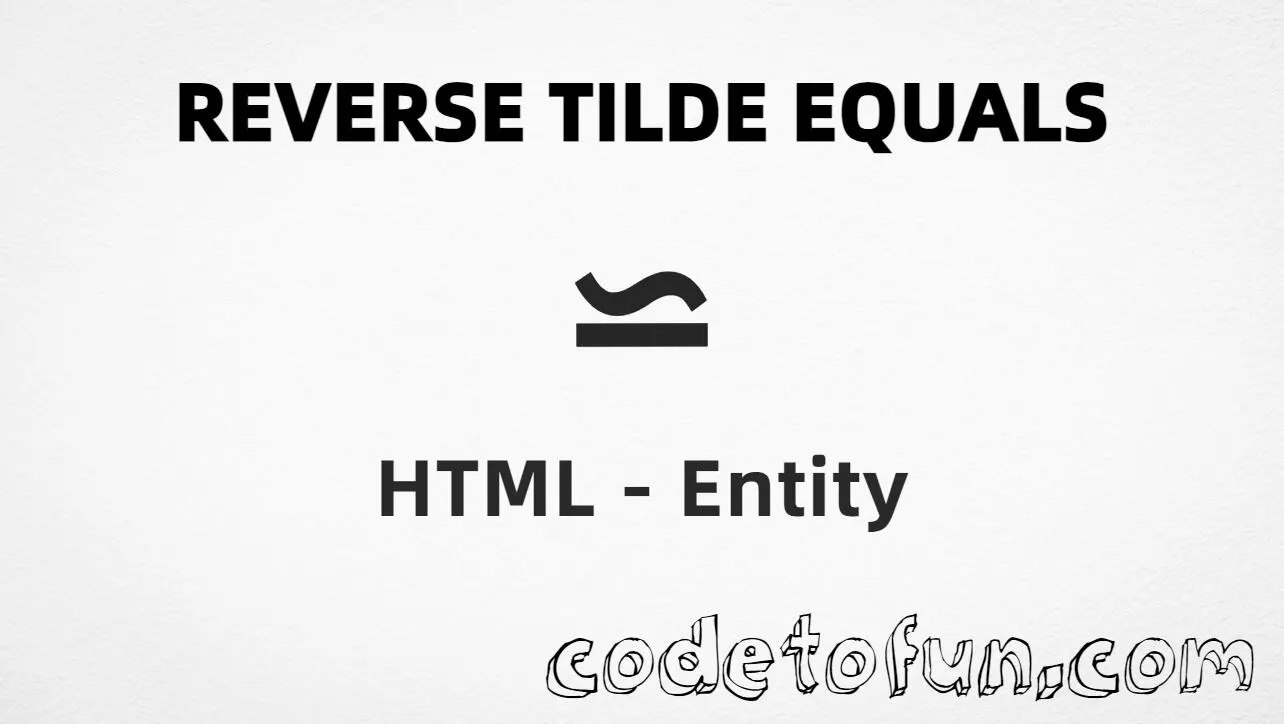
HTML Entity for Reverse Tilde Equals (⋍)

What You'll Learn
How to display the Reverse Tilde Equals symbol (⋍) in HTML using numeric references, the named entity, and CSS escapes. This character is U+22CD (REVERSE TILDE EQUALS) in the Mathematical Operators block (U+2200–U+22FF)—used in mathematical notation, logic symbols, and formal academic writing.
You can use the named entity ⋍, hex ⋍, decimal ⋍, or CSS \22CD. Do not confuse ⋍ with U+2243 (≃, asymptotically equal, ≃) or U+2248 (≈, almost equal, ≈).
⚡ Quick Reference — Reverse Tilde Equals
U+22CDMathematical Operators (U+2200–U+22FF)
⋍Hexadecimal reference
⋍Decimal reference
⋍Standard HTML entity
Name Value
──────────── ──────────
Unicode U+22CD
Hex code ⋍
HTML code ⋍
Named entity ⋍
CSS code \22CD
Meaning Reverse tilde over equals sign
Related U+2243 = asymptotically equal (≃, ≃)
U+2248 = almost equal (≈, ≈)
U+2236 = ratio (∶, ∶)
Block Mathematical Operators (U+2200–U+22FF)Complete HTML Example
A simple example showing ⋍ using hexadecimal code, decimal HTML code, the named entity, and a CSS content escape:
<!DOCTYPE html>
<html>
<head>
<style>
#point::after{
content: "\22CD";
}
</style>
</head>
<body>
<p>Reverse tilde equals (hex): ⋍</p>
<p>Reverse tilde equals (decimal): ⋍</p>
<p>Reverse tilde equals (named): ⋍</p>
<p id="point">Reverse tilde equals (CSS): </p>
</body>
</html>🌐 Browser Support
U+22CD is widely supported in all modern browsers:
👀 Live Preview
See the Reverse Tilde Equals symbol (⋍) in mathematical contexts:
🧠 How It Works
Hexadecimal Code
⋍ uses Unicode hex 22CD to display the reverse tilde equals symbol.
Decimal HTML Code
⋍ is the decimal equivalent (8909) for the same character.
Named HTML Entity
⋍ is the standard named entity for U+22CD—readable in HTML source.
CSS Entity
\22CD is the CSS escape for U+22CD, used in pseudo-element content.
Same visual result
All four methods produce ⋍. Unicode U+22CD in Mathematical Operators. Next: Reverse Triple Prime.
Use Cases
The Reverse Tilde Equals symbol (⋍) is commonly used in:
Formal expressions and proofs involving reverse tilde relations.
Logical statements, formal logic systems, and equivalence notation.
Research papers, mathematical journals, and scholarly publications.
Computer science specifications, algorithm descriptions, and formal specs.
Character pickers, entity documentation, and math symbol guides.
Pair ⋍ with descriptive text or MathML when used as a meaningful symbol.
💡 Best Practices
Do
- Use
⋍for readable reverse tilde equals markup - Set
<meta charset="utf-8">for reliable rendering - Distinguish ⋍ from ≃ (asymptotically equal) and ≈ (almost equal)
- Use serif or math-friendly fonts for academic and technical documents
- Pick one reference style per project for consistency
Don’t
- Confuse ⋍ with ≃ (asymptotically equal) or ≈ (almost equal)
- Use padded Unicode notation like U+022CD—the correct value is
U+22CD - Use CSS escape
\22CDin HTML text nodes - Substitute a plain tilde and equals (
~=) when ⋍ is required formally - Assume every font renders Mathematical Operators identically
Key Takeaways
Four ways to render U+22CD in HTML and CSS
⋍ ⋍For CSS stylesheets, use \22CD in the content property
Unicode U+22CD — REVERSE TILDE EQUALS (⋍)
Distinct from asymptotically equal ≃ and almost equal ≈
Previous: Reverse Rotated Floral Heart Bullet (☙) Next: Reverse Triple Prime
❓ Frequently Asked Questions
⋍ (named entity), ⋍ (hex), ⋍ (decimal), or \22CD in CSS content. All four render ⋍.U+22CD (REVERSE TILDE EQUALS). Mathematical Operators block (U+2200–U+22FF). Hex 22CD, decimal 8909.≃) is asymptotically equal to. They are different Unicode characters.⋍ is the standard named entity for U+22CD and is the most readable option in HTML source.Explore More HTML Entities!
Discover 1500+ HTML character references — math operators, logic symbols, punctuation, and more.
8 people found this page helpful