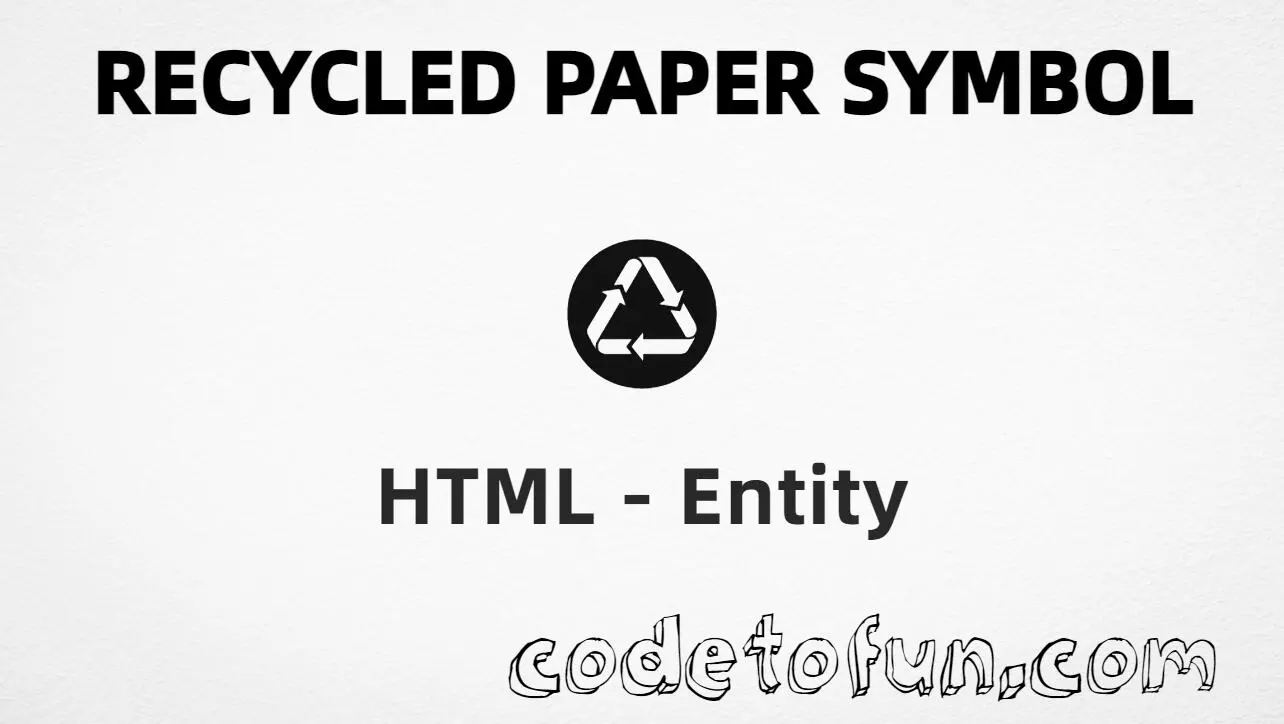
HTML Entity for Recycled Paper Symbol (♼)

Beginner
6 min read
Updated: Sep 2026
1 example
Unicode U+267C

What Is the Recycled Paper Symbol Entity?

Recycled paper symbol (♼) is the Miscellaneous Symbols character at Unicode U+267C (RECYCLED PAPER SYMBOL). It marks fully recycled paper for eco labels and sustainability content. There is no named HTML entity; use hex, decimal, UTF-8, or CSS.

Remember
Character     ♼
Unicode       U+267C
Named entity  none
Hex entity    ♼
Decimal       ♼
CSS escape    \267C

All numeric and UTF-8 forms produce the same glyph: ♼. Prefer ♼ for portable markup; paste ♼ in UTF-8 when convenient.

Quick Reference

One table for every form you will actually use.

FormCodeWhere it goes
Named entitynoneNot defined in HTML5
Hex entity♼HTML markup
Decimal entity♼HTML markup
Direct character♼HTML text (UTF-8 default)
CSS escape\267CStylesheet content

When to Use Which

SituationUse
Portable HTML without pasting Unicode♼ or ♼
UTF-8 eco / product labelsType or paste ♼
Generated text via ::before / ::aftercontent: "\267C"
Partially recycled paper♽ (U+267D)
Universal recycling / Mobius loop♻ (U+267B)
Accessible eco labelsGlyph + clear wording (e.g. “100% recycled paper”)

Live Preview

Recycled paper symbol rendered in common eco contexts.

Glyph ♼
Large glyph ♼
In a label ♼ 100% recycled paper
With entities Hex: ♼ | Decimal: ♼ | Named: none
Related ♽ (partial) · ♻ (universal) · ♾ (permanent)

Complete HTML Example

One page that shows the recycled paper symbol with hex, decimal, direct, and CSS forms. Use View Output or open the live editor.

Hex + Decimal + Direct + CSS

Four ways to produce ♼ in a single document (no named entity).

html
<!DOCTYPE html>
<html lang="en">
<head>
  <meta charset="UTF-8">
  <title>Recycled Paper Symbol (♼) in HTML</title>
  <style>
    #point::after {
      content: "\267C";
    }
  </style>
</head>
<body>
  <p>Using Hex Code: &#x267C;</p>
  <p>Using Decimal: &#9852;</p>
  <p>Using Direct Character: ♼</p>
  <p id="point">Using CSS Entity: </p>
  <p>&#x267C; 100% recycled paper</p>
</body>
</html>
Try It Yourself

How It Works

1. Hex: U+267C → &#x267C; in HTML. Best portable choice (no named entity).

2. Decimal: same code point as 9852 → &#9852;. Same glyph.

3. Direct: paste ♼ in a UTF-8 file with <meta charset="UTF-8">.

4. CSS: use \267C in content (not an HTML entity). #point::after appends that ♼ after the paragraph text.

5. Named: HTML5 has none — do not invent a name like &recycled;.

Pitfalls & Tips

Common mistakes when working with this eco entity.

No name

Do not invent a named entity

There is no &…; name for U+267C. Use &#x267C; or &#9852;.

Not partial

♼ vs ♽

Partially recycled paper is U+267D. Fully recycled paper is U+267C. Do not swap them on product labels.

Not ♻

Not the universal recycling symbol

♻ (U+267B) is the general Mobius-loop recycling mark. ♼ specifically means recycled paper.

A11y

Pair glyph with text

Screen readers may announce ♼ inconsistently. Keep clear wording nearby (e.g. “100% recycled paper”).

CSS vs HTML

Do not mix escapes

\267C belongs in CSS. &#x267C; / &#9852; belong in HTML.

UTF-8

Declare charset

If you paste ♼ directly, serve the page as UTF-8 with <meta charset="UTF-8">.

Browser Support

Recycled paper symbol (U+267C) and its entity forms (&#x267C;, &#9852;, CSS \\267C) are supported in all mainstream browsers. Glyph availability depends on the font.

✓ Universal support

Recycled Paper Symbol (♼)

Prefer &#x267C;, or encode with decimal or CSS escape — same glyph everywhere (when the font has it).

100% Browser coverage
Google Chrome Supported
Yes
Microsoft Edge Supported
Yes
Mozilla Firefox Supported
Yes
Apple Safari Supported
Yes
Opera Supported
Yes
Internet Explorer All versions
Yes
U+267C / entities Full support

Bottom line: There is no named entity. Prefer &#x267C; or &#9852; in HTML, and \\267C only inside CSS content.

Key Takeaways

  • Unicode: recycled paper symbol is U+267C (decimal 9852), Miscellaneous Symbols.
  • HTML: no named entity — use &#x267C; or &#9852;.
  • CSS: use \267C inside content for generated text.
  • Meaning: fully recycled paper — not ♽ or ♻.

One line: U+267C → &#x267C; / &#9852; / CSS \267C (no named entity).

Frequently Asked Questions

Use &#x267C; (hex), &#9852; (decimal), type ♼ in UTF-8, or the CSS escape \267C in content. There is no named HTML entity for U+267C.
U+267C (RECYCLED PAPER SYMBOL). Hex 267C, decimal 9852. It belongs to Miscellaneous Symbols and marks fully recycled paper.
No. HTML5 does not define a named entity for this character. Prefer &#x267C; or &#9852;, or paste ♼ in a UTF-8 document.
Use it for eco labels, sustainability pages, and product markings for fully recycled paper. Prefer &#x267C; for portable markup. Pair the glyph with clear text for accessibility.
HTML numeric entities (&#9852; or &#x267C;) go in markup. The CSS escape \267C is used in stylesheets (usually in the content property of ::before/::after). Both render ♼.
♼ (U+267C) is fully recycled paper. ♽ (U+267D) is partially recycled paper. ♻ (U+267B) is the universal recycling symbol. Related eco marks — different code points.

Did you know?

Recycled paper symbol (♼) is Unicode U+267C (decimal 9852) — RECYCLED PAPER SYMBOL in Miscellaneous Symbols. There is no named HTML entity; use &#x267C;, &#9852;, UTF-8 ♼, or CSS \267C. It marks fully recycled paper — not partially recycled (♽, U+267D) or the universal recycling symbol (♻, U+267B).

Next: Recycling Symbol For Type 6 Plastics

Learn the HTML entity for the type-6 plastics recycling symbol — the next character in this entity sequence.

Type 6 Plastics tutorial →

CODETOFUN NEWS

Stay Ahead in Tech

Get the latest IT news, programming updates, and technology trends directly on your phone.

Your daily dose of tech, straight to your feed.

About the author

Mari Selvan M P
Mari Selvan M P 🔗

Developer, cloud engineer, and technical writer

  • Experience 12 years building web and cloud systems
  • Focus Full Stack Development, AWS, and Developer Education

I write practical tutorials so students and working developers can learn by doing—from databases and APIs to deployment on AWS.

8 people found this page helpful
