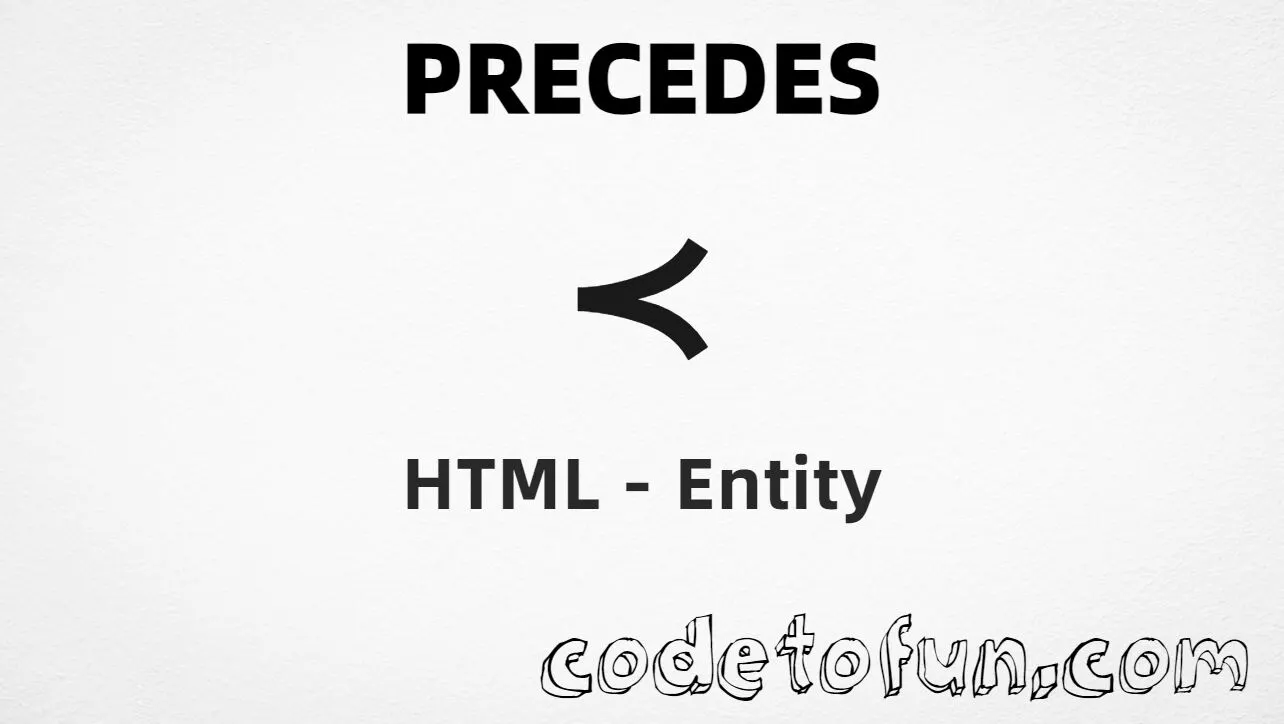
Precedes (≺) is the Mathematical Operators character at Unicode U+227A (PRECEDES). In order theory and logic it means “precedes” or “comes before” — a strict order relation, not the numeric less-than sign.
Remember
Character     ≺
Unicode       U+227A
Hex entity    ≺
Decimal       ≺
Named entity  ≺  (also ≺)
CSS escape    \227A
Not the same  ≻ · <
All of these produce the same glyph: ≺. Prefer ≺ in HTML source for clarity; use hex/decimal when generating entities, and CSS \227A only in content.
One page that shows Precedes with the hex entity, decimal entity, named entity, and CSS escape. Use View Output or open the live editor.
Hex + Decimal + Named + CSS
All four ways to produce ≺ in a single document.
html
<!DOCTYPE html>
<html lang="en">
<head>
<meta charset="UTF-8">
<title>Precedes (≺) in HTML</title>
<style>
#point::after {
content: "\227A";
}
</style>
</head>
<body>
<p>Precedes using Hex Code: a ≺ b</p>
<p>Precedes using HTML Code: a ≺ b</p>
<p>Precedes using Named Entity: a ≺ b</p>
<p id="point">Precedes using CSS Entity: a </p>
</body>
</html>
Precedes using Hex Code: a ≺ b
Precedes using HTML Code: a ≺ b
Precedes using Named Entity: a ≺ b
Precedes using CSS Entity: a ≺
How It Works
1. Hex:U+227A → ≺ in HTML. The browser turns it into ≺.
2. Decimal: same code point as 8826 → ≺. Same result as hex.
3. Named:≺ is the HTML5 name for this character — easiest to read in source (aliases: ≺).
4. CSS: use \227A in content (not an HTML entity). #point::after appends that ≺ after the paragraph text.
Pitfalls & Tips
Common mistakes when working with the precedes symbol.
Named
Prefer ≺
Named form is clearer than numeric codes in hand-written HTML. ≺ is an equivalent alias.
≻
Not succeeds
≻ is U+227B (≻) — the opposite order relation.
<
Not less-than
Use < for numeric <. ≺ is a math order operator, not ASCII comparison.
CSS vs HTML
Do not mix escapes
\227A belongs in CSS. ≺ / ≺ / ≺ belong in HTML.
Semicolon
End references
Always finish with ; — write ≺, not &pr.
Fonts
Math Operators support
Use fonts that include U+227A (e.g. Cambria Math, Noto Sans Math) so the glyph is not missing.
Compatibility
Browser Support
Precedes (U+227A) and its entity forms (≺, ≺, ≺, CSS \\227A) are supported in all mainstream browsers when the font includes Mathematical Operators.
✓ Universal support
Precedes (≺)
Use ≺, or encode with hex, decimal, or CSS escape — same glyph everywhere fonts support it.
100%Browser coverage
Google ChromeSupported
Yes
Microsoft EdgeSupported
Yes
Mozilla FirefoxSupported
Yes
Apple SafariSupported
Yes
OperaSupported
Yes
Internet ExplorerAll versions
Yes
U+227A / entitiesFull support
Bottom line: Prefer ≺ in HTML for readability. Use ≺ or ≺ when encoding must be numeric, and \\227A only inside CSS content.
Remember
Key Takeaways
Unicode: Precedes is U+227A (decimal 8826) — glyph ≺.
HTML: prefer ≺, or use ≺ / ≺.
CSS: use \227A inside content for generated text.
Use case: order theory “precedes” — not ≻ and not <.
Use ≺ (named), ≺ (hex), ≺ (decimal), or the CSS escape \227A in the content property. All render ≺. Aliases include ≺ and ≺.
U+227A (PRECEDES). Hex 227A, decimal 8826. It belongs to the Mathematical Operators block.
Yes. ≺ is the common named HTML5 entity for ≺ (also ≺ / ≺) and is supported in all modern browsers.
Use it in order theory, logic, and math when ≺ means “precedes” or “comes before.” Prefer ≺ for readable source. Use < only for numeric less-than comparisons.
HTML entities (≺, ≺, or ≺) go in markup. The CSS escape \227A is used in stylesheets (usually in the content property of ::before/::after). Both render ≺.
No. ≺ is precedes (U+227A). ≻ is succeeds (U+227B, ≻). < is the less-than sign (U+003C, <) — a different Basic Latin character.
🤔
Did you know?
Precedes is Unicode U+227A (decimal 8826) — glyph ≺. HTML5 provides ≺ (aliases include ≺ and ≺). Prefer the named form for readable math markup. Distinct from succeeds ≻ (≻, U+227B) and less-than < (<, U+003C).