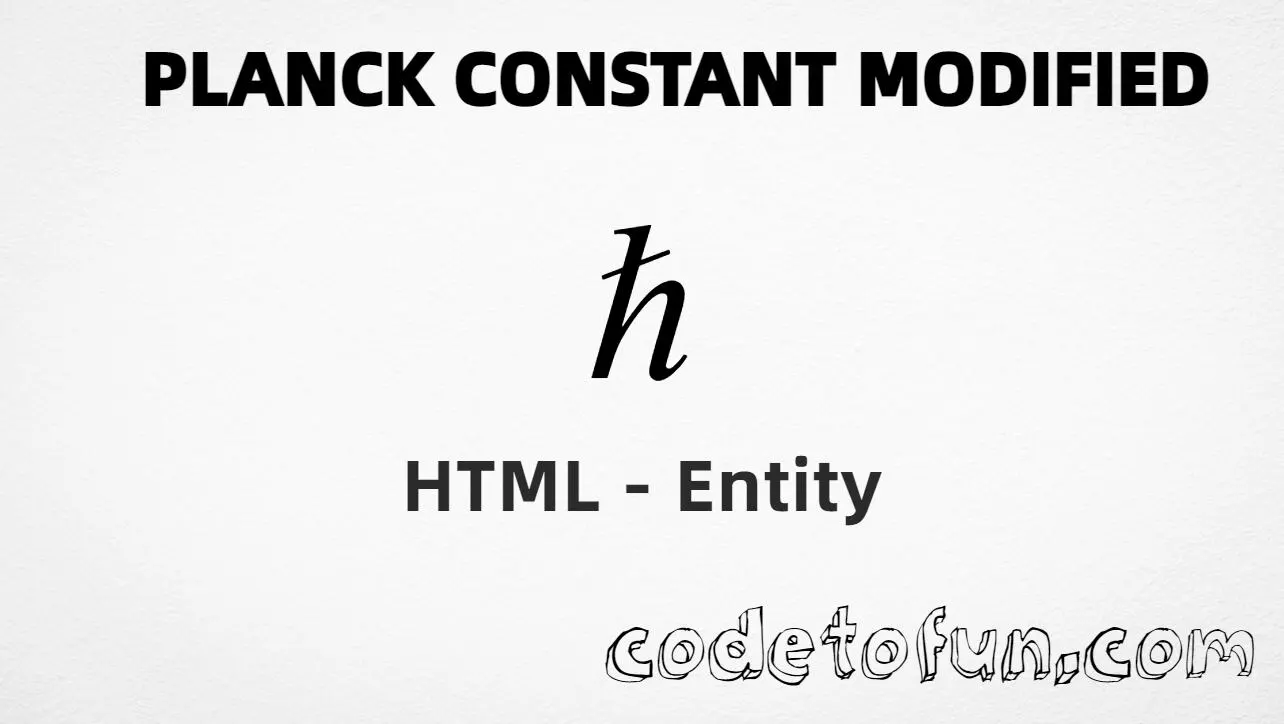
HTML Entity for Planck Constant Over Two Pi (ℏ)

What You'll Learn
How to display the reduced Planck constant (ℏ, h-bar) in HTML using various entity methods. This character represents ħ (h divided by 2π) in quantum mechanics—the symbol physicists call h-bar—and is essential for wave functions, angular momentum, and quantum physics notation.
This character is part of the Letterlike Symbols Unicode block and can be rendered with a hexadecimal reference, a decimal reference, the named entity ℏ, or a CSS escape in the content property. Do not confuse ℏ with U+210E (ℎ, Planck constant h) or ordinary Latin h (U+0068).
⚡ Quick Reference — Planck Constant Over Two Pi
U+210FLetterlike Symbols block
ℏHexadecimal reference
ℏDecimal reference
ℏMost readable option
Name Value
──────────── ──────────
Unicode U+210F
Hex code ℏ
HTML code ℏ
Named entity ℏ
CSS code \210F
Meaning Planck constant over two pi (h-bar)
Also written ħ = h / 2π
Related U+210E = Planck constant h (ℎ)
U+0068 = Latin small letter h (h)
Block Letterlike Symbols (U+2100–U+214F)Complete HTML Example
A simple example showing ℏ (h-bar) using hexadecimal code, decimal HTML code, the named entity, and a CSS content escape:
<!DOCTYPE html>
<html>
<head>
<style>
#point::after{
content: "\210F";
}
</style>
</head>
<body>
<p>h-bar (hex): ℏ</p>
<p>h-bar (decimal): ℏ</p>
<p>h-bar (named): ℏ</p>
<p id="point">h-bar (CSS): </p>
</body>
</html>🌐 Browser Support
The reduced Planck constant entity is universally supported in all modern browsers:
👀 Live Preview
See h-bar (ℏ) rendered live in different contexts:
🧠 How It Works
Hexadecimal Code
ℏ uses the Unicode hexadecimal value 210F to display h-bar. The x prefix indicates hexadecimal format.
Decimal HTML Code
ℏ uses the decimal Unicode value 8463 to display the same character. This is one of the most commonly used methods.
CSS Entity
\210F is used in CSS stylesheets, particularly in the content property of pseudo-elements like ::before and ::after.
Named Entity
ℏ is the semantic named entity — the easiest to read in source HTML for the reduced Planck constant symbol.
Same visual result
All four methods produce h-bar: ℏ. Unicode U+210F sits in the Letterlike Symbols block (U+2100–U+214F). For Planck’s constant h use U+210E (ℎ).
Use Cases
The reduced Planck constant symbol (ℏ) commonly appears in the following scenarios:
Wave functions, Schrödinger equation, and ℏ in quantum formulas.
Physics preprints, journal articles, and academic publications online.
University physics courses, textbooks, and lecture notes on quantum theory.
Popular science articles explaining angular momentum and energy quanta.
Unicode and HTML entity guides for physics and Letterlike Symbols.
Scientific software, simulation tools, and physics API documentation.
Pair ℏ with “h-bar” or “reduced Planck constant” on first use.
💡 Best Practices
Do
- Use
ℏfor readable h-bar markup - Distinguish ℏ (h-bar) from ℎ (Planck constant h)
- Pick one style (hex / decimal / named) per project
- Use MathML or LaTeX for complex multi-line equations when appropriate
- Test the glyph across browsers and scientific fonts
Don’t
- Use
ℎfor h-bar—that entity is for U+210E (ℎ) - Confuse ℏ with ordinary Latin
hor Greek η - Call it “modified Planck constant” without explaining it means h-bar (ℏ = h/2π)
- Use CSS escape
\210Finside HTML text nodes - Use HTML entities in JS (use
\u210Finstead)
Key Takeaways
Three HTML references all render ℏ
ℏ ℏ ℏFor CSS stylesheets, use the escape in the content property
\210FUnicode U+210F — PLANCK CONSTANT OVER TWO PI (h-bar)
For Planck’s constant h (ℎ), use ℎ on the Planck constant page
Previous: Planck Constant (ℎ) Next: Plus (+)
❓ Frequently Asked Questions
ℏ (hex), ℏ (decimal), ℏ (named), or \210F in CSS content. All produce ℏ.U+210F (PLANCK CONSTANT OVER TWO PI). Letterlike Symbols block. Hex 210F, decimal 8463. Denotes h-bar: ℏ = h/2π.ℎ for h and ℏ for ℏ.ℏ, ℏ, and ℏ are equivalent in modern browsers and all render ℏ.Explore More HTML Entities!
Discover 1500+ HTML character references — currency symbols, arrows, math operators, emojis, and more.
8 people found this page helpful