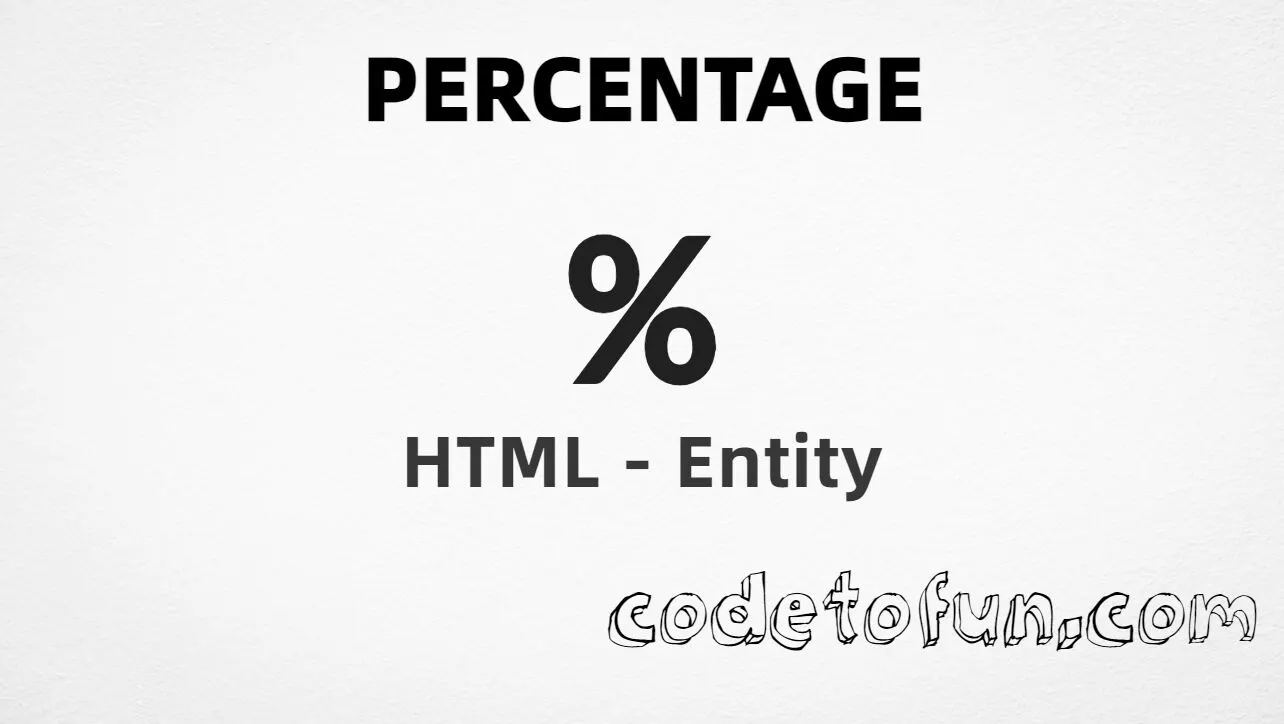
Percentage uses the percent sign (%) — the Basic Latin character at Unicode U+0025 (PERCENT SIGN). It means 1/100 — used for discounts, statistics, and progress values. HTML5 provides the named entity %; you can also type % directly.
Remember
Character     %
Unicode       U+0025
Named entity  %
Hex entity    %  (or %)
Decimal       %
CSS escape    \0025
All of these produce the same glyph: %. Prefer typing % or % for readable HTML.
Reference
Quick Reference
One table for every form you will actually use.
Form
Code
Where it goes
Named entity
%
HTML markup
Hex entity
%
HTML markup (also %)
Decimal entity
%
HTML markup
Direct character
%
HTML text (UTF-8 default)
CSS escape
\0025
Stylesheet content (padded)
When to Use Which
Situation
Use
Everyday HTML rates
Type % or use %
Numeric entity required
% or %
Generated text via ::before / ::after
content: "\0025"
Per thousand / per ten thousand
‰ / ‱
URL query strings
Percent-encode as %25 (different from display)
See it
Live Preview
Percent sign rendered in common contexts.
Glyph%
Large glyph%
In a rate25% off
With entitiesNamed: % | Hex: % | Decimal: %
Related signs% (%) · ‰ (‰) · ‱ (‱)
Code
Complete HTML Example
One page that shows the percent sign with named, hex, decimal, direct, and CSS forms. Use View Output or open the live editor.
Use % (named), % or % (hex), % (decimal), type % in UTF-8, or the CSS escape \0025 in content. All render %.
U+0025 (PERCENT SIGN). Hex 25 / 0025, decimal 37. It belongs to Basic Latin and means 1/100.
Yes. HTML5 defines %. You can also use % or %, or simply type % in a UTF-8 document — % is not a reserved HTML markup character like <, >, or &.
Use it for discounts, statistics, and progress values (e.g. 25%). Prefer typing % or % for readable source. For per thousand use ‰; for per ten thousand use ‱.
HTML entities (%, %, or %) go in markup. The CSS escape \0025 is used in stylesheets (usually in the content property of ::before/::after). Prefer the padded form \0025 so the next digit is not swallowed.
% is per hundred. ‰ (U+2030, ‰) is per thousand. ‱ (U+2031, ‱) is per ten thousand. Do not mix the scales.
🤔
Did you know?
Percentage uses the percent sign (%) — Unicode U+0025 (decimal 37), PERCENT SIGN in Basic Latin. HTML5 provides %. You can also type % directly in UTF-8. One % equals 1/100. Related: ‰ (‰, per 1000) and ‱ (‱, per 10 000).