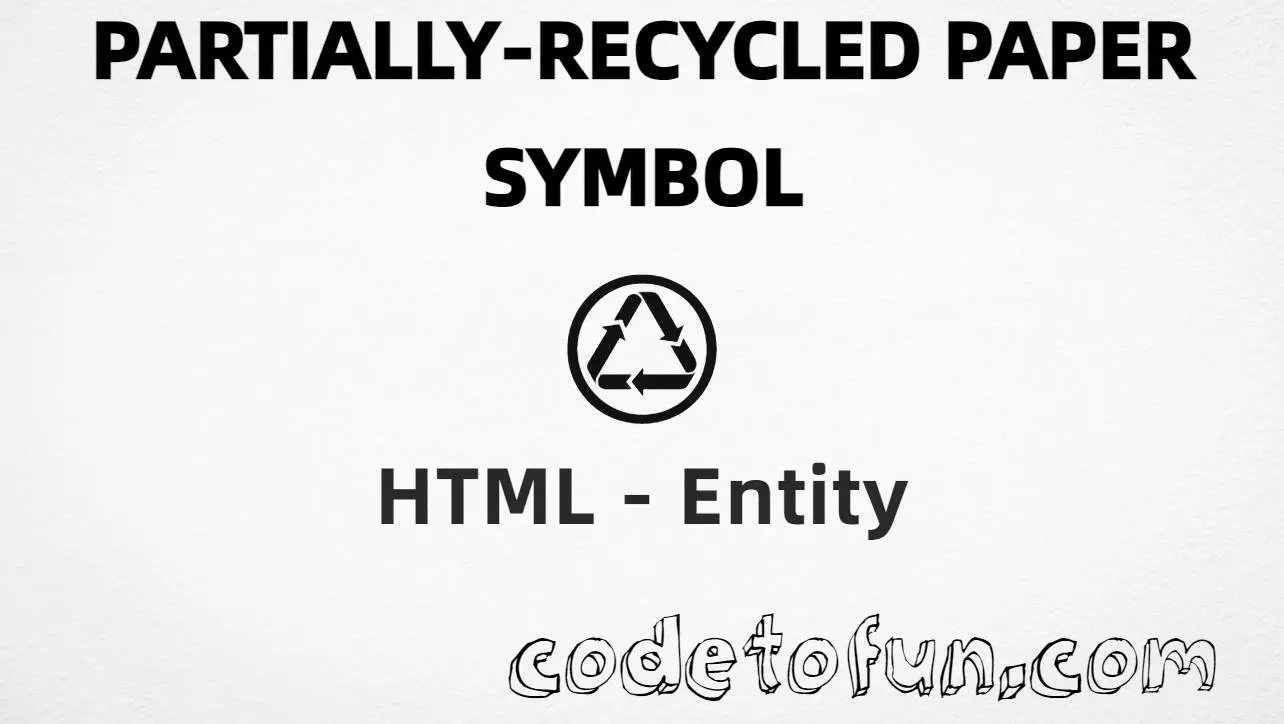
HTML Entity for Partially Recycled Paper Symbol (♽)
Beginner
6 min read
Updated: Sep 2026
1 example
Unicode U+267D
Definition
What Is the Partially Recycled Paper Symbol Entity?
Partially recycled paper symbol (♽) is the Miscellaneous Symbols character at Unicode U+267D. It marks paper that contains some recycled content — useful for eco labels and packaging notes. There is no named HTML entity; use hex, decimal, UTF-8, or CSS.
Remember
Character     ♽
Unicode       U+267D
Named entity  none
Hex entity    ♽
Decimal       ♽
CSS escape    \267D
All numeric and UTF-8 forms produce the same glyph: ♽. Prefer ♽ for portable markup; paste ♽ in UTF-8 when convenient.
Reference
Quick Reference
One table for every form you will actually use.
Form
Code
Where it goes
Named entity
none
Not defined in HTML5
Hex entity
♽
HTML markup
Decimal entity
♽
HTML markup
Direct character
♽
HTML text (UTF-8 default)
CSS escape
\267D
Stylesheet content
When to Use Which
Situation
Use
Portable HTML without pasting Unicode
♽ or ♽
UTF-8 eco / packaging text
Type or paste ♽
Generated text via ::before / ::after
content: "\267D"
Fully recycled paper marking
♼ (U+267C)
Generic recycling symbol
♻ (U+267B)
See it
Live Preview
Partially recycled paper symbol rendered in common contexts.
Glyph♽
Large glyph♽
In a label♽ Partially recycled paper
With entitiesHex: ♽ | Decimal: ♽ | Named: none
Related symbols♼ (recycled paper) · ♻ (recycling) · ♺
Code
Complete HTML Example
One page that shows the symbol with hex, decimal, direct, and CSS forms. Use View Output or open the live editor.
Hex + Decimal + Direct + CSS
Four ways to produce ♽ in a single document (no named entity).
Using Hex Code: ♽
Using Decimal: ♽
Using Direct Character: ♽
Using CSS Entity: ♽
Eco label: ♽ Partially recycled paper
How It Works
1. Hex:U+267D → ♽ in HTML. Best portable choice (no named entity).
2. Decimal: same code point as 9853 → ♽. Same glyph.
3. Direct: paste ♽ in a UTF-8 file with <meta charset="UTF-8">.
4. CSS: use \267D in content (not an HTML entity). #point::after appends that ♽ after the paragraph text.
5. Named: HTML5 has none — do not invent a name like &partrecycle;.
Pitfalls & Tips
Common mistakes when working with this eco symbol entity.
No name
Do not invent a named entity
There is no &…; name for U+267D. Use ♽ or ♽.
Not full
♽ vs ♼
U+267C is recycled paper (full). U+267D means partially recycled — pick the correct marking.
Accessibility
Add visible meaning
Pair the glyph with text (e.g. “Partially recycled paper”) so screen readers and users get the claim clearly.
Font
Glyph coverage varies
Some fonts omit Miscellaneous Symbols. Provide a fallback font or descriptive text if the box appears empty.
CSS vs HTML
Do not mix escapes
\267D belongs in CSS. ♽ / ♽ belong in HTML.
UTF-8
Declare charset
If you paste ♽ directly, serve the page as UTF-8 with <meta charset="UTF-8">.
Compatibility
Browser Support
Partially recycled paper symbol (U+267D) and its entity forms (♽, ♽, CSS \\267D) are supported in all mainstream browsers. Glyph availability depends on the font.
✓ Universal support
Partially Recycled Paper (♽)
Prefer ♽, or encode with decimal or CSS escape — same glyph everywhere (when the font has it).
100%Browser coverage
Google ChromeSupported
Yes
Microsoft EdgeSupported
Yes
Mozilla FirefoxSupported
Yes
Apple SafariSupported
Yes
OperaSupported
Yes
Internet ExplorerAll versions
Yes
U+267D / entitiesFull support
Bottom line: There is no named entity. Prefer ♽ or ♽ in HTML, and \\267D only inside CSS content.
Remember
Key Takeaways
Unicode: partially recycled paper is U+267D (decimal 9853), Miscellaneous Symbols.
HTML: no named entity — use ♽ or ♽.
CSS: use \267D inside content for generated text.
Meaning: partial recycle — not the same as ♼ or ♻.
One line:U+267D → ♽ / ♽ / CSS \267D (no named entity).
Frequently Asked Questions
Use ♽ (hex), ♽ (decimal), type ♽ in UTF-8, or the CSS escape \267D in content. There is no named HTML entity for U+267D.
U+267D (PARTIALLY-RECYCLED PAPER SYMBOL). Hex 267D, decimal 9853. It belongs to Miscellaneous Symbols and marks paper that is only partly recycled content.
No. HTML5 does not define a named entity for this character. Prefer ♽ or ♽, or paste ♽ in a UTF-8 document.
Use it for eco labels, packaging notes, and sustainability content when the product uses partially recycled paper. Prefer ♽ for portable markup. Add accessible text so the meaning is clear.
HTML numeric entities (♽ or ♽) go in markup. The CSS escape \267D is used in stylesheets (usually in the content property of ::before/::after). Both render ♽.
U+267C is the recycled paper symbol (fully recycled paper marking). ♻ (U+267B) is the black universal recycling symbol. U+267D specifically means partially recycled paper.
🤔
Did you know?
Partially recycled paper symbol (♽) is Unicode U+267D (decimal 9853) — PARTIALLY-RECYCLED PAPER SYMBOL in Miscellaneous Symbols. There is no named HTML entity; use ♽, ♽, UTF-8 ♽, or CSS \267D. Fully recycled paper is nearby at U+267C.