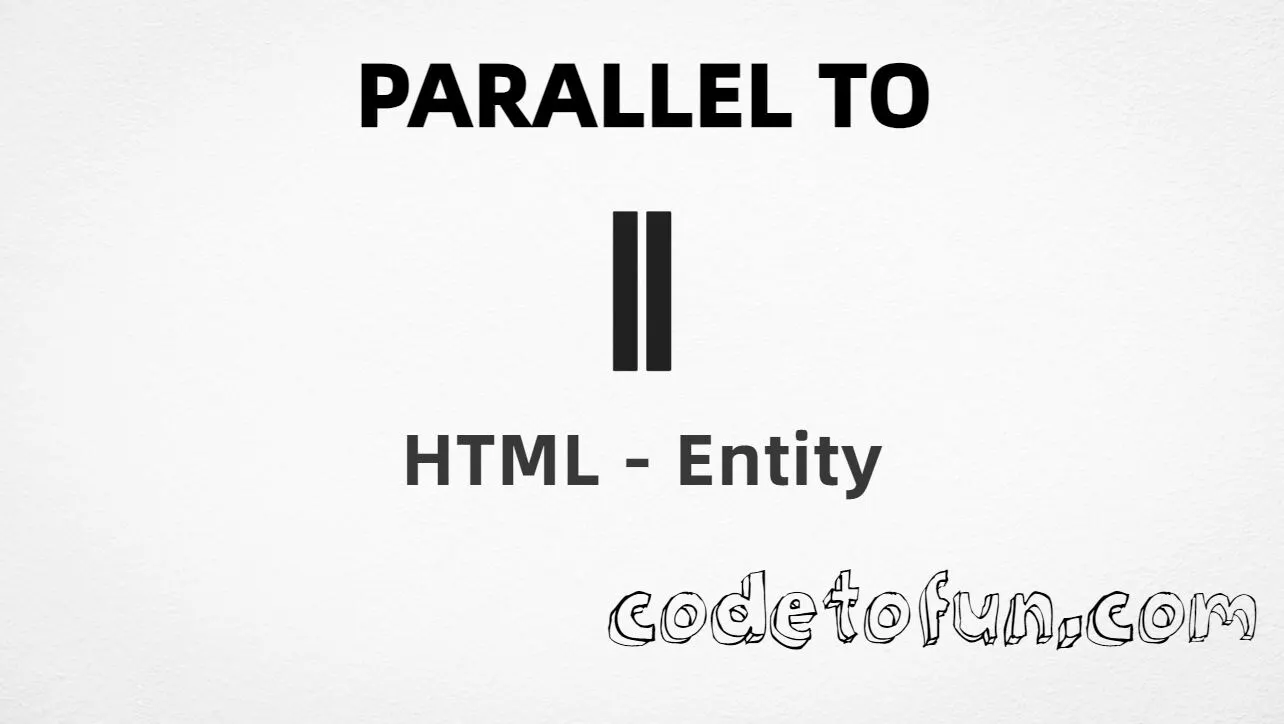
Parallel To is the math operator at Unicode U+2225 that means two lines or vectors are parallel (∥). Prefer the named entity ∥, or use ∥ / ∥.
Remember
Character     ∥
Unicode       U+2225
Named entity  ∥
Hex entity    ∥
Decimal       ∥
CSS escape    \2225
Hex, decimal, named, and CSS all produce the same symbol. Do not confuse it with ‖ (‖) or ASCII |.
Reference
Quick Reference
One table for every form you will actually use.
Form
Code
Where it goes
Named entity
∥
HTML (preferred)
Hex entity
∥
HTML
Decimal entity
∥
HTML
CSS escape
\2225
Stylesheet content
Double vertical line
‖
U+2016 — different character
When to Use Which
Situation
Use
Geometry: lines are parallel
AB ∥ CD
Need a numeric entity
∥ or ∥
Generated text via ::before / ::after
content: "\2225"
Norm / double bar (‖)
‖ (U+2016 — not this page)
ASCII pipe only
Type | — not a parallel operator
See it
Live Preview
Parallel To in math context, compared with lookalikes.
ExampleAB ∥ CD
Large glyph∥
Named entity∥ → ∥
vs lookalikes∥ | ‖ | |
With entitiesHex: ∥ | Decimal: ∥ | Named: ∥
Code
Complete HTML Example
One page that shows Parallel To with hex, decimal, named, and CSS forms. Use View Output or open the live editor.
Use ∥ (hex), ∥ (decimal), ∥ (named), or the CSS escape \2225 in the content property. All four render the parallel symbol ∥.
U+2225 (PARALLEL TO). Hex 2225, decimal 8741. It belongs to the Mathematical Operators block.
Yes. Prefer ∥ for readable HTML. It is the standard named entity for this math operator.
Use it in geometry and math text when two lines or vectors are parallel — for example AB ∥ CD written as AB ∥ CD.
U+2225 (∥) is PARALLEL TO for geometric relations. U+2016 (‖) is DOUBLE VERTICAL LINE, often used for norms. Different characters.
HTML entities (∥, ∥, or ∥) go in markup. The CSS escape \2225 is used in stylesheets (usually in content on ::before/::after). Both render ∥.
🤔
Did you know?
Parallel To is Unicode U+2225 (decimal 8741) — in Mathematical Operators. Prefer the named entity ∥, or use ∥ / ∥. Do not confuse with double vertical line ‖ (‖, U+2016) or ASCII |.