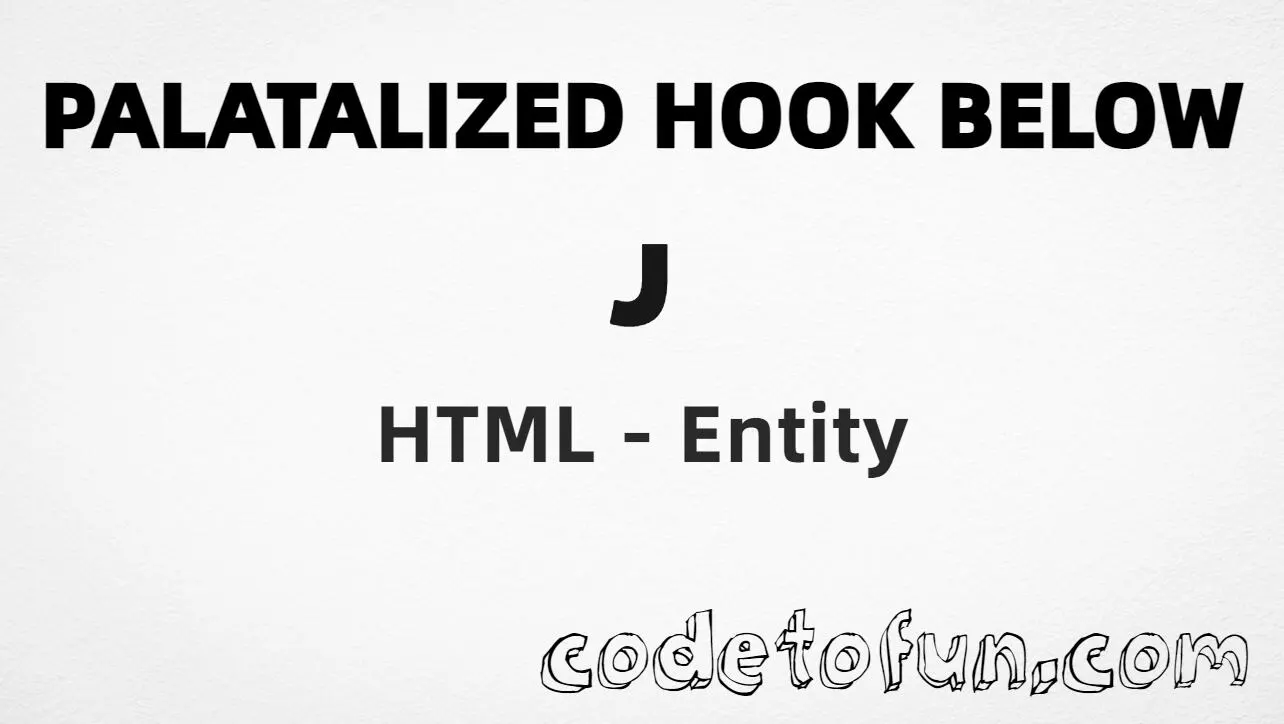
HTML Entity for Combining Palatalized Hook Below (U+0321)
Beginner
5 min read
Updated: Sep 2026
1 example
Unicode U+0321
Definition
What Is the Combining Palatalized Hook Below Entity?
Combining Palatalized Hook Below is the nonspacing mark at Unicode U+0321 that draws a small hook below the preceding character. HTML5 has no named entity — use ̡ or ̡ right after a base (e.g. t̡ → t̡).
Remember
Character     (combining) ̡
Unicode       U+0321
Named entity  (none)
Hex entity    ̡
Decimal       ̡
CSS escape    \321
Hex, decimal, and CSS all produce the same combining mark. Always place it immediately after the base character.
Using Hex Code: t̡
Using HTML Code: t̡
Using CSS Entity: t̡
IPA sample: t̡
How It Works
1. Hex: write the base, then ̡ — e.g. t̡ → t̡.
2. Decimal: same mark as 801 → t̡. Same visual result.
3. CSS: use \321 in content after a base in the string (e.g. "t\321").
4. No named form: there is no &…; name for U+0321 — stick to numeric or CSS escapes.
Pitfalls & Tips
Common mistakes when working with Combining Palatalized Hook Below.
Order
Base first, then mark
Write t̡, not ̡t. The mark attaches to the previous character.
vs U+0322
Not retroflex hook
U+0322 is combining retroflex hook below. Different IPA meaning — do not substitute.
Precomposed
Not a single letter code
Letters like ʈ (U+0288) are separate characters. U+0321 is a mark you attach to a base.
Font
Check combining support
Some fonts stack IPA hooks poorly. Prefer a font with solid Combining Diacritical Marks coverage.
CSS vs HTML
Do not mix escapes
\321 belongs in CSS. ̡ / ̡ belong in HTML.
Semicolon
End references
Always finish with ; — write ̡, not ̡.
Compatibility
Browser Support
Combining Palatalized Hook Below (U+0321) and its entity forms (̡, ̡, CSS \\321) are supported in all mainstream browsers with a font that supports Combining Diacritical Marks.
✓ Universal support
Palatalized Hook Below (U+0321)
Encode with hex, decimal, or CSS escape after a base character. No named entity.
100%Browser coverage
Google ChromeSupported
Yes
Microsoft EdgeSupported
Yes
Mozilla FirefoxSupported
Yes
Apple SafariSupported
Yes
OperaSupported
Yes
Internet ExplorerIE 9+
Yes*
U+0321Full support
Bottom line: Prefer base̡ in HTML. Use \\321 only inside CSS content.
Remember
Key Takeaways
Unicode: Combining Palatalized Hook Below is U+0321 (decimal 801).
HTML: prefer base̡ (no named entity).
CSS: use \321 inside content after a base.
Lookalike: not retroflex U+0322 or precomposed IPA letters.
One line:U+0321 → t̡ (also ̡ / CSS \321).
Frequently Asked Questions
Use ̡ (hex), ̡ (decimal), or the CSS escape \321 in the content property. Place it immediately after the base character (e.g. t̡). There is no named HTML entity for U+0321.
U+0321 (COMBINING PALATALIZED HOOK BELOW). Hex 0321, decimal 801. It belongs to the Combining Diacritical Marks block.
No. Use ̡ or ̡ after a base character. There is no HTML5 named entity for this mark.
Use it in IPA, linguistics, and phonetic notation when a palatalization hook must sit below one letter — for example t̡ written as t̡.
U+0321 is combining palatalized hook below. U+0322 is combining retroflex hook below. Similar placement, different phonetic meaning — do not swap them.
No. U+0321 is a combining mark after any base. Characters like ʈ (U+0288) are separate precomposed letters with their own code points.
🤔
Did you know?
Combining Palatalized Hook Below is Unicode U+0321 (decimal 801) — in Combining Diacritical Marks. HTML5 has no named entity — use ̡ or ̡ right after a base character (e.g. t̡ → t̡). Related: retroflex hook below U+0322.