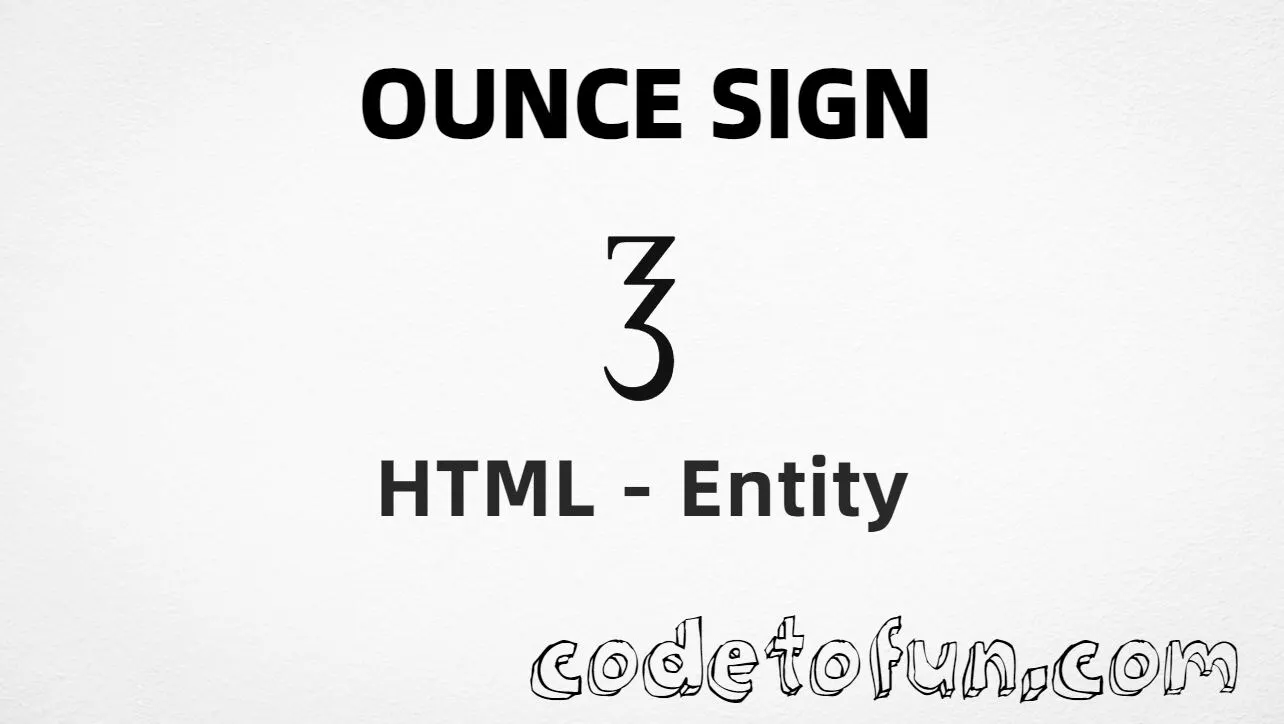
Ounce sign (℥) is the Letterlike Symbols character at Unicode U+2125 (OUNCE SIGN). It marks the apothecaries’ ounce in historical pharmacy and weight notation. There is no named HTML entity; use hex, decimal, UTF-8, or CSS.
Remember
Character     ℥
Unicode       U+2125
Named entity  none
Hex entity    ℥
Decimal       ℥
CSS escape    \2125
Modern text   oz (avoirdupois)
All numeric and UTF-8 forms produce the same glyph: ℥. Prefer ℥ for portable markup; paste ℥ in UTF-8 when convenient.
Using Hex Code: ℥
Using Decimal: ℥
Using Direct Character: ℥
Using CSS Entity: ℥
Example: Dose: 2 ℥
How It Works
1. Hex:U+2125 → ℥ in HTML. Best portable choice (no named entity).
2. Decimal: same code point as 8485 → ℥. Same glyph.
3. Direct: paste ℥ in a UTF-8 file with <meta charset="UTF-8">.
4. CSS: use \2125 in content (not an HTML entity). #point::after appends that ℥ after the paragraph text.
5. Named: HTML5 has none — do not invent a name like &ounce;.
Pitfalls & Tips
Common mistakes when working with the ounce-sign entity.
No name
No &ounce;
HTML5 does not define a named entity for U+2125. Use ℥ or ℥.
oz vs ℥
Not the same as oz
Plain oz is modern avoirdupois text. ℥ is the dedicated Letterlike symbol for apothecaries’ contexts.
Look-alikes
Not £
£ is £ (currency). Do not confuse currency pounds with the ounce weight symbol.
CSS vs HTML
Do not mix escapes
\2125 belongs in CSS. ℥ / ℥ belong in HTML.
Encoding
Declare UTF-8
If you paste ℥ directly, keep <meta charset="UTF-8"> so the file is not misread.
Fonts
Glyph coverage
Some fonts lack ℥. If it falls back to a box, try a font with Letterlike Symbols coverage.
Compatibility
Browser Support
Ounce sign (U+2125) and its entity forms (℥, ℥, CSS \\2125) are supported in all modern browsers. Glyph availability depends on the font.
✓ Universal encoding
Ounce Sign (℥)
Encode with hex, decimal, or CSS escape — or paste ℥ directly in UTF-8 HTML. No named entity.
100%Browser coverage
Google ChromeSupported
Yes
Microsoft EdgeSupported
Yes
Mozilla FirefoxSupported
Yes
Apple SafariSupported
Yes
OperaSupported
Yes
Internet ExplorerAll versions
Yes
U+2125Full support
Bottom line: Prefer ℥ (or ℥) for readable portable HTML. Use \\2125 only inside CSS content.
Remember
Key Takeaways
Unicode: this character is U+2125 (decimal 8485).
HTML: use ℥ or ℥ — there is no named entity.
CSS: use \2125 inside content for generated text.
Watch out: ℥ ≠ oz ≠ £.
One line:U+2125 → ℥ / ℥ / CSS \2125 (no named entity).
Frequently Asked Questions
Use ℥ (hex), ℥ (decimal), type ℥ in UTF-8, or the CSS escape \2125 in content. There is no named HTML entity for U+2125.
U+2125 (OUNCE SIGN). Hex 2125, decimal 8485. It belongs to the Letterlike Symbols block (U+2100–U+214F).
No. HTML5 does not define a named entity for the ounce sign. Prefer ℥ or ℥.
Use it for apothecaries’ / historical pharmacy ounce notation. For everyday modern ounces, prefer the letters oz. Prefer ℥ for portable markup.
HTML entities (℥ or ℥) go in markup. The CSS escape \2125 is used in stylesheets (usually in the content property of ::before/::after). Both render ℥.
oz is ordinary ASCII text for the avoirdupois ounce. £ (U+00A3, £) is the pound currency sign. ℥ is the dedicated Letterlike ounce symbol — do not substitute one for another.
🤔
Did you know?
Ounce sign (℥) is Unicode U+2125 (decimal 8485) — OUNCE SIGN in Letterlike Symbols (U+2100–U+214F). HTML5 defines no named entity; use ℥ or ℥. It marks the apothecaries’ ounce in historical pharmacy notation. For modern avoirdupois ounces, plain text oz is more common.