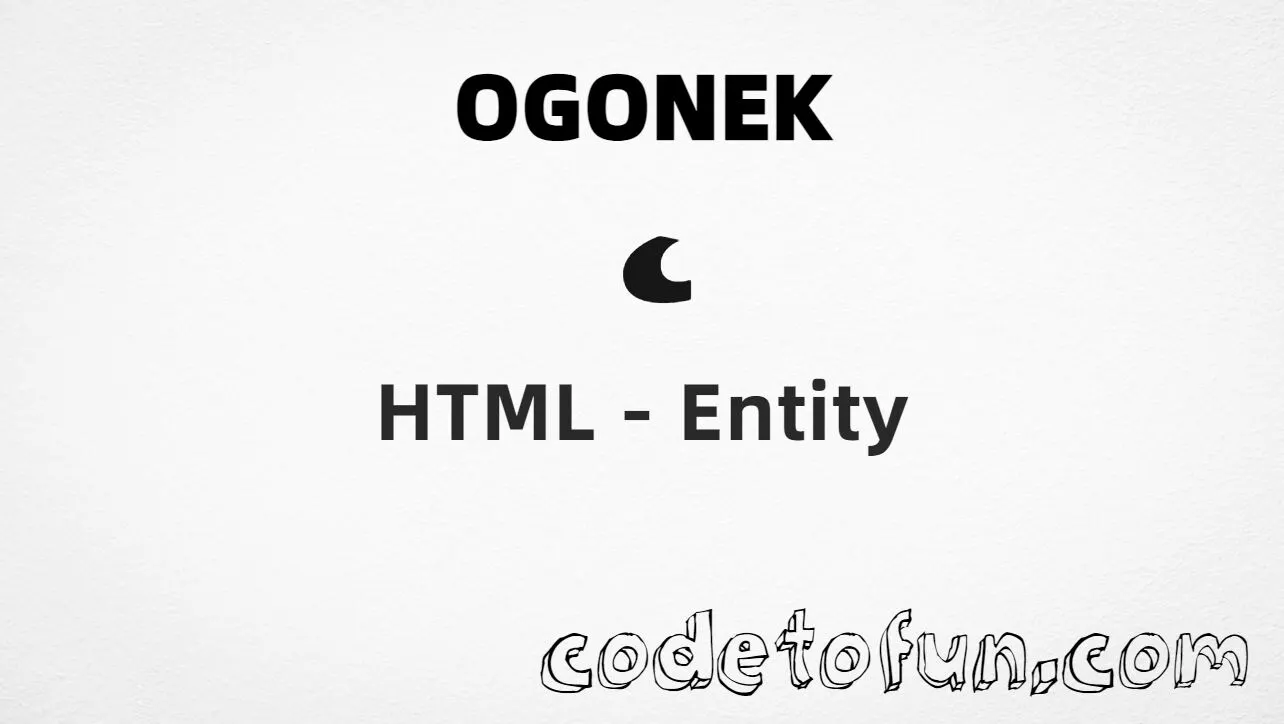
Combining ogonek (U+0328) is a combining mark in the Combining Diacritical Marks block. It does not stand alone like a normal letter — it attaches as a hook below the character that comes before it. Example: a + ̨ renders as ą (same look as precomposed ą).
Remember
Character     combining ogonek (after a base)
Unicode       U+0328
Hex entity    ̨
Decimal       ̨
CSS escape    \0328
Named entity  (none for U+0328)
Example       ą → ą
Prefer        ą / ę when available
Prefer a precomposed letter (e.g. ą / ą) for everyday Polish or Lithuanian text. Use U+0328 when you need to compose accents, work with NFD text, or attach an ogonek to a base that has no single precomposed form.
Ogonek using Hex Code: ą
Ogonek using HTML Code: ą
Ogonek using CSS Entity: ą
Typed directly: ą
Prefer precomposed: ą
How It Works
1. Hex: write the base letter, then ̨ → ą becomes ą.
2. Decimal: same mark as 808 → ą. Same result as hex.
3. CSS: put base + escape in one string: content: "a\0328". #point::after appends that sequence after the paragraph text.
4. Typed / precomposed: in UTF-8 you can type a then the combining ogonek (base first). For normal text, ą (ą) is usually clearer than composing U+0328 yourself.
Pitfalls & Tips
Common mistakes when working with combining ogonek.
Order
Base letter first
Write ą, never put U+0328 before the letter you want to mark.
Named?
No named entity for U+0328
Use numeric forms. Named entities like ą are for precomposed letters, not the combining mark itself.
Default
Prefer precomposed
For ą, ę, ų, and į, use ą, ę, ų, and į in normal copy.
CSS vs HTML
Do not mix escapes
\0328 belongs in CSS strings. ̨ / ̨ belong in HTML.
Fonts
Combining support varies
Some fonts stack poorly. If layout looks wrong, prefer a precomposed letter for display text.
Semicolon
End references
Always finish with ; — write ̨, not ̨.
Compatibility
Browser Support
Combining ogonek (U+0328) and its numeric entity forms (̨, ̨, CSS \\0328) are supported in all mainstream browsers. Stacking quality depends on font support for combining marks.
✓ Universal support
Combining Ogonek (U+0328)
Encode with hex, decimal, or CSS escape after a base letter — same combining mark everywhere encoding is supported.
100%Browser coverage
Google ChromeSupported
Yes
Microsoft EdgeSupported
Yes
Mozilla FirefoxSupported
Yes
Apple SafariSupported
Yes
OperaSupported
Yes
Internet ExplorerAll versions
Yes
U+0328 / entitiesFull support
Bottom line: Prefer precomposed letters for normal prose. Use ̨ or ̨ after a base letter when you need the combining mark, and \\0328 only inside CSS content strings.
Remember
Key Takeaways
Unicode: combining ogonek is U+0328 (decimal 808).
HTML: base first, then ̨ or ̨ (e.g. ą).
CSS: use "a\0328" (or another base) inside content.
Default: use precomposed ą / ą for everyday text when you can.
One line:U+0328 → after a base letter as ̨ / ̨ / CSS \0328.
Frequently Asked Questions
Place ̨ (hex) or ̨ (decimal) immediately after a base letter — for example ą for ą. In CSS, use content: "a\0328". There is no named HTML entity for U+0328.
U+0328 (COMBINING OGONEK). Hex 0328, decimal 808. It belongs to the Combining Diacritical Marks block (U+0300–U+036F) and stacks below the preceding base character.
No. Use numeric references like ̨ or ̨. Precomposed letters have names: ą (ą), ę (ę), ų (ų), į (į).
Use U+0328 when composing accents dynamically, for NFD text, or bases without a precomposed form. For ordinary Polish or Lithuanian prose, prefer precomposed letters like ą / ą.
HTML entities (̨ or ̨) go in markup after the base letter. The CSS escape \0328 goes in stylesheet strings (usually content on ::before/::after), typically as "a\0328".
No. Combining ogonek is U+0328 (hook below). Combining cedilla is U+0327. They look different and are used in different orthographies.
🤔
Did you know?
Combining ogonek is Unicode U+0328 (decimal 808). It is a combining mark — place it after a base letter (e.g. ą → ą). HTML5 has no named entity for U+0328. Prefer precomposed letters like ą (ą) and ę (ę) when available.