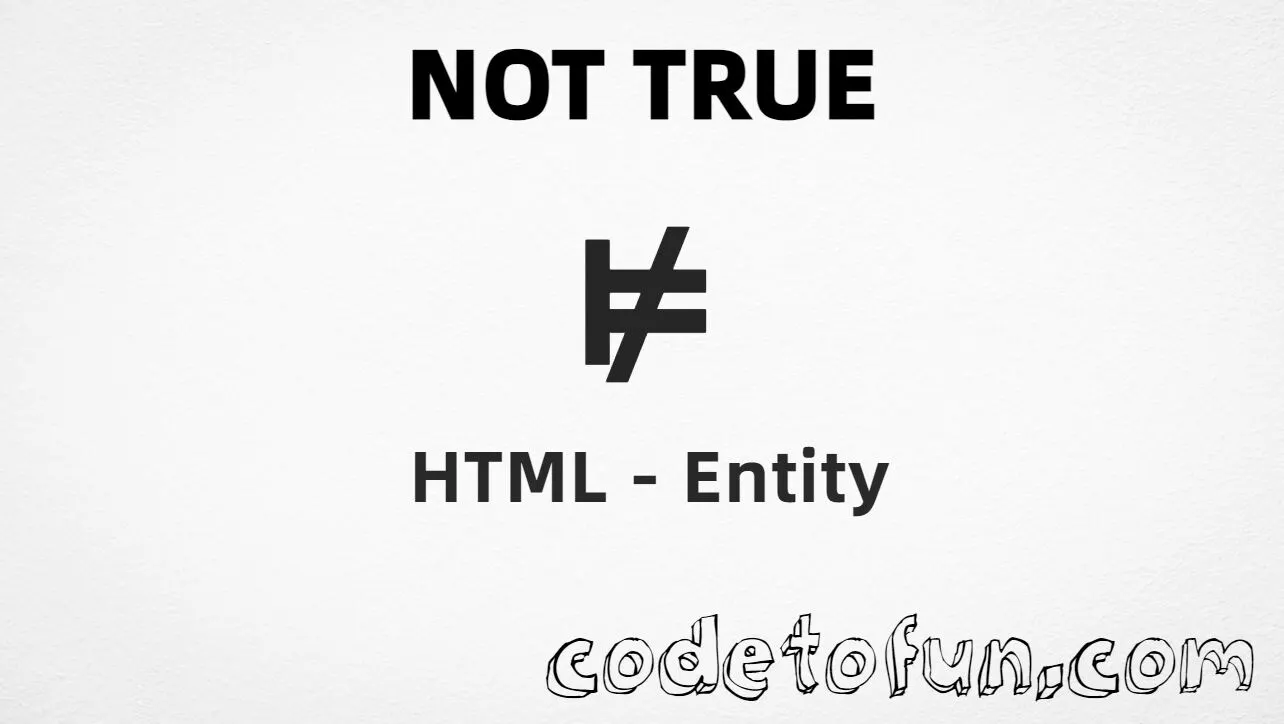
Not true (⊭) is the Mathematical Operators character at Unicode U+22AD (NOT TRUE). It is a negated turnstile used in modal logic and proof theory to say a formula is not true (not modeled) in a given context.
Remember
Character     ⊭
Unicode       U+22AD
Named entity  ⊭
Hex entity    ⊭
Decimal       ⊭
CSS escape    \22AD
Affirmative   ⊨ (⊨, U+22A8)
Named, hex, decimal, CSS, and a typed character all produce the same glyph: ⊭. Prefer ⊭ in HTML source for clarity.
Using Named Entity: ⊭
Using Hex Code: ⊭
Using HTML Code: ⊭
Using CSS Entity: ⊭
Example: W ⊭ φ
How It Works
1. Named:⊭ is the clearest HTML form and renders ⊭.
2. Hex:U+22AD → ⊭ in HTML. Same result as the named entity.
3. Decimal: same code point as 8877 → ⊭. Same result as hex.
4. CSS: use \22AD in content (not an HTML entity). #point::after appends that ⊭ after the paragraph text.
Pitfalls & Tips
Common mistakes when working with the not-true entity.
Pair
⊭ ≠ ⊨
⊭ is the negation. ⊨ is the affirmative true / models symbol (⊨).
Case
⊭ ≠ ⊯
Named entities are case-sensitive. ⊯ is ⊯ (U+22AF) — a different turnstile.
Look-alikes
Not ¬
¬ (¬) is propositional negation. ⊭ is a logic turnstile meaning “not true.”
CSS vs HTML
Do not mix escapes
\22AD belongs in CSS. ⊭ / ⊭ / ⊭ belong in HTML.
Fonts
Glyph coverage
Some fonts omit Mathematical Operators. If ⊭ looks like a box, switch to a math-capable font.
Semicolon
End references
Always finish with ; — write ⊭, not &nvDash.
Compatibility
Browser Support
Not true (U+22AD) and its entity forms (⊭, ⊭, ⊭, CSS \\22AD) are supported in all modern browsers. Glyph availability depends on the font.
✓ Universal encoding
Not True (⊭)
Encode with named, hex, decimal, or CSS escape — or paste ⊭ directly in UTF-8 HTML.
100%Browser coverage
Google ChromeSupported
Yes
Microsoft EdgeSupported
Yes
Mozilla FirefoxSupported
Yes
Apple SafariSupported
Yes
OperaSupported
Yes
Internet ExplorerAll versions
Yes
U+22ADFull support
Bottom line: Prefer ⊭ for readable HTML. Use \\22AD only inside CSS content.
Remember
Key Takeaways
Unicode: this character is U+22AD (decimal 8877).
HTML: prefer ⊭ — or use ⊭ / ⊭.
Use ⊭ (named), ⊭ (hex), ⊭ (decimal), or the CSS escape \22AD in the content property. All render ⊭. Prefer ⊭ in HTML source.
U+22AD (NOT TRUE). Hex 22AD, decimal 8877. It belongs to the Mathematical Operators block (U+2200–U+22FF).
Yes. ⊭ is the HTML5 named entity for ⊭. Related: ⊨ for ⊨ (U+22A8) and ⊯ for ⊯ (U+22AF). Names are case-sensitive.
Use it in modal logic, proof theory, and formal semantics when a formula is not true (not modeled) in a given context. Prefer ⊭ for readable source.
HTML entities (⊭, ⊭, or ⊭) go in markup. The CSS escape \22AD is used in stylesheets (usually in the content property of ::before/::after). Both render ⊭.
⊨ (⊨) means true / models. ⊭ (⊭) is its negation. ¬ (¬) is propositional negation. ⊯ (⊯) is a different double-bar negated turnstile.
🤔
Did you know?
Not true (⊭) is Unicode U+22AD (decimal 8877) in Mathematical Operators. HTML5 provides ⊭ — the most readable form. It negates true / models (⊨, ⊨, U+22A8). Distinct from propositional ¬ (¬) and from ⊯ (⊯, double-bar negation).