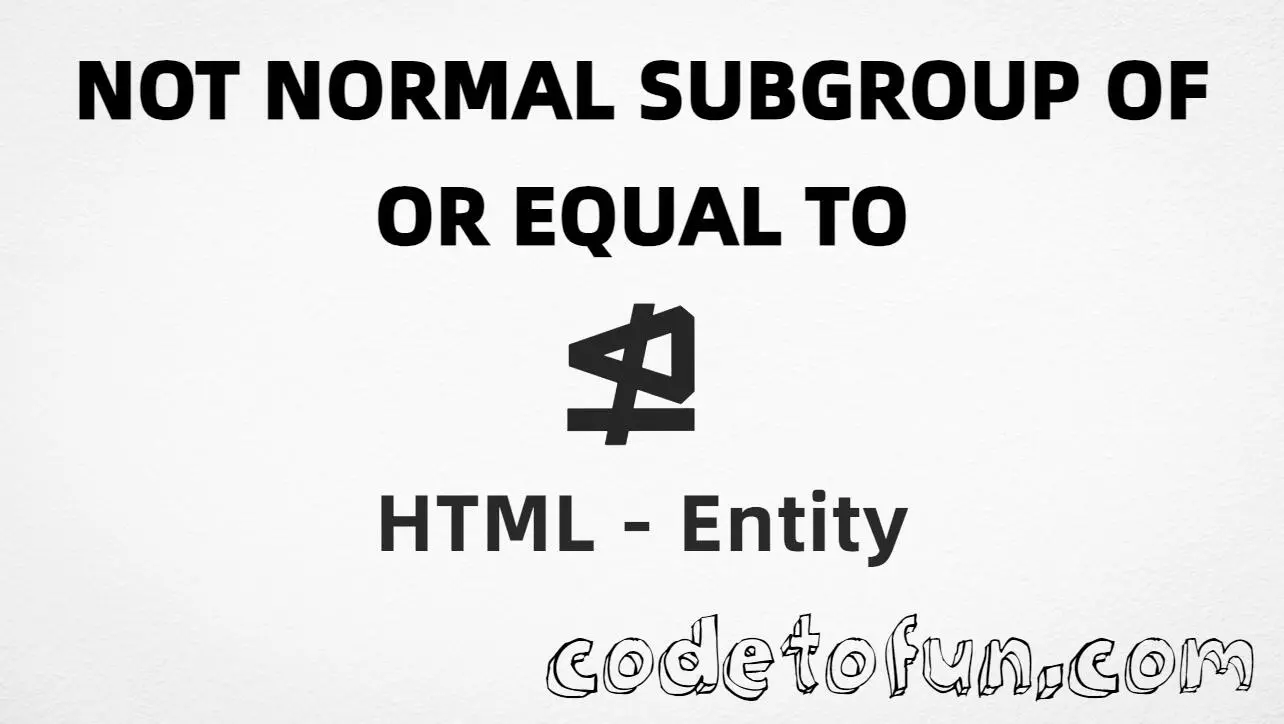
HTML Entity for Not Normal Subgroup Of Equal To (⋬)
Beginner
5 min read
Updated: Sep 2026
1 example
Unicode U+22EC
Definition
What Is the Not Normal Subgroup Of Equal To Entity?
Not Normal Subgroup Of Equal To (⋬) is the group-theory operator at Unicode U+22EC. HTML5 provides ⋬. Example: H ⋬ G means H is neither a normal subgroup of G nor equal to G.
Remember
Character     ⋬
Unicode       U+22EC
Named entity  ⋬
Hex entity    ⋬
Decimal       ⋬
CSS escape    \22EC
Named, hex, decimal, CSS, and a typed character all produce the same glyph: ⋬.
Using Named Entity: ⋬
Using Hex Code: ⋬
Using HTML Code: ⋬
Using CSS Entity: ⋬
Formula: H ⋬ G
How It Works
1. Named:⋬ is the clearest HTML form and renders ⋬.
2. Hex:U+22EC → ⋬ in HTML. Same result as the named entity.
3. Decimal: same code point as 8940 → ⋬. Same result as hex and named.
4. CSS: use \22EC in content (not an HTML entity). #point::after appends that ⋬ after the paragraph text.
Pitfalls & Tips
Common mistakes when working with this group-theory symbol.
Prefer
Use ⋬
The named form is clearer than numeric references and is defined in HTML5.
vs ⋪
Not the strict form
⋪ is ⋪ (U+22EA). This page’s symbol includes the “or equal” negation.
vs ⋭
Not opposite containment
⋭ is ⋭ (U+22ED). Do not swap left/right variants.
CSS vs HTML
Do not mix escapes
\22EC belongs in CSS. ⋬ / ⋬ / ⋬ belong in HTML.
Encoding
Declare UTF-8
If you type ⋬ directly, keep <meta charset="UTF-8"> so the file is not misread.
Semicolon
End references
Always finish with ; — write ⋬, not &nltrie.
Compatibility
Browser Support
Not Normal Subgroup Of Equal To (U+22EC) and its entity forms (⋬, ⋬, ⋬, CSS \\22EC) are supported in all mainstream browsers with a Unicode-capable font.
✓ Universal support
nltrie (⋬)
Encode with named, hex, decimal, or CSS escape — or type ⋬ directly in UTF-8 HTML.
100%Browser coverage
Google ChromeSupported
Yes
Microsoft EdgeSupported
Yes
Mozilla FirefoxSupported
Yes
Apple SafariSupported
Yes
OperaSupported
Yes
Internet ExplorerIE 9+
Yes*
U+22EC / ⋬Full support
Bottom line: Prefer ⋬ in math HTML. Use \\22EC only inside CSS content.
Remember
Key Takeaways
Unicode: this symbol is U+22EC (decimal 8940).
HTML: prefer ⋬.
CSS: use \22EC inside content for generated text.
Lookalike: not ⋪ (⋪) or ⋭ (⋭).
One line:U+22EC → prefer ⋬ (also ⋬ / CSS \22EC).
Frequently Asked Questions
Use ⋬ (named), ⋬ (hex), ⋬ (decimal), or the CSS escape \22EC in the content property. All render ⋬. Prefer ⋬ in math HTML.
U+22EC (DOES NOT CONTAIN AS NORMAL SUBGROUP OR EQUAL). Hex 22EC, decimal 8940. It belongs to the Mathematical Operators block.
Yes. HTML5 defines ⋬ for ⋬.
Use it in group theory when writing that a subgroup is neither a normal subgroup nor equal — for example H ⋬ G (rendered as H ⋬ G).
HTML entities (⋬, ⋬, or ⋬) go in markup. The CSS escape \22EC is used in stylesheets (usually in the content property of ::before/::after). Both render ⋬.
No. ⋬ is ⋬ (U+22EC). ⋪ is ⋪ (U+22EA). ⋭ is ⋭ (U+22ED). Different relations.
🤔
Did you know?
Not Normal Subgroup Of Equal To is Unicode U+22EC (decimal 8940) — DOES NOT CONTAIN AS NORMAL SUBGROUP OR EQUAL. HTML5 provides ⋬. Related: ⋪ (⋪), ⋭ (⋭).