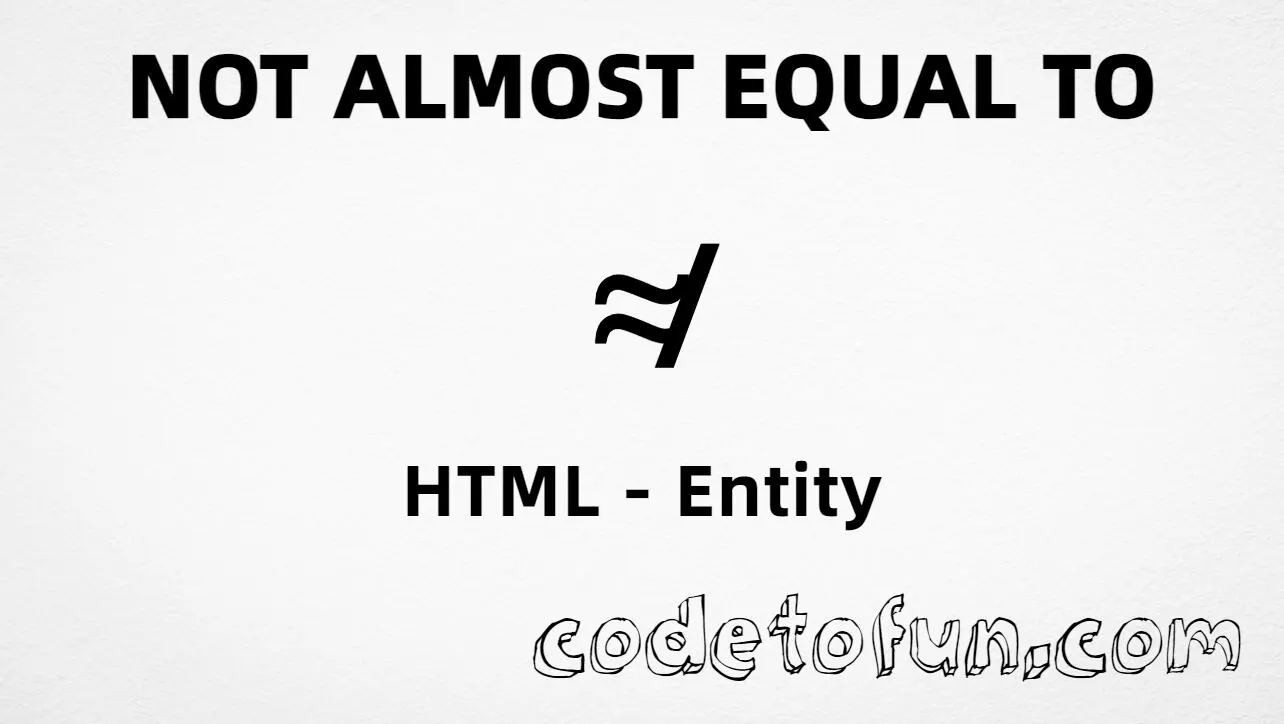
Not almost equal to (≉) is the Mathematical Operators character at Unicode U+2249 (NOT ALMOST EQUAL TO). It states that two values are not approximately equal — for example x ≉ y.
Using Named Entity: ≉
Using Hex Code: ≉
Using HTML Code: ≉
Using CSS Entity: ≉
Example: 0.1 + 0.2 ≉ 0.3
How It Works
1. Named:≉ (or ≉) is the clearest HTML form and renders ≉.
2. Hex:U+2249 → ≉ in HTML. Same result as the named entity.
3. Decimal: same code point as 8777 → ≉. Same result as hex.
4. CSS: use \2249 in content (not an HTML entity). #point::after appends that ≉ after the paragraph text.
Pitfalls & Tips
Common mistakes when working with the not-almost-equal entity.
Pair
≉ ≠ ≈
≉ is the negation. ≈ is the affirmative almost equal to (≈).
Look-alikes
Not ≠ or ≇
≠ is ≠ (strict inequality). ≇ is ≇ (neither approximately nor actually equal) — a different operator.
Aliases
≉ = ≉
Both (and ≉) map to U+2249. Pick one and stay consistent.
CSS vs HTML
Do not mix escapes
\2249 belongs in CSS. ≉ / ≉ / ≉ belong in HTML.
Encoding
Declare UTF-8
If you paste ≉ directly, keep <meta charset="UTF-8"> so the file is not misread.
Semicolon
End references
Always finish with ; — write ≉, not &napprox.
Compatibility
Browser Support
Not almost equal to (U+2249) and its entity forms (≉, ≉, ≉, CSS \\2249) are supported in all modern browsers. Glyph availability depends on the font.
✓ Universal encoding
Not Almost Equal To (≉)
Encode with named, hex, decimal, or CSS escape — or paste ≉ directly in UTF-8 HTML.
100%Browser coverage
Google ChromeSupported
Yes
Microsoft EdgeSupported
Yes
Mozilla FirefoxSupported
Yes
Apple SafariSupported
Yes
OperaSupported
Yes
Internet ExplorerAll versions
Yes
U+2249Full support
Bottom line: Prefer ≉ (or ≉) for readable HTML. Use \\2249 only inside CSS content.
Remember
Key Takeaways
Unicode: this character is U+2249 (decimal 8777).
HTML: prefer ≉ (alias ≉) — or use ≉ / ≉.
Use ≉ or ≉ (named), ≉ (hex), ≉ (decimal), type ≉ in UTF-8, or the CSS escape \2249 in content. All render ≉. Prefer ≉ in HTML source.
U+2249 (NOT ALMOST EQUAL TO). Hex 2249, decimal 8777. It belongs to the Mathematical Operators block (U+2200–U+22FF).
Yes. HTML5 defines ≉, ≉, and ≉ (aliases for the same character). Related: ≈ for ≈ (U+2248).
Use it when two values fail an approximate-equality test (e.g. x ≉ y). Prefer ≉ for readable source. For strict inequality use ≠ (≠). For almost equal use ≈ (≈).
HTML entities (≉, ≉, or ≉) go in markup. The CSS escape \2249 is used in stylesheets (usually in the content property of ::before/::after). Both render ≉.
≈ (U+2248, ≈) means almost equal. ≠ (U+2260, ≠) means not equal. ≉ (≉) specifically means not almost equal — do not substitute one for another.
🤔
Did you know?
Not almost equal to (≉) is Unicode U+2249 (decimal 8777) — NOT ALMOST EQUAL TO in Mathematical Operators. HTML5 provides ≉, ≉, and ≉ (same glyph). It negates almost equal to (≈, ≈, U+2248). Related: ≠ (≠, not equal).