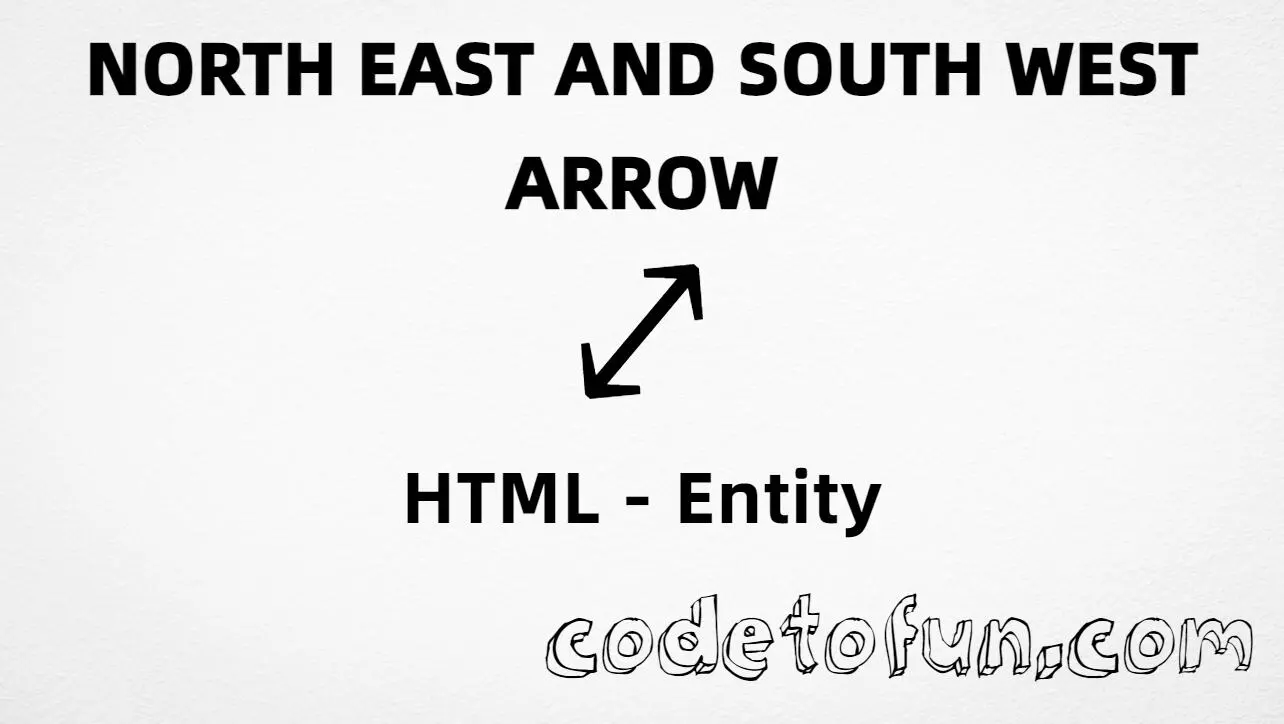
HTML Entity for North East Arrow and South West Arrow (⤢)
Beginner
5 min read
Updated: Sep 2026
1 example
Unicode U+2922
Definition
What Is the North East Arrow and South West Arrow Entity?
North East Arrow and South West Arrow (⤢) is the combined diagonal symbol at Unicode U+2922. HTML5 has no named entity — use ⤢ or ⤢. Useful for maps and compass-style UI.
Remember
Character     ⤢
Unicode       U+2922
Named entity  (none)
Hex entity    ⤢
Decimal       ⤢
CSS escape    \2922
Hex, decimal, CSS, and a typed character all produce the same glyph: ⤢.
Reference
Quick Reference
One table for every form you will actually use.
Form
Code
Where it goes
Direct character
⤢
UTF-8 HTML text
Hex entity
⤢
HTML markup (preferred)
Decimal entity
⤢
HTML markup
CSS escape
\2922
Stylesheet content
Named entity
None
Not available in HTML5
When to Use Which
Situation
Use
Combined NE + SW diagonal
⤢ or type ⤢
Need an entity in HTML source
⤢ or ⤢
Generated text via ::before / ::after
content: "\2922"
Single north-east arrow (↗)
↗
Single south-west arrow (↙)
↙
See it
Live Preview
The combined glyph alone and beside related diagonal arrows.
ExampleResize ⤢ corner
Large glyph⤢
Hex entity⤢ → ⤢
vs ↗ / ↙ / ↖⤢ | ↗ | ↙ | ↖
With entitiesHex: ⤢ | Decimal: ⤢
Code
Complete HTML Example
One page that shows the symbol with hex, decimal, and CSS forms. Use View Output or open the live editor.
Hex + Decimal + CSS
Three ways to produce ⤢ in a single document (no named entity).
Using Hex Code: ⤢
Using HTML Code: ⤢
Using CSS Entity: ⤢
UI hint: Resize ⤢
How It Works
1. Hex:U+2922 → ⤢ in HTML. Preferred numeric form.
2. Decimal: same code point as 10530 → ⤢. Same result as hex.
3. CSS: use \2922 in content (not an HTML entity). #point::after appends that ⤢ after the paragraph text.
4. No named form: do not invent names like &neswarr; — browsers will not recognize them.
Pitfalls & Tips
Common mistakes when working with this combined diagonal arrow.
Named
No named entity
HTML5 has no name for U+2922. Use ⤢ or ⤢.
vs ↗
Not a single NE arrow
↗ is ↗ alone. This glyph pairs NE and SW in one character.
Font
Check font coverage
Supplemental Arrows-B may fall back in some fonts. Prefer a Unicode-complete UI font.
CSS vs HTML
Do not mix escapes
\2922 belongs in CSS. ⤢ / ⤢ belong in HTML.
Encoding
Declare UTF-8
If you type ⤢ directly, keep <meta charset="UTF-8"> so the file is not misread.
Semicolon
End references
Always finish with ; — write ⤢, not ⤢.
Compatibility
Browser Support
North East Arrow and South West Arrow (U+2922) and its entity forms (⤢, ⤢, CSS \\2922) are supported in all mainstream browsers with a Unicode-capable font.
✓ Universal support
NE and SW Arrow (⤢)
Encode with hex, decimal, or CSS escape — or type ⤢ directly in UTF-8 HTML. No named entity.
100%Browser coverage
Google ChromeSupported
Yes
Microsoft EdgeSupported
Yes
Mozilla FirefoxSupported
Yes
Apple SafariSupported
Yes
OperaSupported
Yes
Internet ExplorerIE 9+
Yes*
U+2922Full support
Bottom line: Prefer ⤢ in HTML. Use \\2922 only inside CSS content.
Remember
Key Takeaways
Unicode: this symbol is U+2922 (decimal 10530).
HTML: prefer ⤢ (no named entity).
CSS: use \2922 inside content for generated text.
Lookalike: not single ↗ (↗) or ↙ (↙).
One line:U+2922 → prefer ⤢ (also ⤢ / CSS \2922).
Frequently Asked Questions
Use ⤢ (hex), ⤢ (decimal), or the CSS escape \2922 in the content property. All render ⤢. There is no named HTML entity for U+2922.
U+2922 (NORTH EAST ARROW AND SOUTH WEST ARROW). Hex 2922, decimal 10530. It belongs to the Supplemental Arrows-B block.
No. HTML5 does not define a named entity for this combined diagonal arrow. Use ⤢ or ⤢, or type ⤢ in UTF-8.
Use it for navigation UI, maps, and compass-style design when you need both north-east and south-west directions in one glyph.
HTML entities (⤢ or ⤢) go in markup. The CSS escape \2922 is used in stylesheets (usually in the content property of ::before/::after). Both render ⤢.
No. ⤢ (U+2922) combines both diagonals. Single arrows are ↗ (↗, U+2197) and ↙ (↙, U+2199).
🤔
Did you know?
North East Arrow and South West Arrow is Unicode U+2922 (decimal 10530) — in Supplemental Arrows-B. HTML5 has no named entity — use ⤢ or ⤢. Related single arrows: ↗ (↗) and ↙ (↙).