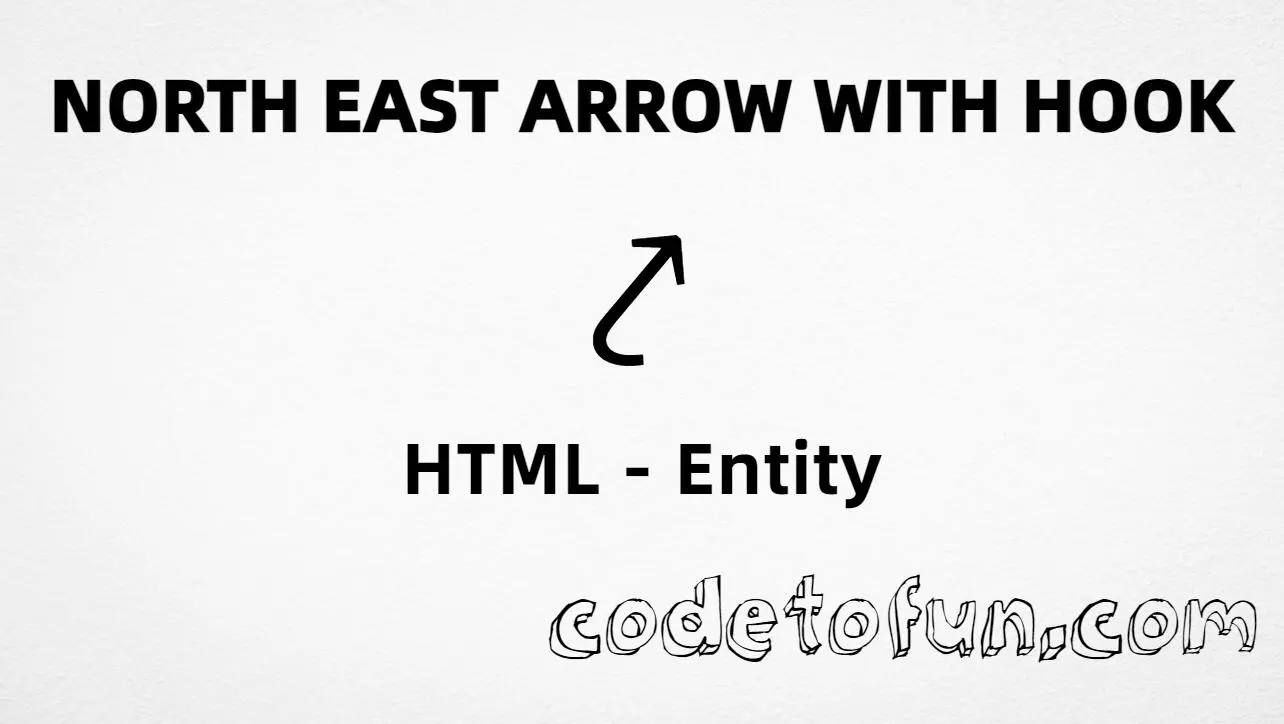
North east arrow hook (⤤) is the Supplemental Arrows-B character at Unicode U+2924 (NORTH EAST ARROW WITH HOOK). It is a diagonal up-right arrow with a hooked end — useful for maps and UI cues. HTML5 provides the named entity ⤤.
Remember
Character     ⤤
Unicode       U+2924
Named entity  ⤤
Hex entity    ⤤
Decimal       ⤤
CSS escape    \2924
All of these produce the same glyph: ⤤. Prefer ⤤ for readable HTML; paste ⤤ in UTF-8 when convenient.
Reference
Quick Reference
One table for every form you will actually use.
Form
Code
Where it goes
Named entity
⤤
HTML markup
Hex entity
⤤
HTML markup
Decimal entity
⤤
HTML markup
Direct character
⤤
HTML text (UTF-8 default)
CSS escape
\2924
Stylesheet content
When to Use Which
Situation
Use
Readable arrows in HTML
⤤
UTF-8 UI or map text
Type or paste ⤤
Numeric entity required
⤤ or ⤤
Generated text via ::before / ::after
content: "\2924"
Plain NE arrow (no hook)
↗ (↗)
See it
Live Preview
North east arrow hook rendered in common contexts.
Glyph⤤
Large glyph⤤
In a sentenceTurn ⤤ at the corner
With entitiesNamed: ⤤ | Hex: ⤤ | Decimal: ⤤
Related arrows↗ (↗) · ⤥ (⤥) · ⤨
Code
Complete HTML Example
One page that shows the north east arrow hook with named, hex, decimal, direct, and CSS forms. Use View Output or open the live editor.
Named + Hex + Decimal + Direct + CSS
Five ways to produce ⤤ in a single document.
html
<!DOCTYPE html>
<html lang="en">
<head>
<meta charset="UTF-8">
<title>North East Arrow Hook (⤤) in HTML</title>
<style>
#point::after {
content: "\2924";
}
</style>
</head>
<body>
<p>Using Named Entity: ⤤</p>
<p>Using Hex Code: ⤤</p>
<p>Using Decimal: ⤤</p>
<p>Using Direct Character: ⤤</p>
<p id="point">Using CSS Entity: </p>
<p>Example: Turn ⤤ at the corner</p>
</body>
</html>
Using Named Entity: ⤤
Using Hex Code: ⤤
Using Decimal: ⤤
Using Direct Character: ⤤
Using CSS Entity: ⤤
Example: Turn ⤤ at the corner
How It Works
1. Named:⤤ is the clearest HTML form for U+2924.
2. Hex:U+2924 → ⤤ in HTML. Reliable numeric form.
3. Decimal: same code point as 10532 → ⤤. Same glyph.
4. Direct: paste ⤤ in a UTF-8 file with <meta charset="UTF-8">.
5. CSS: use \2924 in content (not an HTML entity). #point::after appends that ⤤ after the paragraph text.
Pitfalls & Tips
Common mistakes when working with this arrow entity.
Hook vs plain
⤤ vs ↗
↗ is a plain NE arrow. ⤤ includes a hook — use the one that matches your design.
Font
Glyph coverage varies
Supplemental Arrows-B may be missing in some fonts. Provide a fallback or descriptive text if the box appears empty.
Accessibility
Do not rely on the glyph alone
If the arrow conveys action or direction, add visible or aria-label text so screen readers get the meaning.
CSS vs HTML
Do not mix escapes
\2924 belongs in CSS. ⤤ / ⤤ / ⤤ belong in HTML.
Semicolon
End references
Always finish with ; — write ⤤, not &nearhk.
UTF-8
Declare charset
If you paste ⤤ directly, serve the page as UTF-8 with <meta charset="UTF-8">.
Compatibility
Browser Support
North east arrow hook (U+2924) and its entity forms (⤤, ⤤, ⤤, CSS \\2924) are supported in all mainstream browsers. Glyph availability depends on the font.
✓ Universal support
North East Arrow Hook (⤤)
Prefer ⤤, or encode with hex, decimal, or CSS escape — same glyph everywhere (when the font has it).
100%Browser coverage
Google ChromeSupported
Yes
Microsoft EdgeSupported
Yes
Mozilla FirefoxSupported
Yes
Apple SafariSupported
Yes
OperaSupported
Yes
Internet ExplorerAll versions
Yes
U+2924 / entitiesFull support
Bottom line: Prefer ⤤ in HTML. Use ⤤ / ⤤ when a numeric form is required, and \\2924 only inside CSS content.
Remember
Key Takeaways
Unicode: north east arrow with hook is U+2924 (decimal 10532), Supplemental Arrows-B.
HTML: prefer ⤤, or ⤤ / ⤤.
CSS: use \2924 inside content for generated text.
Meaning: hooked NE arrow — not the same as plain ↗.
Use ⤤ (named), ⤤ (hex), ⤤ (decimal), type ⤤ in UTF-8, or the CSS escape \2924 in content. All render ⤤.
U+2924 (NORTH EAST ARROW WITH HOOK). Hex 2924, decimal 10532. It belongs to Supplemental Arrows-B and shows a north-east arrow with a hooked end.
Yes. HTML5 defines ⤤. You can also use ⤤ or ⤤.
Use it for maps, wayfinding, and UI where a hooked NE direction matters. Prefer ⤤ for readable source. For a plain NE arrow without a hook, use ↗ (U+2197).
HTML entities (⤤, ⤤, or ⤤) go in markup. The CSS escape \2924 is used in stylesheets (usually in the content property of ::before/::after). Both render ⤤.
↗ (U+2197, ↗) is a plain north-east arrow. U+2924 (⤤) adds a hook. They look similar at small sizes — pick the code point that matches your design.
🤔
Did you know?
North east arrow hook (⤤) is Unicode U+2924 (decimal 10532) — NORTH EAST ARROW WITH HOOK in Supplemental Arrows-B. HTML5 provides ⤤. Use it for hooked diagonal directions in maps and UI — distinct from the plain NE arrow ↗ (U+2197).