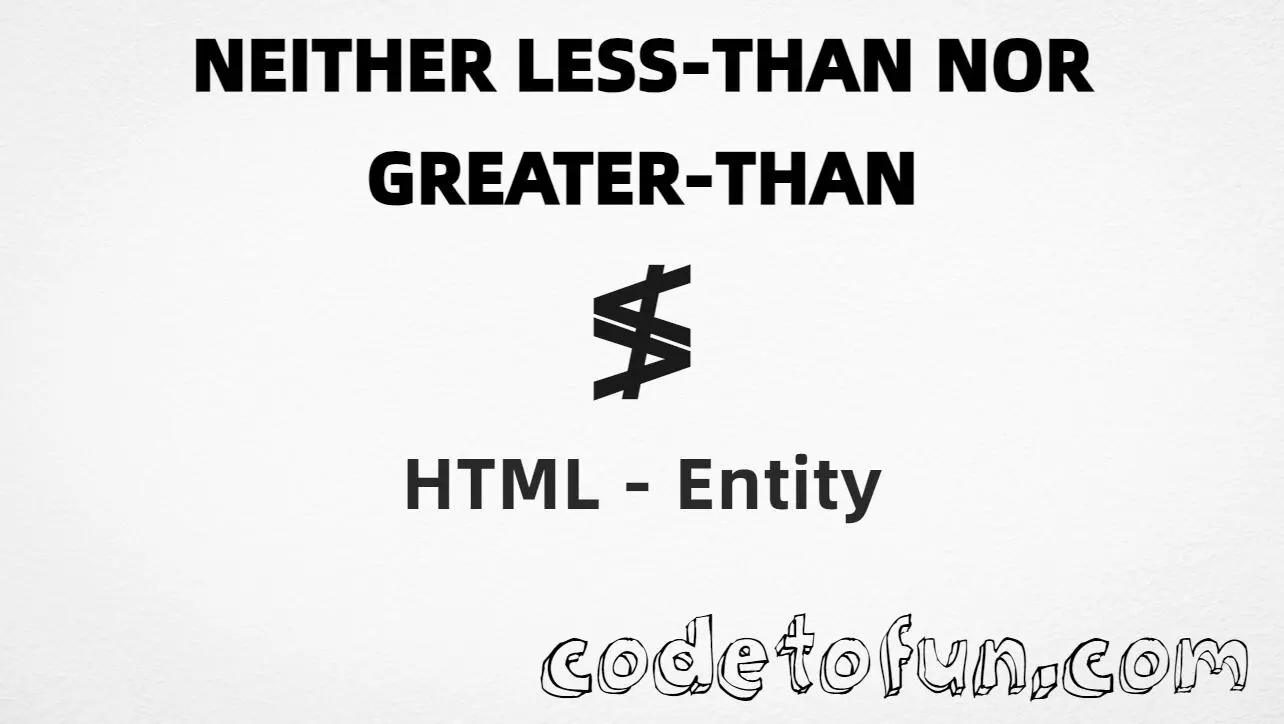
HTML Entity for Neither Less Than Nor Greater Than (≸)
Beginner
6 min read
Updated: Sep 2026
1 example
Unicode U+2278
Definition
What Is the Neither Less Than Nor Greater Than Entity?
Neither less than nor greater than (≸) is the Mathematical Operators character at Unicode U+2278 (NEITHER LESS-THAN NOR GREATER-THAN). It means A is not < B and not > B — the negation of ≶ (≶). HTML5 provides the named entity ≸.
Remember
Character     ≸
Unicode       U+2278
Named entity  ≸
Hex entity    ≸
Decimal       ≸
CSS escape    \2278
All of these produce the same glyph: ≸. Prefer ≸ for readable HTML; paste ≸ in UTF-8 when convenient.
Reference
Quick Reference
One table for every form you will actually use.
Form
Code
Where it goes
Named entity
≸
HTML markup
Hex entity
≸
HTML markup
Decimal entity
≸
HTML markup
Direct character
≸
HTML text (UTF-8 default)
CSS escape
\2278
Stylesheet content
When to Use Which
Situation
Use
Readable math in HTML
≸
UTF-8 math text
Type or paste ≸
Numeric entity required
≸ or ≸
Generated text via ::before / ::after
content: "\2278"
Positive relation (≶)
≶ (≶)
See it
Live Preview
Neither less than nor greater than rendered in common contexts.
Glyph≸
Large glyph≸
In a relationa ≸ b
With entitiesNamed: ≸ | Hex: ≸ | Decimal: ≸
Related symbols≶ (≶) · ≹ (≹) · ≠ (≠)
Code
Complete HTML Example
One page that shows neither less than nor greater than with named, hex, decimal, direct, and CSS forms. Use View Output or open the live editor.
Named + Hex + Decimal + Direct + CSS
Five ways to produce ≸ in a single document.
html
<!DOCTYPE html>
<html lang="en">
<head>
<meta charset="UTF-8">
<title>Neither Less Than Nor Greater Than (≸) in HTML</title>
<style>
#point::after {
content: "\2278";
}
</style>
</head>
<body>
<p>Using Named Entity: ≸</p>
<p>Using Hex Code: ≸</p>
<p>Using HTML Code: ≸</p>
<p>Using Direct Character: ≸</p>
<p id="point">Using CSS Entity: </p>
<p>Example: a ≸ b</p>
</body>
</html>
Using Named Entity: ≸
Using Hex Code: ≸
Using HTML Code: ≸
Using Direct Character: ≸
Using CSS Entity: ≸
Example: a ≸ b
How It Works
1. Named:≸ is the clearest HTML form for U+2278.
2. Hex:U+2278 → ≸ in HTML. Reliable numeric form.
3. Decimal: same code point as 8824 → ≸. Same glyph.
4. Direct: paste ≸ in a UTF-8 file with <meta charset="UTF-8">.
5. CSS: use \2278 in content (not an HTML entity). #point::after appends that ≸ after the paragraph text.
Pitfalls & Tips
Common mistakes when working with this order-relation entity.
Meaning
Negates ≶, not ≠
≸ is “notlg”. For general inequality use ≠ (≠). In total orders, A ≸ B often implies equality; in partial orders it can mean incomparable.
Sibling
≸ vs ≹
≹ is U+2279 (neither greater-than nor less-than) — a different character. Do not swap them.
CSS vs HTML
Do not mix escapes
\2278 belongs in CSS. ≸ / ≸ / ≸ belong in HTML.
Look-alikes
Not ≶, ≹, or ≠
≶ is lg; ≹ is ntgl; ≠ is not equal. Different symbols with different meanings.
Semicolon
End references
Always finish with ; — write ≸, not &ntlg.
UTF-8
Declare charset
If you paste ≸ directly, serve the page as UTF-8 with <meta charset="UTF-8">.
Compatibility
Browser Support
Neither less than nor greater than (U+2278) and its entity forms (≸, ≸, ≸, CSS \\2278) are supported in all mainstream browsers. Glyph availability depends on the font.
✓ Universal support
Neither Less Than Nor Greater Than (≸)
Prefer ≸, or encode with hex, decimal, or CSS escape — same glyph everywhere.
100%Browser coverage
Google ChromeSupported
Yes
Microsoft EdgeSupported
Yes
Mozilla FirefoxSupported
Yes
Apple SafariSupported
Yes
OperaSupported
Yes
Internet ExplorerAll versions
Yes
U+2278 / entitiesFull support
Bottom line: Prefer ≸ in HTML. Use ≸ / ≸ when a numeric form is required, and \\2278 only inside CSS content.
Remember
Key Takeaways
Unicode: notlg is U+2278 (decimal 8824), Mathematical Operators.
Use ≸ (named), ≸ (hex), ≸ (decimal), type ≸ in UTF-8, or the CSS escape \2278 in content. All render ≸.
U+2278 (NEITHER LESS-THAN NOR GREATER-THAN). Hex 2278, decimal 8824. It belongs to Mathematical Operators and is the negation of ≶ (less-than or greater-than).
Yes. HTML5 defines ≸ for this character. You can also use ≸ or ≸.
Use it in order theory or math when A is neither less than nor greater than B (A ≸ B). Prefer ≸ for readable source. For ordinary English, write the relation in words.
HTML entities (≸, ≸, or ≸) go in markup. The CSS escape \2278 is used in stylesheets (usually in the content property of ::before/::after). Both render ≸.
≶ (U+2276, ≶) means less-than or greater-than. ≹ (U+2279, ≹) is neither greater-than nor less-than. ≠ (U+2260, ≠) is not equal to. ≸ specifically negates ≶. Do not substitute one for another.
🤔
Did you know?
Neither less than nor greater than (≸) is Unicode U+2278 (decimal 8824) — NEITHER LESS-THAN NOR GREATER-THAN in Mathematical Operators. HTML5 provides ≸. It negates ≶ (≶, less-than or greater-than). Sibling ≹ (≹) is neither greater-than nor less-than.