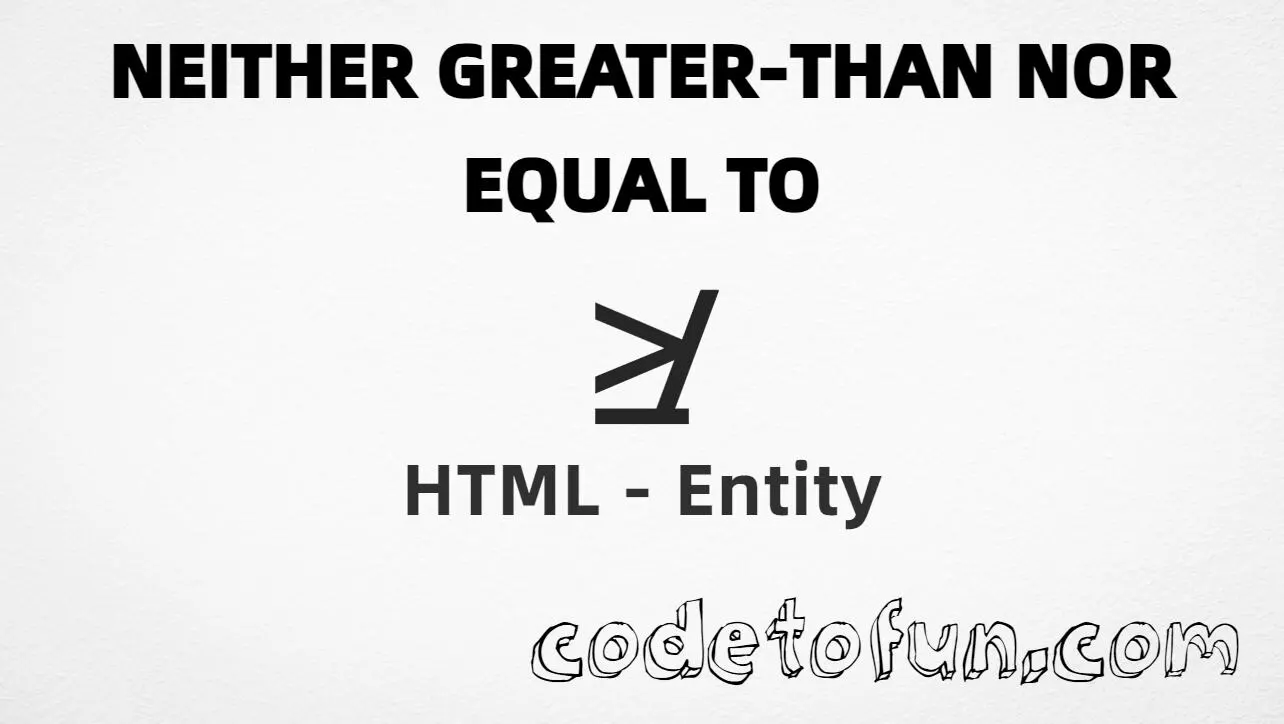
HTML Entity for Neither Greater Than Nor Equal To (≱)
Beginner
6 min read
Updated: Sep 2026
1 example
Unicode U+2271
Definition
What Is the Neither Greater Than Nor Equal To Entity?
Neither greater than nor equal to (≱) is the Mathematical Operators character at Unicode U+2271 (NEITHER GREATER-THAN NOR EQUAL TO). It means A is not ≥ B (so A < B) — the negation of ≥ (≥). HTML5 provides ≱ and ≱.
Remember
Character     ≱
Unicode       U+2271
Named entity  ≱  (also ≱)
Hex entity    ≱
Decimal       ≱
CSS escape    \2271
All of these produce the same glyph: ≱. Prefer ≱ for readable HTML; paste ≱ in UTF-8 when convenient.
Reference
Quick Reference
One table for every form you will actually use.
Form
Code
Where it goes
Named entity
≱
HTML markup (also ≱)
Hex entity
≱
HTML markup
Decimal entity
≱
HTML markup
Direct character
≱
HTML text (UTF-8 default)
CSS escape
\2271
Stylesheet content
When to Use Which
Situation
Use
Readable inequality in HTML
≱ or ≱
UTF-8 math text
Type or paste ≱
Numeric entity required
≱ or ≱
Generated text via ::before / ::after
content: "\2271"
Positive relation (≥)
≥ / ≥ (≥)
See it
Live Preview
Neither greater than nor equal to rendered in common contexts.
Glyph≱
Large glyph≱
In a relation3 ≱ 5
With entitiesNamed: ≱ | Hex: ≱ | Decimal: ≱
Related symbols≥ (≥) · ≰ (≰) · > (>)
Code
Complete HTML Example
One page that shows neither greater than nor equal to with named, hex, decimal, direct, and CSS forms. Use View Output or open the live editor.
Named + Hex + Decimal + Direct + CSS
Five ways to produce ≱ in a single document.
html
<!DOCTYPE html>
<html lang="en">
<head>
<meta charset="UTF-8">
<title>Neither Greater Than Nor Equal To (≱) in HTML</title>
<style>
#point::after {
content: "\2271";
}
</style>
</head>
<body>
<p>Using Named Entity: ≱</p>
<p>Using Hex Code: ≱</p>
<p>Using HTML Code: ≱</p>
<p>Using Direct Character: ≱</p>
<p id="point">Using CSS Entity: </p>
<p>Example: 3 ≱ 5</p>
</body>
</html>
Using Named Entity: ≱
Using Hex Code: ≱
Using HTML Code: ≱
Using Direct Character: ≱
Using CSS Entity: ≱
Example: 3 ≱ 5
How It Works
1. Named:≱ (or ≱) is the clearest HTML form for U+2271.
2. Hex:U+2271 → ≱ in HTML. Reliable numeric form.
3. Decimal: same code point as 8817 → ≱. Same glyph.
4. Direct: paste ≱ in a UTF-8 file with <meta charset="UTF-8">.
5. CSS: use \2271 in content (not an HTML entity). #point::after appends that ≱ after the paragraph text.
Pitfalls & Tips
Common mistakes when working with this inequality entity.
Meaning
Negates ≥, implies <
A ≱ B means A is not ≥ B, so A < B. For “not >” alone, use ≯ (≯).
Aliases
≱ = ≱
Both named forms map to U+2271. Pick one and stay consistent.
CSS vs HTML
Do not mix escapes
\2271 belongs in CSS. ≱ / ≱ / ≱ belong in HTML.
Look-alikes
Not ≥, ≰, or ≯
≥ is ge; ≰ is nle; ≯ is ngt. Different symbols with different meanings.
Semicolon
End references
Always finish with ; — write ≱, not &nge.
UTF-8
Declare charset
If you paste ≱ directly, serve the page as UTF-8 with <meta charset="UTF-8">.
Compatibility
Browser Support
Neither greater than nor equal to (U+2271) and its entity forms (≱, ≱, ≱, CSS \\2271) are supported in all mainstream browsers. Glyph availability depends on the font.
✓ Universal support
Neither Greater Than Nor Equal To (≱)
Prefer ≱, or encode with hex, decimal, or CSS escape — same glyph everywhere.
100%Browser coverage
Google ChromeSupported
Yes
Microsoft EdgeSupported
Yes
Mozilla FirefoxSupported
Yes
Apple SafariSupported
Yes
OperaSupported
Yes
Internet ExplorerAll versions
Yes
U+2271 / entitiesFull support
Bottom line: Prefer ≱ (or ≱) in HTML. Use ≱ / ≱ when a numeric form is required, and \\2271 only inside CSS content.
Remember
Key Takeaways
Unicode: notgeq is U+2271 (decimal 8817), Mathematical Operators.
HTML: prefer ≱ (alias ≱), or ≱ / ≱.
Use ≱ or ≱ (named), ≱ (hex), ≱ (decimal), type ≱ in UTF-8, or the CSS escape \2271 in content. All render ≱.
U+2271 (NEITHER GREATER-THAN NOR EQUAL TO). Hex 2271, decimal 8817. It belongs to Mathematical Operators and means “not ≥” in inequalities.
Yes. HTML5 defines ≱ and ≱ (aliases for the same character). You can also use ≱ or ≱.
Use it in math when A is neither greater than nor equal to B (A ≱ B), which means A < B. Prefer ≱ for readable source. For ordinary English, write the relation in words.
HTML entities (≱, ≱, or ≱) go in markup. The CSS escape \2271 is used in stylesheets (usually in the content property of ::before/::after). Both render ≱.
≥ (U+2265, ≥) means greater than or equal to. > is the greater-than sign. ≰ (U+2270, ≰) is neither less than nor equal to. ≱ specifically negates ≥. Do not substitute one for another.
🤔
Did you know?
Neither greater than nor equal to (≱) is Unicode U+2271 (decimal 8817) — NEITHER GREATER-THAN NOR EQUAL TO in Mathematical Operators. HTML5 provides ≱ and ≱ (same glyph). It negates ≥ / ≥ (≥). Pair with ≰ (≰) for the less-than side.