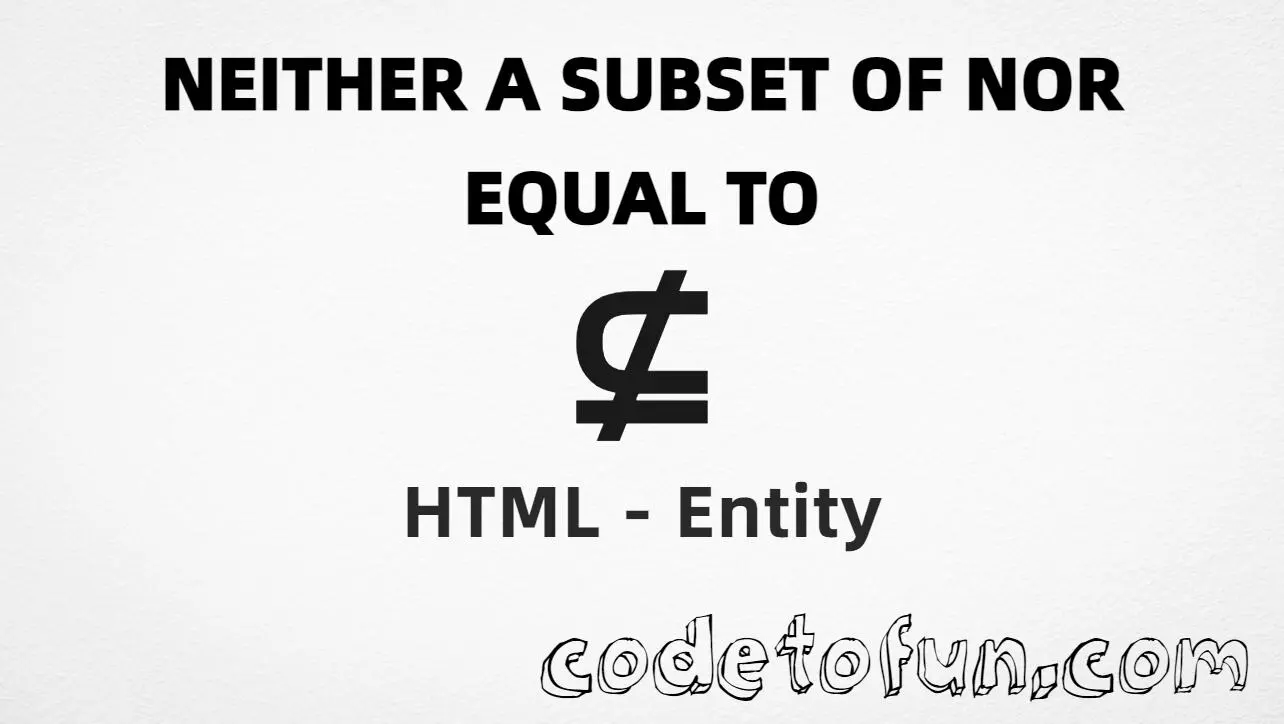
Neither a subset nor equal to (⊈) is the Mathematical Operators character at Unicode U+2288 (NEITHER A SUBSET OF NOR EQUAL TO). In set theory it means A is not a subset of B and not equal to B — the negation of ⊆ (⊆). HTML5 provides the named entities ⊈ and ⊈.
Remember
Character     ⊈
Unicode       U+2288
Named entity  ⊈  (also ⊈)
Hex entity    ⊈
Decimal       ⊈
CSS escape    \2288
All of these produce the same glyph: ⊈. Prefer ⊈ for readable HTML; paste ⊈ in UTF-8 when convenient.
Reference
Quick Reference
One table for every form you will actually use.
Form
Code
Where it goes
Named entity
⊈
HTML markup (also ⊈)
Hex entity
⊈
HTML markup
Decimal entity
⊈
HTML markup
Direct character
⊈
HTML text (UTF-8 default)
CSS escape
\2288
Stylesheet content
When to Use Which
Situation
Use
Readable math / set theory in HTML
⊈ or ⊈
UTF-8 math text
Type or paste ⊈
Numeric entity required
⊈ or ⊈
Generated text via ::before / ::after
content: "\2288"
Positive relation (subset or equal)
⊆ / ⊆ (⊆)
See it
Live Preview
Neither a subset nor equal to rendered in common contexts.
Glyph⊈
Large glyph⊈
In a relation{1, 3} ⊈ {1, 2}
With entitiesNamed: ⊈ | Hex: ⊈ | Decimal: ⊈
Related symbols⊆ (⊆) · ⊂ (⊂) · ⊄ (⊄)
Code
Complete HTML Example
One page that shows neither a subset nor equal to with named, hex, decimal, direct, and CSS forms. Use View Output or open the live editor.
Named + Hex + Decimal + Direct + CSS
Five ways to produce ⊈ in a single document.
html
<!DOCTYPE html>
<html lang="en">
<head>
<meta charset="UTF-8">
<title>Neither A Subset Nor Equal To (⊈) in HTML</title>
<style>
#point::after {
content: "\2288";
}
</style>
</head>
<body>
<p>Using Named Entity: ⊈</p>
<p>Using Hex Code: ⊈</p>
<p>Using HTML Code: ⊈</p>
<p>Using Direct Character: ⊈</p>
<p id="point">Using CSS Entity: </p>
<p>Example: {1, 3} ⊈ {1, 2}</p>
</body>
</html>
Using Named Entity: ⊈
Using Hex Code: ⊈
Using HTML Code: ⊈
Using Direct Character: ⊈
Using CSS Entity: ⊈
Example: {1, 3} ⊈ {1, 2}
How It Works
1. Named:⊈ (or ⊈) is the clearest HTML form for U+2288.
2. Hex:U+2288 → ⊈ in HTML. Reliable numeric form.
3. Decimal: same code point as 8840 → ⊈. Same glyph.
4. Direct: paste ⊈ in a UTF-8 file with <meta charset="UTF-8">.
5. CSS: use \2288 in content (not an HTML entity). #point::after appends that ⊈ after the paragraph text.
Pitfalls & Tips
Common mistakes when working with this set-theory entity.
Meaning
Negates ⊆, not ⊂
⊈ is “notsubseteq”. For “not a subset of” alone, use ⊄ (⊄).
Aliases
⊈ = ⊈
Both named forms map to U+2288. Pick one and stay consistent.
CSS vs HTML
Do not mix escapes
\2288 belongs in CSS. ⊈ / ⊈ / ⊈ belong in HTML.
Look-alikes
Not ⊆, ⊄, or ⊊
⊆ is subseteq; ⊄ is notsubset; ⊊ is subset with not equal. Different symbols.
Semicolon
End references
Always finish with ; — write ⊈, not &nsube.
UTF-8
Declare charset
If you paste ⊈ directly, serve the page as UTF-8 with <meta charset="UTF-8">.
Compatibility
Browser Support
Neither a subset nor equal to (U+2288) and its entity forms (⊈, ⊈, ⊈, CSS \\2288) are supported in all mainstream browsers. Glyph availability depends on the font.
✓ Universal support
Neither A Subset Nor Equal To (⊈)
Prefer ⊈, or encode with hex, decimal, or CSS escape — same glyph everywhere.
100%Browser coverage
Google ChromeSupported
Yes
Microsoft EdgeSupported
Yes
Mozilla FirefoxSupported
Yes
Apple SafariSupported
Yes
OperaSupported
Yes
Internet ExplorerAll versions
Yes
U+2288 / entitiesFull support
Bottom line: Prefer ⊈ (or ⊈) in HTML. Use ⊈ / ⊈ when a numeric form is required, and \\2288 only inside CSS content.
Remember
Key Takeaways
Unicode: neither subseteq is U+2288 (decimal 8840), Mathematical Operators.
HTML: prefer ⊈ (alias ⊈), or ⊈ / ⊈.
CSS: use \2288 inside content for generated text.
Meaning: set theory “notsubseteq” — not the same as ⊆, ⊄, or ⊊.
Use ⊈ or ⊈ (named), ⊈ (hex), ⊈ (decimal), type ⊈ in UTF-8, or the CSS escape \2288 in content. All render ⊈.
U+2288 (NEITHER A SUBSET OF NOR EQUAL TO). Hex 2288, decimal 8840. It belongs to Mathematical Operators and means “notsubseteq” in set theory.
Yes. HTML5 defines ⊈ and ⊈ (aliases for the same character). You can also use ⊈ or ⊈.
Use it in set theory or math when A is not a subset of B and not equal to B (A ⊈ B). Prefer ⊈ for readable source. For ordinary English text, write the relation in words.
HTML entities (⊈, ⊈, or ⊈) go in markup. The CSS escape \2288 is used in stylesheets (usually in the content property of ::before/::after). Both render ⊈.
⊆ (U+2286, ⊆) means subset or equal. ⊂ (U+2282, ⊂) means subset of. ⊄ (U+2284, ⊄) means not a subset of. ⊈ (U+2288) specifically negates ⊆. Do not substitute one for another.
🤔
Did you know?
Neither a subset nor equal to (⊈) is Unicode U+2288 (decimal 8840) — NEITHER A SUBSET OF NOR EQUAL TO in Mathematical Operators. HTML5 provides ⊈ and ⊈ (same glyph). It negates ⊆ / ⊆ (⊆). Use it in set theory when A is neither a subset of nor equal to B.