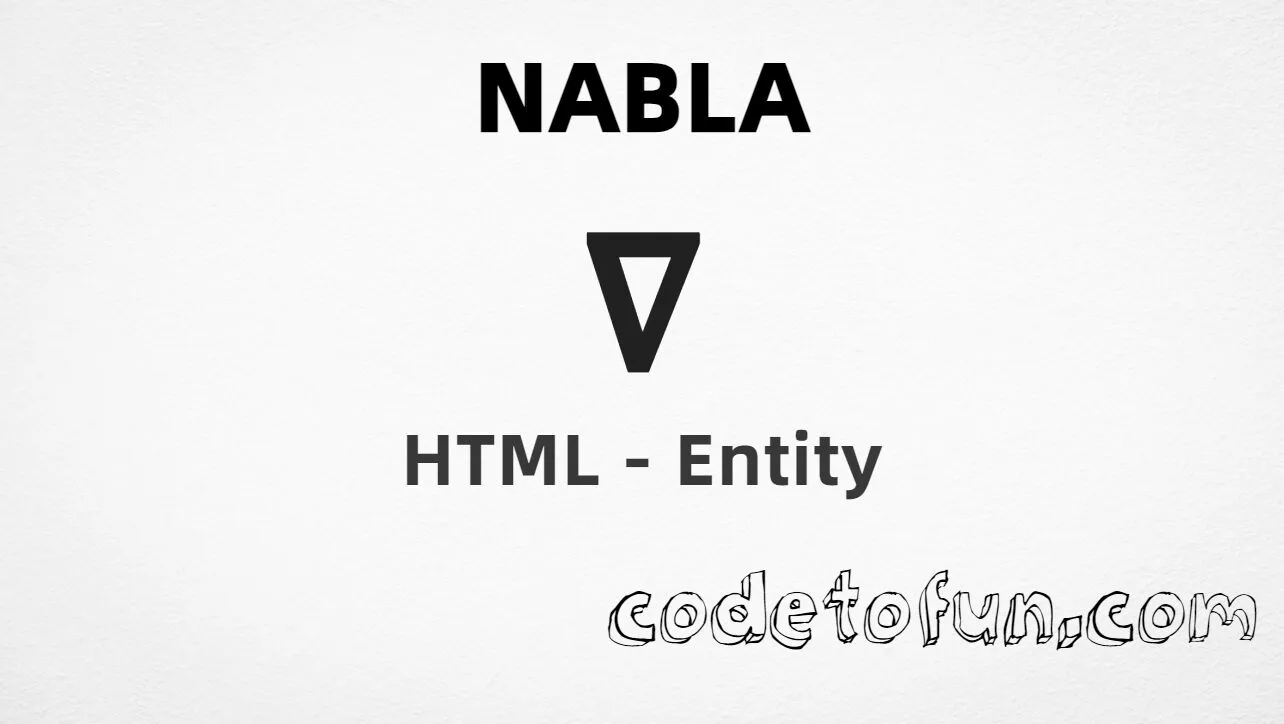
Nabla (∇) is the del operator at Unicode U+2207, used for gradient, divergence, curl, and Laplacian in vector calculus. HTML5 provides ∇. Example: ∇f for the gradient of f.
Remember
Character     ∇
Unicode       U+2207
Named entity  ∇
Hex entity    ∇
Decimal       ∇
CSS escape    \2207
Named, hex, decimal, CSS, and a typed character all produce the same glyph: ∇.
Reference
Quick Reference
One table for every form you will actually use.
Form
Code
Where it goes
Named entity
∇
HTML markup (preferred)
Direct character
∇
UTF-8 HTML text
Hex entity
∇
HTML markup
Decimal entity
∇
HTML markup
CSS escape
\2207
Stylesheet content
When to Use Which
Situation
Use
Gradient / divergence / curl
∇
Need an entity in HTML source
∇, ∇, or ∇
Generated text via ::before / ::after
content: "\2207"
Greek capital Delta (Δ)
Δ — not nabla
Partial derivative (∂)
∂ — not nabla
See it
Live Preview
Nabla alone, in common formulas, and beside lookalikes.
Example∇f | ∇·F | ∇×F
Large glyph∇
Named entity∇ → ∇
vs Δ / ∂ / ∑∇ | Δ | ∂ | ∑
With entitiesNamed: ∇ | Hex: ∇ | Decimal: ∇
Code
Complete HTML Example
One page that shows Nabla with named, hex, decimal, and CSS forms. Use View Output or open the live editor.
Using Named Entity: ∇
Using Hex Code: ∇
Using HTML Code: ∇
Using CSS Entity: ∇
Gradient: ∇f
How It Works
1. Named:∇ is the clearest HTML form and renders ∇.
2. Hex:U+2207 → ∇ in HTML. Same result as the named entity.
3. Decimal: same code point as 8711 → ∇. Same result as hex and named.
4. CSS: use \2207 in content (not an HTML entity). #point::after appends that ∇ after the paragraph text.
Pitfalls & Tips
Common mistakes when working with Nabla.
Prefer
Use ∇
The named form is clearer than numeric references and is defined in HTML5.
vs Δ
Not Greek Delta
Δ is Δ (U+0394). Nabla (∇) is the del operator, not the Greek letter.
vs ∂
Not partial
∂ is ∂ (U+2202). Use partial for ∂f/∂x; use nabla for ∇f.
CSS vs HTML
Do not mix escapes
\2207 belongs in CSS. ∇ / ∇ / ∇ belong in HTML.
Encoding
Declare UTF-8
If you type ∇ directly, keep <meta charset="UTF-8"> so the file is not misread.
Semicolon
End references
Always finish with ; — write ∇, not &nabla.
Compatibility
Browser Support
Nabla (U+2207) and its entity forms (∇, ∇, ∇, CSS \\2207) are supported in all mainstream browsers with a Unicode-capable font.
✓ Universal support
Nabla (∇)
Encode with named, hex, decimal, or CSS escape — or type ∇ directly in UTF-8 HTML.
100%Browser coverage
Google ChromeSupported
Yes
Microsoft EdgeSupported
Yes
Mozilla FirefoxSupported
Yes
Apple SafariSupported
Yes
OperaSupported
Yes
Internet ExplorerIE 9+
Yes*
U+2207 / ∇Full support
Bottom line: Prefer ∇ in math HTML. Use \\2207 only inside CSS content.
Remember
Key Takeaways
Unicode: Nabla is U+2207 (decimal 8711).
HTML: prefer ∇.
CSS: use \2207 inside content for generated text.
Lookalike: not Δ (Δ) or ∂ (∂).
One line:U+2207 → prefer ∇ (also ∇ / CSS \2207).
Frequently Asked Questions
Use ∇ (named), ∇ (hex), ∇ (decimal), or the CSS escape \2207 in the content property. All render ∇. Prefer ∇ in math HTML.
U+2207 (NABLA). Hex 2207, decimal 8711. It belongs to the Mathematical Operators block.
Yes. HTML5 defines ∇ for ∇.
Use it in vector calculus and physics when writing the del operator — for example ∇f (gradient), ∇·F (divergence), or ∇×F (curl).
HTML entities (∇, ∇, or ∇) go in markup. The CSS escape \2207 is used in stylesheets (usually in the content property of ::before/::after). Both render ∇.
No. Nabla is ∇ (∇, U+2207), the del operator. Greek Delta is Δ (Δ, U+0394). Partial differential is ∂ (∂, U+2202). Different symbols.
🤔
Did you know?
Nabla is Unicode U+2207 (decimal 8711) — in Mathematical Operators. HTML5 provides ∇. Also called del, it marks gradient (∇f), divergence (∇·F), curl (∇×F), and Laplacian (∇²). Related: Union ⋃ (⋃), Product ∏ (∏).