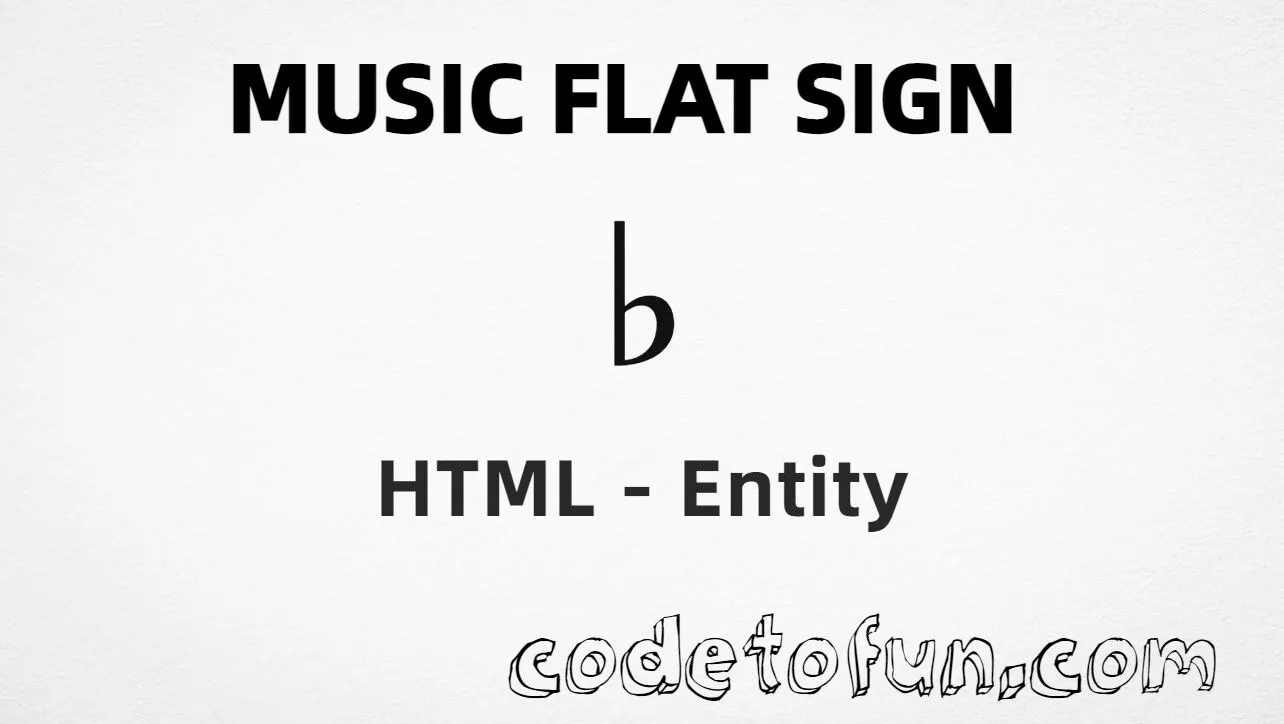
Using Named Entity: ♭
Using Hex Code: ♭
Using HTML Code: ♭
Using CSS Entity: ♭
Key: B♭ major
How It Works
1. Named:♭ is the clearest HTML form and renders ♭.
2. Hex:U+266D → ♭ in HTML. Same result as the named entity.
3. Decimal: same code point as 9837 → ♭. Same result as hex and named.
4. CSS: use \266D in content (not an HTML entity). #point::after appends that ♭ after the paragraph text.
Pitfalls & Tips
Common mistakes when working with the Music Flat Sign.
Prefer
Use ♭
The named form is clearer than numeric references and is defined in HTML5.
vs b
Not the letter b
Letter b is ASCII. Prefer ♭ for proper music accidentals in typography.
vs ♯
Not sharp
♯ raises pitch. ♭ lowers pitch. Do not swap them.
CSS vs HTML
Do not mix escapes
\266D belongs in CSS. ♭ / ♭ / ♭ belong in HTML.
Encoding
Declare UTF-8
If you type ♭ directly, keep <meta charset="UTF-8"> so the file is not misread.
Semicolon
End references
Always finish with ; — write ♭, not &flat.
Compatibility
Browser Support
Music Flat Sign (U+266D) and its entity forms (♭, ♭, ♭, CSS \\266D) are supported in all mainstream browsers with a Unicode-capable font.
✓ Universal support
Music Flat Sign (♭)
Encode with named, hex, decimal, or CSS escape — or type ♭ directly in UTF-8 HTML.
100%Browser coverage
Google ChromeSupported
Yes
Microsoft EdgeSupported
Yes
Mozilla FirefoxSupported
Yes
Apple SafariSupported
Yes
OperaSupported
Yes
Internet ExplorerIE 9+
Yes*
U+266D / ♭Full support
Bottom line: Prefer ♭ in music HTML. Use \\266D only inside CSS content.
Remember
Key Takeaways
Unicode: Music Flat Sign is U+266D (decimal 9837).
HTML: prefer ♭.
CSS: use \266D inside content for generated text.
Accidentals: pair with ♮ and ♯.
One line:U+266D → prefer ♭ (also ♭ / CSS \266D).
Frequently Asked Questions
Use ♭ (named), ♭ (hex), ♭ (decimal), or the CSS escape \266D in the content property. All render ♭. Prefer ♭ in music HTML.
U+266D (MUSIC FLAT SIGN). Hex 266D, decimal 9837. It belongs to the Miscellaneous Symbols block.
Yes. HTML5 defines ♭ for ♭.
Use it in chord charts, key names, sheet-music text, and music education — for example B♭ major or E♭.
HTML entities (♭, ♭, or ♭) go in markup. The CSS escape \266D is used in stylesheets (usually in the content property of ::before/::after). Both render ♭.
No. Flat is ♭ (♭, U+266D). Letter b is not a music accidental. Sharp is ♯ (♯, U+266F). Natural is ♮ (♮, U+266E).
🤔
Did you know?
Music Flat Sign is Unicode U+266D (decimal 9837) — in Miscellaneous Symbols. HTML5 provides ♭. It lowers a pitch by a semitone (e.g. B♭). Pair it with Natural ♮ (♮) and Sharp ♯ (♯).