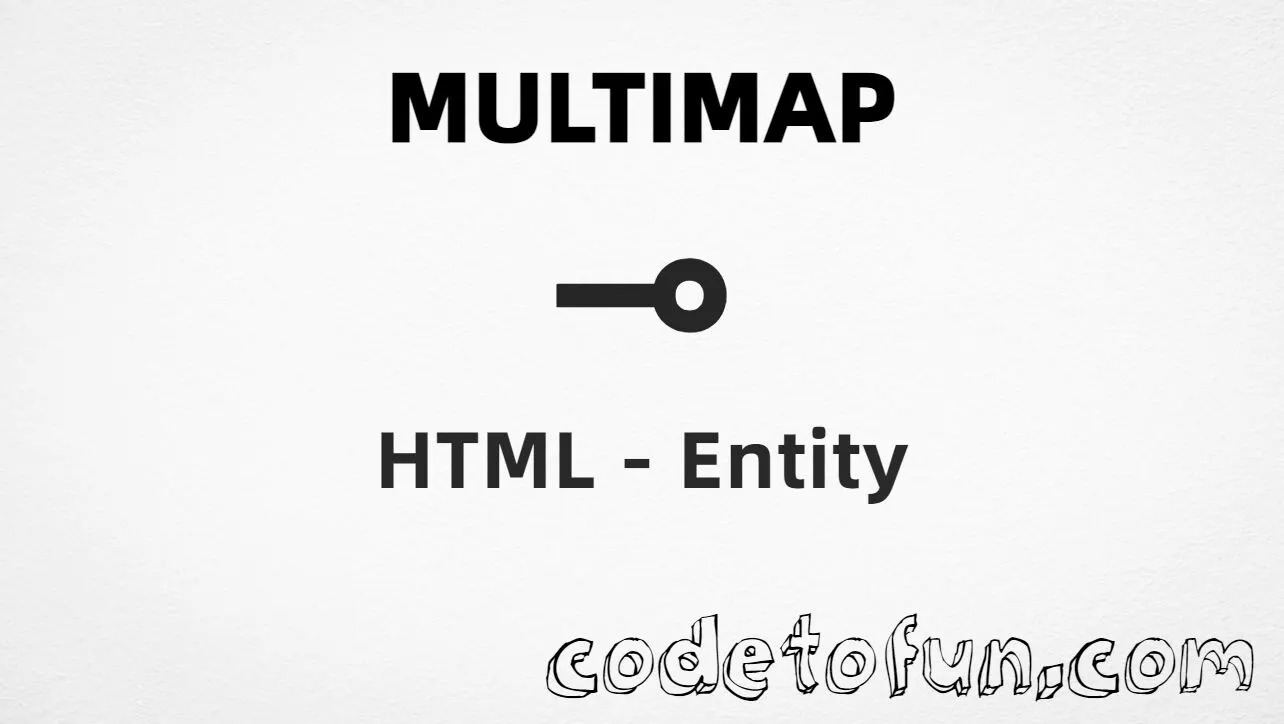
Multimap (⊸) is the mathematical multimap relation at Unicode U+22B8. HTML5 provides ⊸. In math, f : A ⊸ B denotes a multivalued map from A to B.
Remember
Character     ⊸
Unicode       U+22B8
Named entity  ⊸
Hex entity    ⊸
Decimal       ⊸
CSS escape    \22B8
Named, hex, decimal, CSS, and a typed character all produce the same glyph: ⊸.
Reference
Quick Reference
One table for every form you will actually use.
Form
Code
Where it goes
Named entity
⊸
HTML markup (preferred)
Direct character
⊸
UTF-8 HTML text
Hex entity
⊸
HTML markup
Decimal entity
⊸
HTML markup
CSS escape
\22B8
Stylesheet content
When to Use Which
Situation
Use
Multivalued map / relation notation
⊸
Need an entity in HTML source
⊸, ⊸, or ⊸
Generated text via ::before / ::after
content: "\22B8"
Single-valued maps-to (↦)
Use ↦ (U+21A6) — not this page
C++ / programming containers
Write code — do not use this math entity
See it
Live Preview
Multimap in a short relation and beside maps-to.
Examplef : A ⊸ B
Large glyph⊸
Named entity⊸ → ⊸
vs ↦⊸ | ↦
With entitiesNamed: ⊸ | Hex: ⊸ | Decimal: ⊸
Code
Complete HTML Example
One page that shows Multimap with named, hex, decimal, and CSS forms. Use View Output or open the live editor.
Using Named Entity: ⊸
Using Hex Code: ⊸
Using HTML Code: ⊸
Using CSS Entity: ⊸
Relation: f : A ⊸ B
How It Works
1. Named:⊸ is the clearest HTML form and renders ⊸.
2. Hex:U+22B8 → ⊸ in HTML. Same result as the named entity.
3. Decimal: same code point as 8888 → ⊸. Same result as hex and named.
4. CSS: use \22B8 in content (not an HTML entity). #point::after appends that ⊸ after the paragraph text.
Pitfalls & Tips
Common mistakes when working with Multimap.
Prefer
Use ⊸
The named form is clearer than numeric references and is defined in HTML5.
vs ↦
Not maps-to
↦ is ↦ (single-valued). ⊸ is ⊸ (multivalued). Related, not interchangeable.
Meaning
Math, not C++
This entity is a Unicode relation symbol — not std::multimap or any key-value container.
CSS vs HTML
Do not mix escapes
\22B8 belongs in CSS. ⊸ / ⊸ / ⊸ belong in HTML.
Encoding
Declare UTF-8
If you type ⊸ directly, keep <meta charset="UTF-8"> so the file is not misread.
Semicolon
End references
Always finish with ; — write ⊸, not &mumap.
Compatibility
Browser Support
Multimap (U+22B8) and its entity forms (⊸, ⊸, ⊸, CSS \\22B8) are supported in all mainstream browsers with a Unicode-capable font.
✓ Universal support
Multimap (⊸)
Encode with named, hex, decimal, or CSS escape — or type ⊸ directly in UTF-8 HTML.
100%Browser coverage
Google ChromeSupported
Yes
Microsoft EdgeSupported
Yes
Mozilla FirefoxSupported
Yes
Apple SafariSupported
Yes
OperaSupported
Yes
Internet ExplorerIE 9+
Yes*
U+22B8 / ⊸Full support
Bottom line: Prefer ⊸ in mathematical HTML. Use \\22B8 only inside CSS content.
Remember
Key Takeaways
Unicode: Multimap is U+22B8 (decimal 8888).
HTML: prefer ⊸.
CSS: use \22B8 inside content for generated text.
Lookalikes: not ↦ (↦) and not a programming container.
One line:U+22B8 → prefer ⊸ (also ⊸ / CSS \22B8).
Frequently Asked Questions
Use ⊸ (named), ⊸ (hex), ⊸ (decimal), or the CSS escape \22B8 in the content property. All render ⊸. Prefer ⊸ in mathematical HTML.
U+22B8 (MULTIMAP). Hex 22B8, decimal 8888. It belongs to the Mathematical Operators block.
Yes. HTML5 defines ⊸ for ⊸.
Use it in mathematics and set theory for multivalued maps or relations — for example f : A ⊸ B.
HTML entities (⊸, ⊸, or ⊸) go in markup. The CSS escape \22B8 is used in stylesheets (usually in the content property of ::before/::after). Both render ⊸.
Only by name. U+22B8 is a Unicode math relation symbol. It does not implement or represent a programming container.
🤔
Did you know?
Multimap is Unicode U+22B8 (decimal 8888) — MULTIMAP in Mathematical Operators. HTML5 provides ⊸. It denotes a multivalued map or relation (e.g. f : A ⊸ B). It is a math symbol — not C++ std::multimap — and not the same as maps-to ↦ (↦).