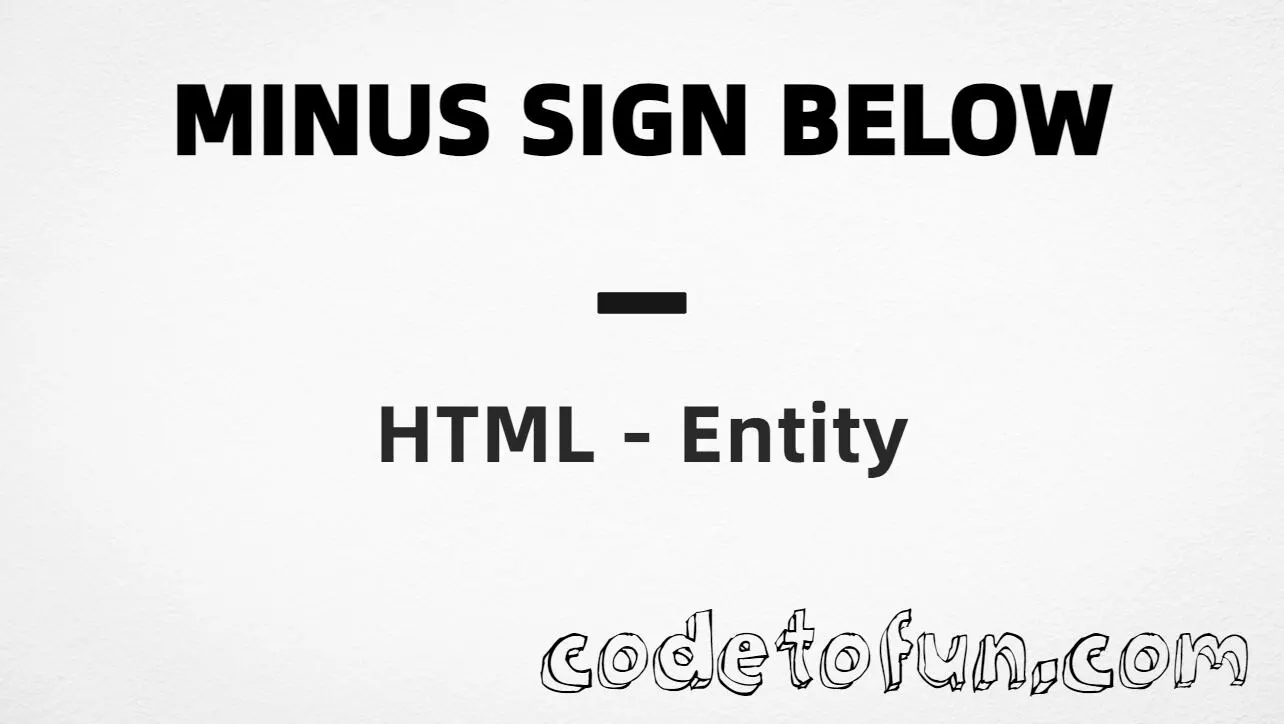
Combining minus sign below is Unicode U+0320 (COMBINING MINUS SIGN BELOW. It is a non-spacing mark placed immediately after a base letter to add a short minus-like bar under it — often in phonetics and linguistics.
Remember
Character     ◌̠ (under base letter)
Unicode       U+0320
Hex entity    ̠
Decimal       ̠
CSS escape    \0320
Named entity  (none)
Hex, decimal, and CSS all produce the same combining mark. Write it right after the base letter (a̠ → a̠).
Using Hex Code: x̠
Using HTML Code: a̠
z̠ (CSS mark on z)
Compare: math − vs diacritic a̠
How It Works
1. Hex:U+0320 → ̠ right after x. The browser combines them into x̠.
2. Decimal: same code point as 800 → ̠ after a. Same combining mark.
3. CSS: use \0320 in content (not an HTML entity). #point::after appends the mark after z, producing z̠.
4. Compare:− is a spacing math operator; ̠ is a diacritic under a letter.
Pitfalls & Tips
Common mistakes when working with combining minus sign below.
Order
Base letter first
Write a̠, not ̠a. The mark attaches to the preceding character.
Named?
No named entity
HTML5 does not define a named entity for U+0320. Use numeric forms.
vs −
Not mathematical minus
Use − for equations. This character is only a combining diacritic.
Underline
Not for UI underlines
Use CSS text-decoration for UI underlines — not combining diacritics.
CSS vs HTML
Do not mix escapes
\0320 belongs in CSS. ̠ / ̠ belong in HTML.
Semicolon
End references
Always finish with ; — write ̠, not ̠.
Compatibility
Browser Support
Combining minus sign below (U+0320) and its numeric entity forms (̠, ̠, CSS \\0320) are supported in all mainstream browsers with Unicode combining-mark support.
✓ Universal support
Minus Sign Below (U+0320)
Encode with hex, decimal, or CSS escape — place after the base letter for the same combining mark under the glyph.
100%Browser coverage
Google ChromeSupported
Yes
Microsoft EdgeSupported
Yes
Mozilla FirefoxSupported
Yes
Apple SafariSupported
Yes
OperaSupported
Yes
Internet ExplorerIE 9+
Yes*
U+0320 / entitiesFull support
Bottom line: Use ̠ or ̠ after a base letter when you need the mark below. Use \\0320 only inside CSS content. Prefer CSS underline for UI decoration.
Remember
Key Takeaways
Unicode: combining minus sign below is U+0320 (decimal 800).
HTML: use ̠ or ̠ immediately after the base letter.
CSS: use \0320 inside content for generated text.
Do not confuse: math uses −; this mark is a diacritic only.
One line:U+0320 → place ̠ / ̠ / CSS \0320 after the base letter.
Frequently Asked Questions
Use ̠ (hex), ̠ (decimal), or the CSS escape \0320 in the content property. Place the entity immediately after the base letter (e.g. a̠). There is no named HTML entity for U+0320.
U+0320 (COMBINING MINUS SIGN BELOW). Hex 0320, decimal 800. It belongs to the Combining Diacritical Marks block.
No. U+0320 has no named HTML entity. Use numeric references like ̠ or ̠.
Use it in phonetics, linguistics, and specialized notation when a short minus-like bar under a letter is required — not as a substitute for CSS underline or mathematical minus.
HTML entities (̠ or ̠) go in markup after the base character. The CSS escape \0320 is used in stylesheets (usually in the content property of ::before/::after). Both render the same combining mark.
No. − is the spacing math minus (−, U+2212). Macron below is U+0331. This mark is U+0320, a combining diacritic under a letter.
🤔
Did you know?
Combining minus sign below is Unicode U+0320 (decimal 800) — in Combining Diacritical Marks. HTML5 has no named entity for it — use ̠ or ̠ right after a base letter. Not the same as mathematical minus − (−) or macron below (U+0331).