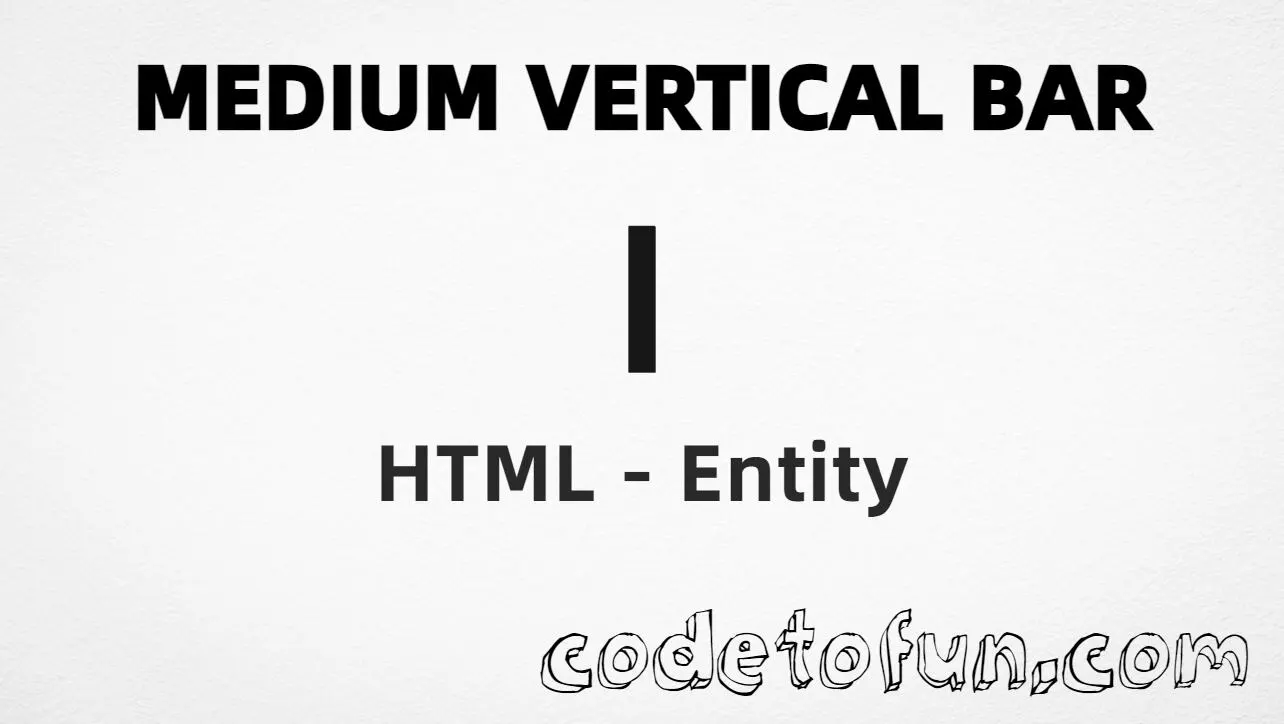
Medium vertical bar (❙) is the Dingbats character at Unicode U+2759. It is a decorative vertical separator used in breadcrumbs, nav labels, and typography — not the ASCII pipe | used in code.
Remember
Character     ❙
Unicode       U+2759
Hex entity    ❙
Decimal       ❙
CSS escape    \2759
Named entity  (none)
Not           ASCII | (U+007C)
Hex, decimal, CSS, and a typed character all produce the same glyph: ❙.
Reference
Quick Reference
One table for every form you will actually use.
Form
Code
Where it goes
Direct character
❙
UTF-8 HTML text (default choice)
Hex entity
❙
HTML markup
Decimal entity
❙
HTML markup
CSS escape
\2759
Stylesheet content
Named entity
—
Not defined in HTML5
When to Use Which
Situation
Use
Breadcrumbs and nav dividers
Type ❙ (UTF-8) or ❙
Need an entity in HTML source
❙ or ❙
Generated text via ::before / ::after
content: "\2759"
Code, shell, CSV, or data pipes
Use ASCII | — not this dingbat
Math / logic OR in monospace
Prefer ASCII | for clarity
See it
Live Preview
Medium vertical bar as a decorative separator.
BreadcrumbHome ❙ Docs ❙ API
Large glyph❙
vs ASCII |❙ | |
Label rowDesign ❙ Code ❙ Ship
With entitiesHex: ❙ | Decimal: ❙
Code
Complete HTML Example
One page that shows this bar with hex, decimal, CSS, and a typed character. Use View Output or open the live editor.
Using Hex Code: ❙
Using HTML Code: ❙
Using CSS Entity: ❙
Separator: Home ❙ Docs ❙ API
How It Works
1. Hex:U+2759 → ❙ in HTML. The browser turns it into ❙.
2. Decimal: same code point as 10073 → ❙. Same result as hex.
3. CSS: use \2759 in content (not an HTML entity). #point::after appends that ❙ after the paragraph text.
4. Separator: place ❙ between labels to create a decorative breadcrumb or nav divider.
Pitfalls & Tips
Common mistakes when working with this vertical bar.
Named?
No named entity
HTML5 does not define a named entity for U+2759. Use numeric forms.
Not |
Not ASCII pipe
Use | for code, shell pipes, and data. Use ❙ only for decorative UI separators.
A11y
Mark decorative separators
If the bar is purely visual in a nav, wrap it with aria-hidden="true" so screen readers skip it.
CSS vs HTML
Do not mix escapes
\2759 belongs in CSS. ❙ / ❙ belong in HTML.
Encoding
Declare UTF-8
If you type ❙ directly, keep <meta charset="UTF-8"> so the file is not misread.
Semicolon
End references
Always finish with ; — write ❙, not ❙.
Compatibility
Browser Support
Medium vertical bar (U+2759) and its numeric entity forms (❙, ❙, CSS \\2759) are supported in all mainstream browsers with a Unicode-capable font.
✓ Universal support
Medium Vertical Bar (❙)
Type ❙, or encode with hex, decimal, or CSS escape — same glyph everywhere fonts support it.
100%Browser coverage
Google ChromeSupported
Yes
Microsoft EdgeSupported
Yes
Mozilla FirefoxSupported
Yes
Apple SafariSupported
Yes
OperaSupported
Yes
Internet ExplorerIE 9+
Yes*
U+2759 / entitiesFull support
Bottom line: Type ❙ for normal UTF-8 text. Prefer ❙ or ❙ when encoding must be explicit, and \\2759 only inside CSS content.
Remember
Key Takeaways
Unicode: this bar is U+2759 (decimal 10073).
HTML: use ❙ or ❙ when you need an entity.
CSS: use \2759 inside content for generated text.
Use case: decorative separators — not ASCII |.
One line:U+2759 → type ❙, or encode as ❙ / ❙ / CSS \2759.
Frequently Asked Questions
Use ❙ (hex), ❙ (decimal), or the CSS escape \2759 in the content property. All render ❙. There is no named HTML entity for U+2759.
U+2759 (MEDIUM VERTICAL BAR). Hex 2759, decimal 10073. It belongs to the Dingbats block.
No. U+2759 has no named HTML entity. Use numeric references like ❙ or ❙.
Use it for decorative separators, breadcrumbs, nav dividers, and typography accents — not as a substitute for the ASCII pipe | in code or data.
HTML entities (❙ or ❙) go in markup. The CSS escape \2759 is used in stylesheets (usually in the content property of ::before/::after). Both render ❙.
No. The ASCII pipe is U+007C (|). Medium vertical bar is U+2759 (❙), a thicker decorative Dingbat separator.
🤔
Did you know?
Medium vertical bar is Unicode U+2759 (decimal 10073) — in Dingbats. HTML5 has no named entity for it — use ❙ or ❙. It is a decorative separator, not the ASCII pipe | used in code, tables, or shell commands.