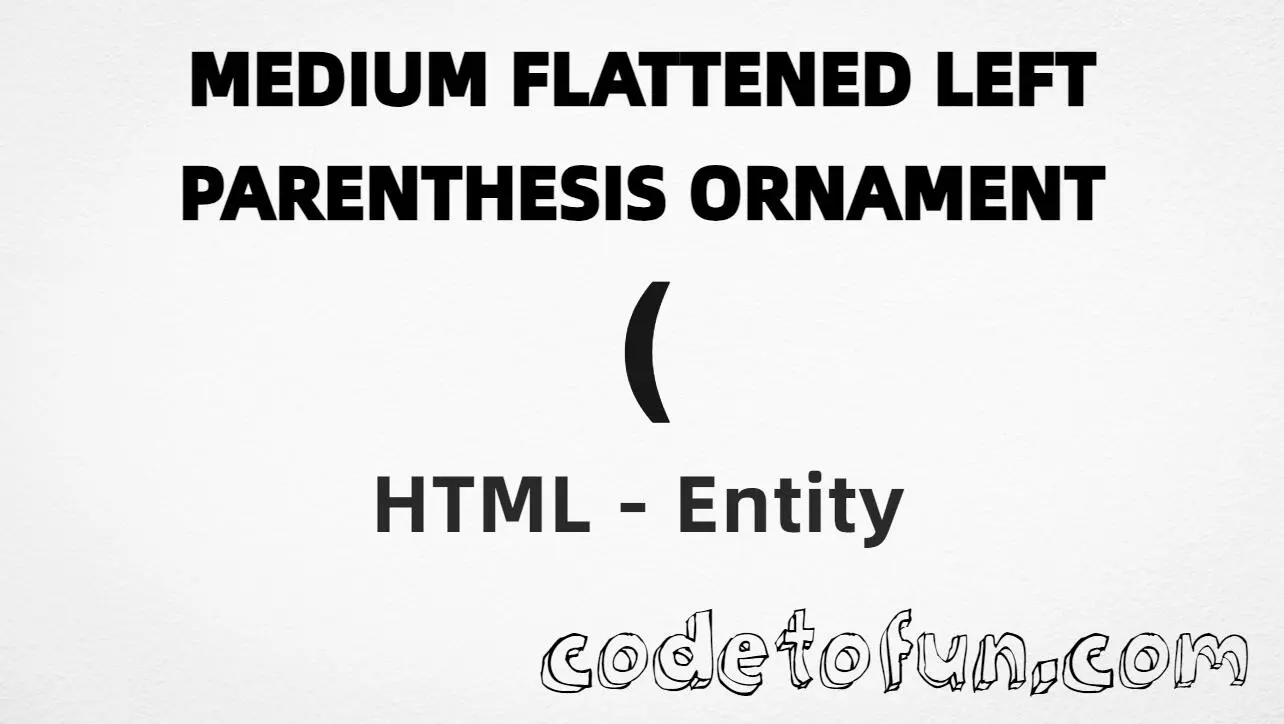
HTML Entity for Medium Flattened Left Parenthesis Ornament (❪)
Beginner
5 min read
Updated: Sep 2026
1 example
Unicode U+276A
Definition
What Is the Medium Flattened Left Parenthesis Ornament Entity?
Medium flattened left parenthesis ornament (❪) is the Dingbats character at Unicode U+276A. It is a decorative left parenthesis used for typography and design accents — not the ASCII ( used in code.
Remember
Character     ❪
Unicode       U+276A
Hex entity    ❪
Decimal       ❪
CSS escape    \276A
Named entity  (none)
Pair          U+276B (❫)
Hex, decimal, CSS, and a typed character all produce the same glyph: ❪. Pair it with ❫ for a matching right ornament.
Using Hex Code: ❪
Using HTML Code: ❪
Using CSS Entity: ❪
Paired: ❪ Featured text ❫
How It Works
1. Hex:U+276A → ❪ in HTML. The browser turns it into ❪.
2. Decimal: same code point as 10090 → ❪. Same result as hex.
3. CSS: use \276A in content (not an HTML entity). #point::after appends that ❪ after the paragraph text.
4. Pairing: ❪ opens the ornament; ❫ (U+276B) closes it for a decorative frame.
Pitfalls & Tips
Common mistakes when working with this parenthesis ornament.
Named?
No named entity
HTML5 does not define a named entity for U+276A. Use numeric forms.
Not code
Not ASCII (
Use this dingbat for decoration only. Programming and math grouping still use (.
Pair
Match with U+276B
Close decorative frames with the right ornament ❫ so the pair looks intentional.
CSS vs HTML
Do not mix escapes
\276A belongs in CSS. ❪ / ❪ belong in HTML.
Encoding
Declare UTF-8
If you type ❪ directly, keep <meta charset="UTF-8"> so the file is not misread.
Semicolon
End references
Always finish with ; — write ❪, not ❪.
Compatibility
Browser Support
Medium flattened left parenthesis ornament (U+276A) and its numeric entity forms (❪, ❪, CSS \\276A) are supported in all mainstream browsers with a Unicode-capable font.
✓ Universal support
Left Parenthesis Ornament (❪)
Type ❪, or encode with hex, decimal, or CSS escape — same glyph everywhere fonts support it.
100%Browser coverage
Google ChromeSupported
Yes
Microsoft EdgeSupported
Yes
Mozilla FirefoxSupported
Yes
Apple SafariSupported
Yes
OperaSupported
Yes
Internet ExplorerIE 9+
Yes*
U+276A / entitiesFull support
Bottom line: Type ❪ for normal UTF-8 text. Prefer ❪ or ❪ when encoding must be explicit, and \\276A only inside CSS content.
Remember
Key Takeaways
Unicode: this ornament is U+276A (decimal 10090).
HTML: use ❪ or ❪ when you need an entity.
CSS: use \276A inside content for generated text.
Pair: close with U+276B (❫); do not use this as ASCII (.
One line:U+276A → type ❪, or encode as ❪ / ❪ / CSS \276A.
Frequently Asked Questions
Use ❪ (hex), ❪ (decimal), or the CSS escape \276A in the content property. All render ❪. There is no named HTML entity for U+276A.
U+276A (MEDIUM FLATTENED LEFT PARENTHESIS ORNAMENT). Hex 276A, decimal 10090. It belongs to the Dingbats block.
No. U+276A has no named HTML entity. Use numeric references like ❪ or ❪.
Use it for decorative typography, callouts, publishing accents, and design framing — not as a substitute for the ASCII left parenthesis ( in code.
HTML entities (❪ or ❪) go in markup. The CSS escape \276A is used in stylesheets (usually in the content property of ::before/::after). Both render ❪.
The matching right ornament is U+276B (❫). Use ❪ text ❫ for a decorative pair.
🤔
Did you know?
Medium flattened left parenthesis ornament is Unicode U+276A (decimal 10090) — in Dingbats. HTML5 has no named entity for it — use ❪ or ❪. Pair with the right ornament U+276B (❫). Not a programming parenthesis (().