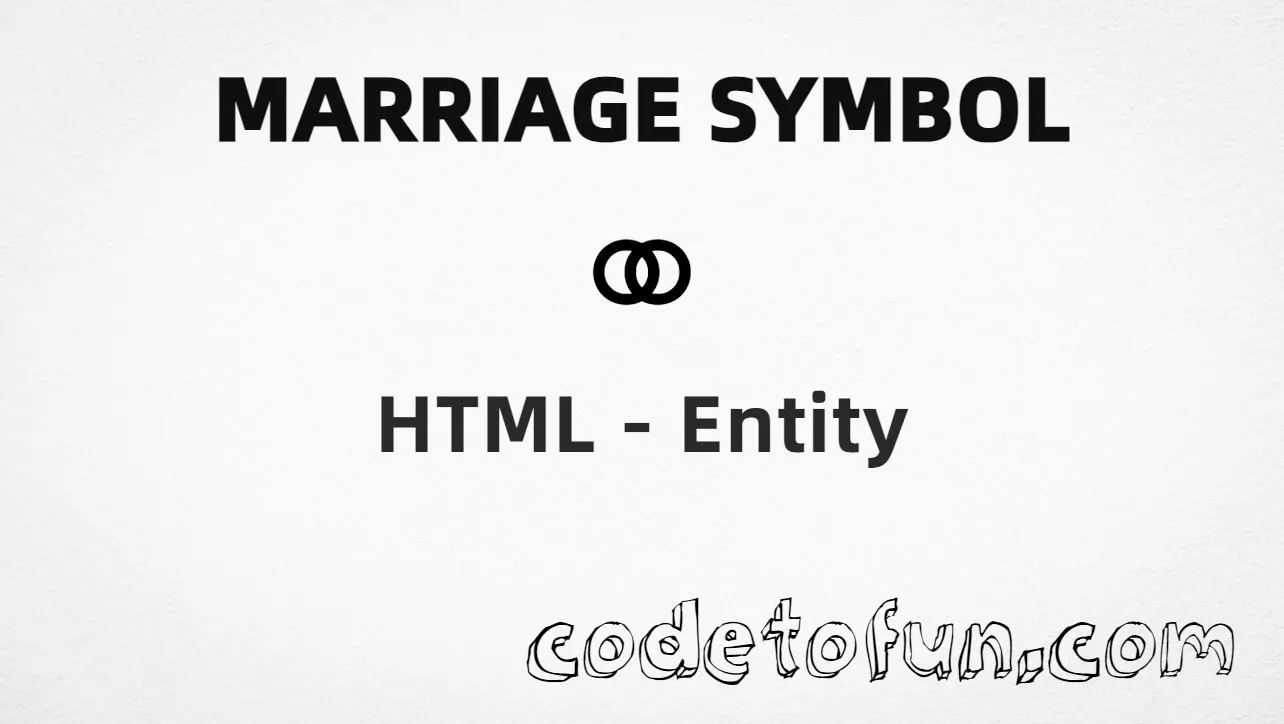
Marriage symbol (⚭) is the Miscellaneous Symbols character at Unicode U+26AD (MARRIAGE SYMBOL). It is used mainly in genealogy charts and wedding notation — not a decorative heart.
Remember
Character     ⚭
Unicode       U+26AD
Hex entity    ⚭
Decimal       ⚭
CSS escape    \26AD
Named entity  (none)
Hex, decimal, CSS, and a typed character all produce the same glyph: ⚭. Prefer typing ⚭ in UTF-8 HTML when you can; use entities when encoding must be explicit.
Reference
Quick Reference
One table for every form you will actually use.
Form
Code
Where it goes
Direct character
⚭
UTF-8 HTML text (default choice)
Hex entity
⚭
HTML markup
Decimal entity
⚭
HTML markup
CSS escape
\26AD
Stylesheet content
Named entity
—
Not defined in HTML5
When to Use Which
Situation
Use
Genealogy or wedding notation
Type ⚭ (UTF-8)
Need an entity in HTML source
⚭ or ⚭
Generated text via ::before / ::after
content: "\26AD"
Decorative heart instead
♥ (♥) — different character
Looking for &marriage;
Does not exist — use numeric form
See it
Live Preview
Marriage symbol rendered in common study contexts.
GenealogyJohn ⚭ Mary
Large glyph⚭
vs ♥ / ∞⚭ | ♥ | ∞
With dateAlex ⚭ Sam · 2019
With entitiesHex: ⚭ | Decimal: ⚭
Code
Complete HTML Example
One page that shows the marriage symbol with hex, decimal, CSS, and a typed character. Use View Output or open the live editor.
Using Hex Code: ⚭
Using HTML Code: ⚭
Using CSS Entity: ⚭
Genealogy: John ⚭ Mary
How It Works
1. Hex:U+26AD → ⚭ in HTML. The browser turns it into ⚭.
2. Decimal: same code point as 9901 → ⚭. Same result as hex.
3. CSS: use \26AD in content (not an HTML entity). #point::after appends that ⚭ after the paragraph text.
4. Typed ⚭: best for normal UTF-8 text, such as genealogy lines.
Pitfalls & Tips
Common mistakes when working with the marriage symbol.
Named?
No named entity
HTML5 does not define a named entity for U+26AD. Use numeric forms.
Look-alikes
Not a heart
♥ (♥) and ∞ (∞) are different characters. Marriage is only U+26AD.
A11y
Provide text context
Screen readers may not name the glyph clearly — add a visible word like “married” when meaning matters.
CSS vs HTML
Do not mix escapes
\26AD belongs in CSS. ⚭ / ⚭ belong in HTML.
Encoding
Declare UTF-8
If you type ⚭ directly, keep <meta charset="UTF-8"> so the file is not misread.
Semicolon
End references
Always finish with ; — write ⚭, not ⚭.
Compatibility
Browser Support
Marriage symbol (U+26AD) and its numeric entity forms (⚭, ⚭, CSS \\26AD) are supported in all mainstream browsers with a Unicode-capable font.
✓ Universal support
Marriage Symbol (⚭)
Type ⚭, or encode with hex, decimal, or CSS escape — same glyph everywhere fonts support it.
100%Browser coverage
Google ChromeSupported
Yes
Microsoft EdgeSupported
Yes
Mozilla FirefoxSupported
Yes
Apple SafariSupported
Yes
OperaSupported
Yes
Internet ExplorerIE 9+
Yes*
U+26AD / entitiesFull support
Bottom line: Type ⚭ for normal UTF-8 text. Prefer ⚭ or ⚭ when encoding must be explicit, and \\26AD only inside CSS content.
Remember
Key Takeaways
Unicode: marriage symbol is U+26AD (decimal 9901).
HTML: use ⚭ or ⚭ when you need an entity.
One line:U+26AD → type ⚭, or encode as ⚭ / ⚭ / CSS \26AD.
Frequently Asked Questions
Use ⚭ (hex), ⚭ (decimal), or the CSS escape \26AD in the content property. All render ⚭. There is no named HTML entity for U+26AD.
U+26AD (MARRIAGE SYMBOL). Hex 26AD, decimal 9901. It belongs to the Miscellaneous Symbols block.
No. U+26AD has no named HTML entity. Use numeric references like ⚭ or ⚭.
Use it in genealogy charts, wedding notation, and symbol references that need ⚭ between names or dates.
HTML entities (⚭ or ⚭) go in markup. The CSS escape \26AD is used in stylesheets (usually in the content property of ::before/::after). Both render ⚭.
No. Heart is ♥ (♥). Infinity is ∞ (∞). Marriage symbol ⚭ (U+26AD) is a different character used mainly in genealogy.
🤔
Did you know?
Marriage symbol is Unicode U+26AD (decimal 9901) — MARRIAGE SYMBOL in Miscellaneous Symbols. HTML5 has no named entity for it — use ⚭ or ⚭. It is used in genealogy charts — not a heart (♥) or infinity (∞) symbol.