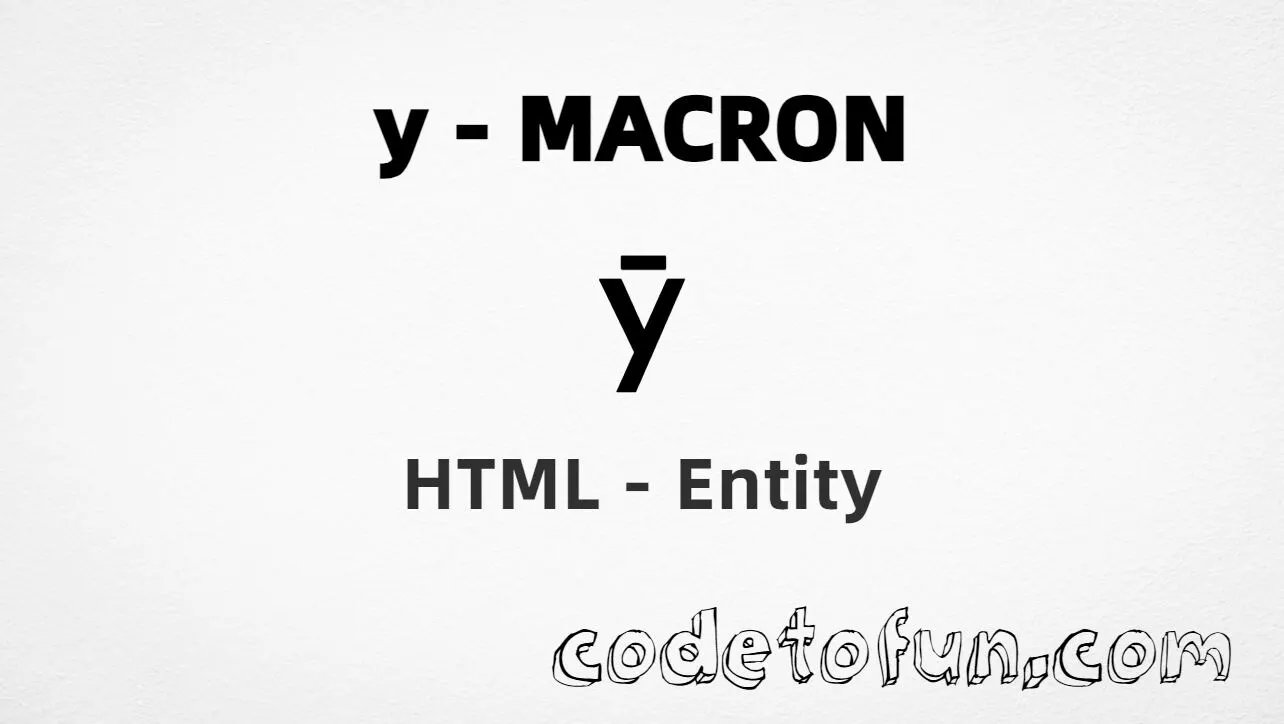
Lowercase y macron (&ymacr;) is the Latin Extended-B character at Unicode U+0233 (LATIN SMALL LETTER Y WITH MACRON). It is the letter y with a macron (¯) above — typically marking a long vowel in linguistic and academic notation.
Remember
Character     &ymacr;
Unicode       U+0233
Named entity  &ymacr;
Hex entity    ȳ
Decimal       ȳ
CSS escape    \0233
Capital       &Ymacr; (Ȳ)
Named, hex, decimal, CSS, and a typed character all produce the same glyph: &ymacr;. Prefer &ymacr; in HTML source for clarity.
Use &ymacr; (named), ȳ (hex), ȳ (decimal), or the CSS escape \0233 in the content property. All render ȳ. Prefer &ymacr; in HTML source.
U+0233 (LATIN SMALL LETTER Y WITH MACRON). Hex 0233, decimal 563. It belongs to Latin Extended-B (U+0180–U+024F).
Yes. &ymacr; is the HTML5 named entity for ȳ. The capital form is &Ymacr; (Ȳ, U+0232) — names are case-sensitive.
Use it for linguistic notation, academic orthographies, phonetic or historical text that needs ȳ, multilingual sites, and internationalized pages.
HTML entities (&ymacr;, ȳ, or ȳ) go in markup. The CSS escape \0233 is used in stylesheets (usually in the content property of ::before/::after). Both render ȳ.
Visually similar, but U+0233 is a precomposed character. Combining macron is U+0304 after a base letter. Prefer the precomposed &ymacr; when available.
🤔
Did you know?
Lowercase y macron is Unicode U+0233 (decimal 563) — LATIN SMALL LETTER Y WITH MACRON in Latin Extended-B. HTML5 provides &ymacr; — the most readable form. Capital is &Ymacr; (Ȳ, U+0232). The macron (¯) typically marks a long vowel in linguistic and academic notation.