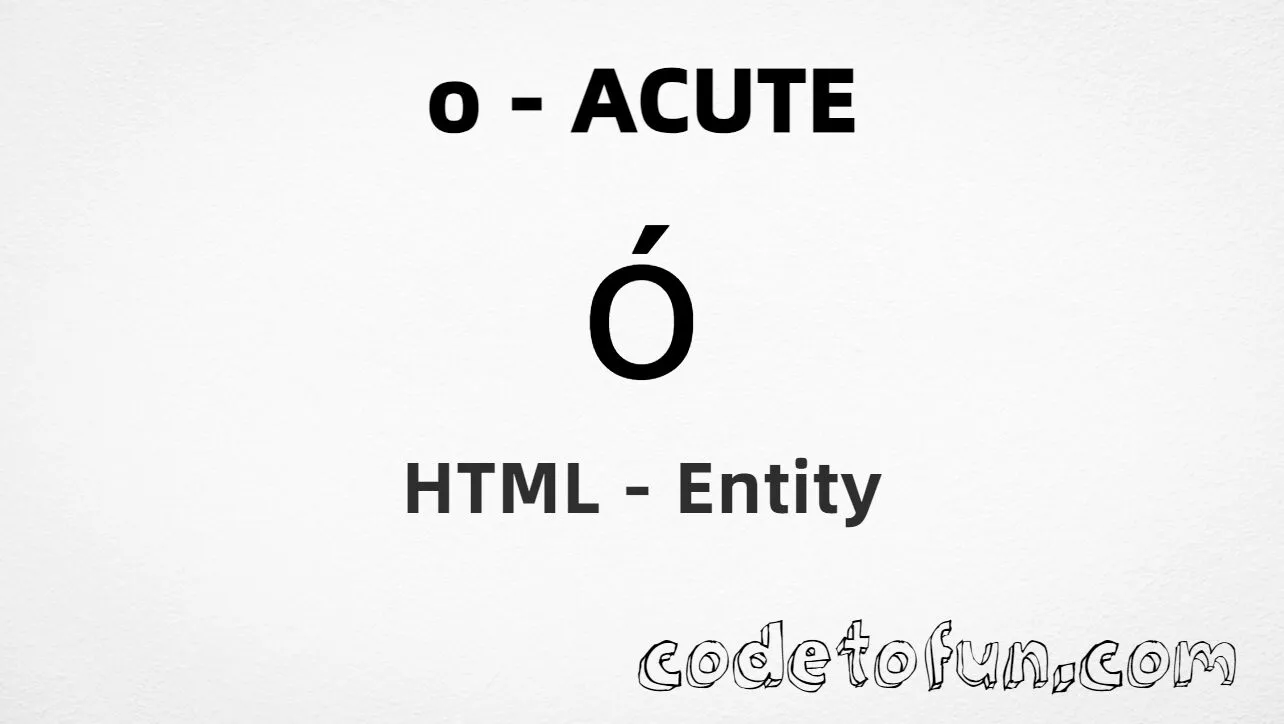
HTML Entity for Lowercase O Acute (ó)

Beginner
⏱️ 5 min read
📚 Updated: Jun 2026
🎯 1 Code Example
Unicode U+00F3

What You'll Learn

How to display the lowercase o with acute accent (ó) in HTML using named entity, hexadecimal, decimal, and CSS escape methods. This character is U+00F3 in the Latin-1 Supplement block. It is used in Spanish, Portuguese, Irish (Gaeilge), Hungarian, Czech, Slovak, and many other languages to indicate stress or a specific vowel quality.

Render it with ó, ó, ó, or CSS escape \00F3. The named entity ó is one of the most common HTML character references for accented letters.

⚡ Quick Reference — Lowercase O Acute Entity

Unicode U+00F3

Latin-1 Supplement

Hex Code ó

Hexadecimal reference

HTML Code ó

Decimal reference

Named Entity ó

Most readable option

Reference Table
Name           Value
────────────   ──────────
Unicode        U+00F3
Hex code       ó
HTML code      ó
Named entity   ó
CSS code       \00F3
Meaning        Latin small letter o with acute
Related        U+00D3 = Ó (Ó)
Block          Latin-1 Supplement (U+0080–U+00FF)
1

Complete HTML Example

A simple example showing the lowercase o acute (ó) using hexadecimal code, decimal HTML code, the named entity, and a CSS content escape:

html
<!DOCTYPE html>
<html>
<head>
 <style>
  #point:after{
   content: "\00F3";
  }
 </style>
</head>
<body>
<p>Symbol (hex): &#x00F3;</p>
<p>Symbol (decimal): &#243;</p>
<p>Symbol (named): &oacute;</p>
<p id="point">Symbol (CSS): </p>
</body>
</html>
Try It Yourself

🌐 Browser Support

The lowercase o acute (ó) and the named entity &oacute; are supported in all modern browsers:

Chrome1+
Firefox1+
Safari1+
Edge12+
Opera4+
Android4.4+
iOS Safari1+

👀 Live Preview

See the lowercase o acute (ó) in language and content contexts:

Large glyphó
Spanishespañol  |  avión  |  corazón
Portuguesecoração  |  avó  |  órgão
Named entity&oacute; renders as ó
UppercaseÓ (U+00D3) — use &Oacute;
Not the same asò (grave)  |  ô (circumflex)  |  o (plain)
Numeric refs&#x00F3; &#243; &oacute; \00F3

🧠 How It Works

1

Hexadecimal Code

&#x00F3; uses the Unicode hexadecimal value 00F3 to display the character. The x prefix indicates hexadecimal format.

HTML markup
2

Decimal HTML Code

&#243; uses the decimal Unicode value 243 to display the same character. A common method when a numeric reference is needed.

HTML markup
3

Named Entity

&oacute; is the named entity for o acute—readable in source HTML and widely used for Spanish and Portuguese content.

HTML markup
4

CSS Entity

\00F3 is used in CSS stylesheets, particularly in the content property of pseudo-elements like ::before and ::after.

CSS stylesheet
=

Same visual result

All four methods produce the glyph: ó. Unicode U+00F3 sits in Latin-1 Supplement. Uppercase equivalent: U+00D3 (Ó, &Oacute;). Do not confuse with ò (grave) or ô (circumflex).

Use Cases

The lowercase o acute (ó) is commonly used in:

🇪🇸 Spanish & Portuguese

Essential for correct spelling (español, avión, coração). Use the entity or UTF-8 for proper display and SEO.

🇪🇺 Irish & Celtic

Used in Irish (Gaeilge) and other Celtic orthographies. Correct character (U+00F3) supports proper spelling.

🌐 Central European

Hungarian, Czech, Slovak, and Polish use ó. Correct characters improve readability for those languages.

⚙ Programmatic HTML

When building HTML from CMS content or translation data, using &oacute; or &#243; guarantees correct output.

📚 Documentation

Tutorials on HTML entities, Unicode, or language learning showing &oacute; and numeric codes for ó.

♿ Accessibility

Using the correct character (U+00F3) with proper lang attributes ensures assistive technologies pronounce content correctly.

🎨 CSS Generated Content

Using \00F3 in the CSS content property to insert ó via pseudo-elements.

💡 Best Practices

Do

  • Serve pages as UTF-8; you can type ó directly in UTF-8 source
  • Use &oacute; for readable HTML when a named form is preferred
  • Set lang attributes (e.g. lang="es", lang="pt") on language-specific content
  • Use \00F3 in CSS content when generating the symbol via pseudo-elements
  • Distinguish ó (acute) from ò (grave) and ô (circumflex)

Don’t

  • Substitute plain o when ó is required in Spanish or Portuguese text
  • Confuse ó (acute) with ò (grave), ô (circumflex), or plain o
  • Put CSS escape \00F3 in HTML text nodes
  • Double-encode entity references in dynamically generated HTML
  • Omit lang attributes on pages with Spanish or Portuguese content

Key Takeaways

1

The named entity is the most familiar form

&oacute;
2

Numeric alternatives: hex and decimal

&#x00F3; &#243;
3

Unicode U+00F3 — LATIN SMALL LETTER O WITH ACUTE

4

Essential for Spanish and Portuguese; uppercase is Ó (&Oacute;)

❓ Frequently Asked Questions

Use &oacute; (named), &#x00F3; (hex), &#243; (decimal), or \00F3 in CSS content. In UTF-8 you can also type ó directly.
U+00F3 (LATIN SMALL LETTER O WITH ACUTE). Latin-1 Supplement block. Hex 00F3, decimal 243. Used in Spanish, Portuguese, Irish, and other languages. Uppercase form is U+00D3 (Ó).
When displaying Spanish, Portuguese, Irish, or other language text that uses ó, in multilingual sites, documentation, or when you need a reliable character reference. In UTF-8 pages you can type ó directly.
The named HTML entity is &oacute;. You can also use &#243; or &#x00F3;, or the CSS entity \00F3.
HTML entity (&oacute;, &#243;, or &#x00F3;) is used in HTML content; CSS entity \00F3 is used in stylesheets in the content property of pseudo-elements. Both produce ó.

Explore More HTML Entities!

Discover 1500+ HTML character references — letters, symbols, and more.

All HTML Entities →

About the author

Mari Selvan M P
Mari Selvan M P 🔗

Developer, cloud engineer, and technical writer

  • Experience 12 years building web and cloud systems
  • Focus Full Stack Development, AWS, and Developer Education

I write practical tutorials so students and working developers can learn by doing—from databases and APIs to deployment on AWS.

8 people found this page helpful