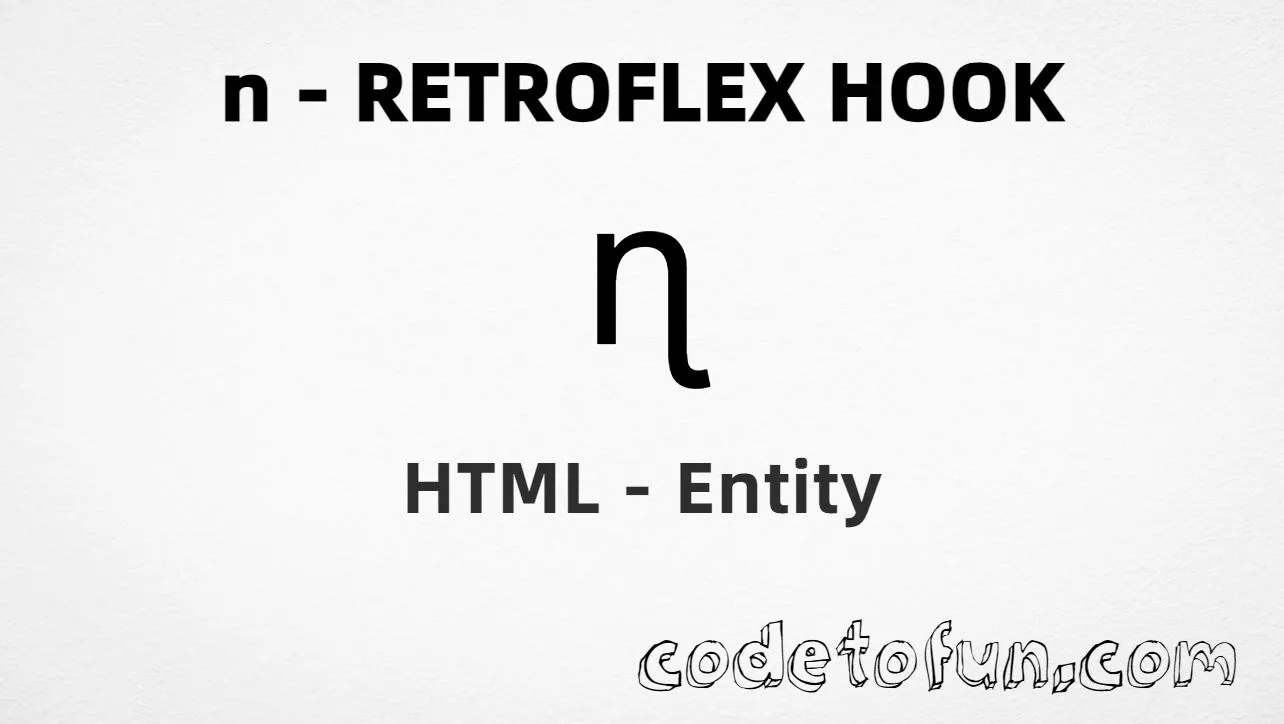
Lowercase n with retroflex hook (ɳ) is the IPA Extensions character at Unicode U+0273 (LATIN SMALL LETTER N WITH RETROFLEX HOOK). It looks like an n with a hook turning under the right leg — the IPA symbol for the voiced retroflex nasal (tongue tip curled back). You can paste ɳ in a UTF-8 file, or use a numeric character reference when encoding must be explicit.
Remember
Character     ɳ
Unicode       U+0273
Hex entity    ɳ
Decimal       ɳ
CSS escape    \0273
Named entity  (none)
IPA           Voiced retroflex nasal
All of these produce the same glyph: ɳ. Prefer typing or pasting ɳ in UTF-8 pages; use entities for CSS content, generated markup, or when encoding must be explicit.
Lowercase n with retroflex hook rendered in comparison contexts.
Sample textn with retroflex hook: ɳ
Large glyphɳ
IPA noteVoiced retroflex nasal
With entitiesHex: ɳ | Decimal: ɳ
Not the samen · ɲ (left hook) · ŋ (eng) · ƞ (long leg)
Code
Complete HTML Example
One page that shows lowercase n retroflex hook with the hex entity, decimal entity, CSS escape, and a typed character. Use View Output or open the live editor.
Retroflex Hook using Hex Code: ɳ
Retroflex Hook using HTML Code: ɳ
Retroflex Hook using CSS Entity: ɳ
Typed / pasted: ɳ
IPA: voiced retroflex nasal
How It Works
1. Hex:U+0273 → ɳ in HTML. The browser turns it into ɳ.
2. Decimal: same code point as 627 → ɳ. Same result as hex.
3. CSS: use \0273 in content (not an HTML entity). #point::after appends that ɳ after the paragraph text.
4. Typed ɳ: fine in UTF-8 documents. All four encoding lines show the same glyph.
Pitfalls & Tips
Common mistakes when working with the n retroflex hook entity.
Named?
No named entity
HTML5 does not define a named entity for ɳ. Use numeric forms.
CSS vs HTML
Do not mix escapes
\0273 belongs in CSS. ɳ / ɳ belong in HTML.
Look-alikes
Not left-hook, eng, or long-leg
Left hook ɲ is U+0272 (palatal). Eng ŋ is U+014B (velar). Long leg ƞ is U+019E. Do not swap them for ɳ.
IPA
Retroflex ≠ palatal
Retroflex ɳ uses a curled tongue tip. Palatal nasal uses left-hook ɲ. Pick the symbol that matches the sound.
Fonts
Glyph coverage
Some fonts omit IPA Extensions. If ɳ looks like a box, switch to a font that includes it.
UTF-8
Declare charset
If you paste ɳ directly, serve the page as UTF-8 with <meta charset="UTF-8">.
Compatibility
Browser Support
Lowercase n retroflex hook (U+0273) and its numeric entity forms (ɳ, ɳ, CSS \\0273) are supported in all mainstream browsers. Glyph availability depends on the font.
✓ Universal support
N Retroflex Hook (ɳ)
Paste ɳ, or encode with hex, decimal, or CSS escape — same code point everywhere.
100%Browser coverage
Google ChromeSupported
Yes
Microsoft EdgeSupported
Yes
Mozilla FirefoxSupported
Yes
Apple SafariSupported
Yes
OperaSupported
Yes
Internet ExplorerAll versions
Yes
U+0273 / entitiesFull support
Bottom line: Use a pasted ɳ in UTF-8 text when you can. Prefer ɳ or ɳ in HTML when encoding must be explicit, and \\0273 only inside CSS content.
Remember
Key Takeaways
Unicode: n retroflex hook is U+0273 (decimal 627), IPA Extensions.
HTML: use ɳ or ɳ when you need an entity.
CSS: use \0273 inside content for generated text.
Watch out: not the same as left-hook ɲ, eng ŋ, or long-leg ƞ.
One line:U+0273 → paste ɳ, or encode as ɳ / ɳ / CSS \0273.
Frequently Asked Questions
Use ɳ (hex), ɳ (decimal), or the CSS escape \0273 in the content property. All render ɳ. There is no named HTML entity for this character.
U+0273 (LATIN SMALL LETTER N WITH RETROFLEX HOOK). Hex 0273, decimal 627. It belongs to the IPA Extensions block and represents the voiced retroflex nasal in the International Phonetic Alphabet.
No. HTML5 does not define a named entity for this character. Use numeric references ɳ or ɳ when you need an entity form.
Use it for IPA phonetic transcription, linguistics documentation, CSS-generated content, or anywhere you must encode ɳ explicitly. Prefer typing or pasting ɳ directly when your file is UTF-8.
HTML entities (ɳ or ɳ) go in markup. The CSS escape \0273 is used in stylesheets (usually in the content property of ::before/::after). Both render ɳ.
Plain n is U+006E. Eng ŋ is the velar nasal. N left hook ɲ is the palatal nasal. N retroflex hook ɳ is U+0273 — the IPA voiced retroflex nasal (tongue curled back).
🤔
Did you know?
Lowercase n with retroflex hook (ɳ) is Unicode U+0273 (decimal 627) in the IPA Extensions block. Official name: LATIN SMALL LETTER N WITH RETROFLEX HOOK. HTML5 has no named entity — use ɳ or ɳ. It is the IPA symbol for the voiced retroflex nasal (tongue curled back), found in many South Asian and other languages.