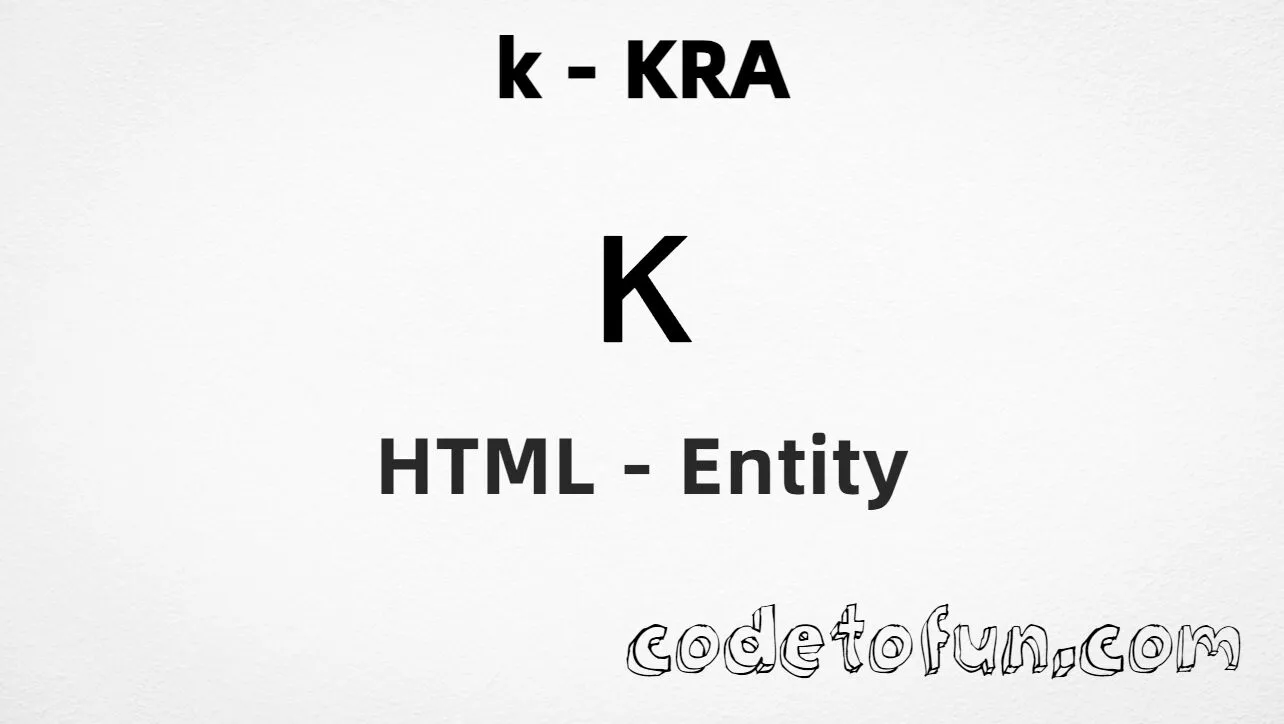
HTML Entity for Lowercase K Kra (ĸ)

Beginner
⏱️ 5 min read
📚 Updated: Jun 2026
🎯 1 Code Example
Unicode U+0138

What You'll Learn

How to display the lowercase kra (ĸ) in HTML using named entity, hexadecimal, decimal, and CSS escape methods. This character is U+0138 in the Latin Extended-A block. It was formerly used in Greenlandic (Kalaallisut) for the voiceless uvular plosive [q]; the 1973 spelling reform replaced kra with q. It still appears in some Inuktitut dialects and in historical or linguistic contexts.

Render it with ĸ, ĸ, ĸ, or CSS escape \138. The named entity ĸ (from “Greenlandic k”) is readable in HTML source; numeric codes are universally supported.

⚡ Quick Reference — Lowercase K Kra Entity

Unicode U+0138

Latin Extended-A

Hex Code ĸ

Hexadecimal reference

HTML Code ĸ

Decimal reference

Named Entity ĸ

Greenlandic k (HTML5)

Reference Table
Name           Value
────────────   ──────────
Unicode        U+0138
Hex code       ĸ
HTML code      ĸ
Named entity   ĸ
CSS code       \138
Meaning        Latin small letter kra
Also known as  Greenlandic k
Related        U+006B = k (plain), modern Greenlandic uses q
Block          Latin Extended-A (U+0100–U+017F)
1

Complete HTML Example

A simple example showing the lowercase kra (ĸ) using hexadecimal code, decimal HTML code, the named entity, and a CSS content escape:

html
<!DOCTYPE html>
<html>
<head>
 <style>
  #point:after{
   content: "\138";
  }
 </style>
</head>
<body>
<p>Symbol (hex): &#x138;</p>
<p>Symbol (decimal): &#312;</p>
<p>Symbol (named): &kgreen;</p>
<p id="point">Symbol (CSS): </p>
</body>
</html>
Try It Yourself

🌐 Browser Support

The lowercase kra (ĸ) and numeric references are supported in modern browsers. The named entity &kgreen; is part of HTML5 and supported in current browsers:

Chrome1+
Firefox1+
Safari1+
Edge12+
Opera4+
Android4.4+
iOS Safari1+

👀 Live Preview

See the lowercase kra (ĸ) in Greenlandic and linguistic contexts:

Large glyphĸ
Historical usePre-1973 Greenlandic orthography for [q] sound
Modern spellingReplaced by q in 1973 Greenlandic reform
Named entity&kgreen; renders as ĸ
Not the same asplain k (U+006B) or q (U+0071)
Numeric refs&#x138; &#312; &kgreen; \138

🧠 How It Works

1

Named Entity

&kgreen; is the named entity for ĸ—readable in source HTML and part of the HTML5 entity set (Greenlandic k).

HTML markup
2

Hexadecimal Code

&#x138; uses the Unicode hexadecimal value 138 to display the character. The x prefix indicates hexadecimal format.

HTML markup
3

Decimal HTML Code

&#312; uses the decimal Unicode value 312 to display the same character. The most universally supported reference method.

HTML markup
4

CSS Entity

\138 is used in CSS stylesheets, particularly in the content property of pseudo-elements like ::before and ::after.

CSS stylesheet
=

Same visual result

All four methods produce the glyph: ĸ. Unicode U+0138 sits in Latin Extended-A. In modern Greenlandic use q for [q]; use ĸ for historical text or specific dialects. Do not confuse with plain k or ƙ (k hook).

Use Cases

The lowercase kra (ĸ) is commonly used in:

📜 Historical Greenlandic

Pre-1973 Kalaallisut orthography used ĸ for [q]; essential for digitizing old texts.

🇪🇲 Inuktitut dialects

Some Inuit languages still use or reference the kra in linguistic notation.

🔤 Linguistics

Academic papers on Greenlandic, Inuit languages, and uvular consonants.

🌐 Digital archives

Websites and archives supporting historical Greenlandic or Inuktitut content.

📚 Language history

Spelling reform documentation and educational content about the kra character.

♿ Accessibility

Correct Unicode ensures screen readers handle ĸ properly in Greenlandic content.

🔍 Search & SEO

Proper encoding helps search indexing for historical language content.

💡 Best Practices

Do

  • Use &kgreen; or numeric codes for ĸ in HTML
  • Serve pages as UTF-8; you can also type ĸ directly in UTF-8 source
  • Use q for modern Greenlandic; reserve ĸ for historical or dialect text
  • Use fonts that support Latin Extended-A for Greenlandic and Inuit content
  • Fall back to &#x138; or &#312; if an environment lacks named-entity support

Don’t

  • Use ĸ in modern Greenlandic when q is the correct spelling
  • Confuse kra ĸ with plain k, ƙ (k hook), or ķ (k cedilla)
  • Put CSS escape \138 in HTML text nodes
  • Assume all fonts render Latin Extended-A glyphs identically
  • Omit UTF-8 encoding on pages with extended Latin characters

Key Takeaways

1

Four references render ĸ; named entity is &kgreen;

&#x138; &#312; &kgreen;
2

For CSS stylesheets, use the escape in the content property

\138
3

Unicode U+0138 — LATIN SMALL LETTER KRA

4

Former Greenlandic letter; replaced by q in the 1973 reform

❓ Frequently Asked Questions

Use &kgreen; (named), &#x138; (hex), &#312; (decimal), or \138 in CSS content. All four methods render ĸ correctly in modern browsers.
U+0138 (LATIN SMALL LETTER KRA). Latin Extended-A block. Hex 138, decimal 312. Formerly used in Greenlandic; still found in some Inuktitut dialects.
When writing historical Greenlandic text, Inuktitut dialect content, linguistic resources referencing the character, and pre-1973 Greenlandic orthography. For modern Greenlandic, use q instead.
Yes. The named HTML entity is &kgreen; (Greenlandic k). It is part of the HTML5 entity set. You can also use numeric references or type ĸ directly in UTF-8.
In the 1973 Greenlandic spelling reform, ĸ (kra) was replaced by the standard Latin letter q to represent the voiceless uvular plosive [q]. This aligned Greenlandic with international usage and simplified typography. Historical texts may still use ĸ.

Explore More HTML Entities!

Discover 1500+ HTML character references — letters, symbols, and more.

All HTML Entities →

About the author

Mari Selvan M P
Mari Selvan M P 🔗

Developer, cloud engineer, and technical writer

  • Experience 12 years building web and cloud systems
  • Focus Full Stack Development, AWS, and Developer Education

I write practical tutorials so students and working developers can learn by doing—from databases and APIs to deployment on AWS.

8 people found this page helpful