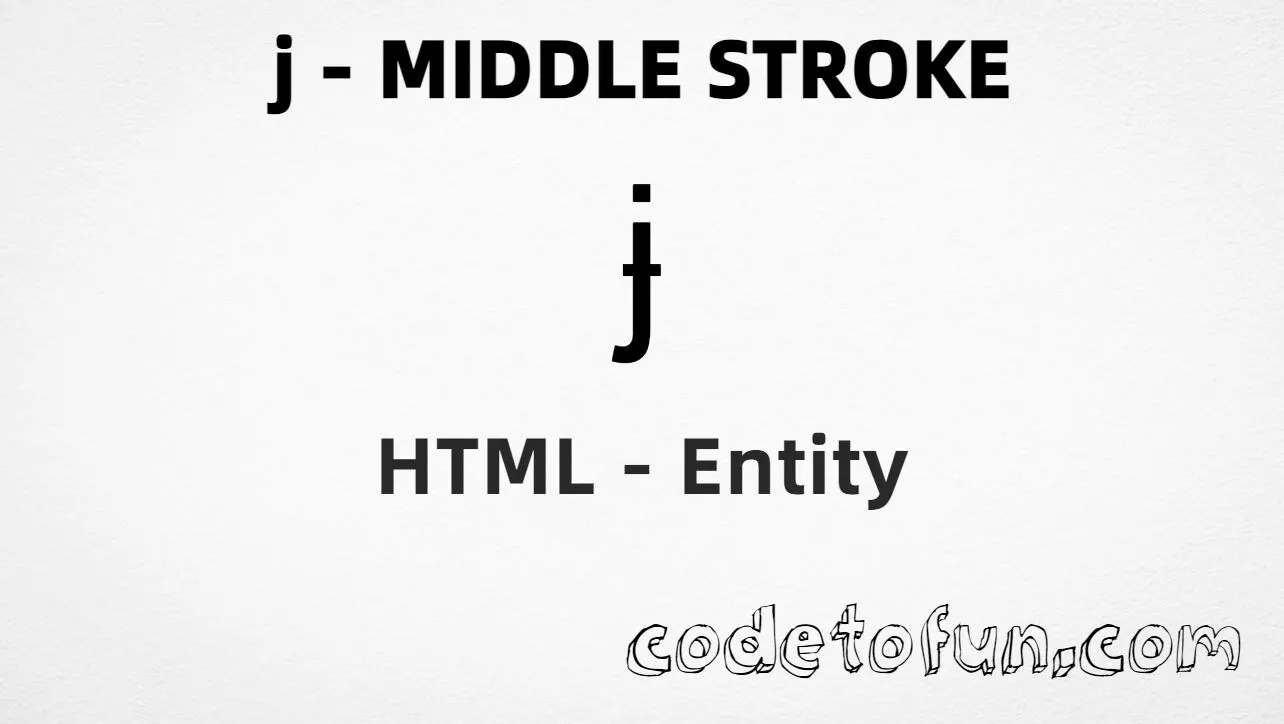
Lowercase j middle stroke (ɉ) is the Latin Extended-B character at Unicode U+0249 (LATIN SMALL LETTER J WITH STROKE). It is the letter j with a horizontal stroke through the middle — used in phonetic notation and some transliteration systems. You can paste ɉ in a UTF-8 file, or use a numeric character reference when encoding must be explicit.
Remember
Character     ɉ
Unicode       U+0249
Hex entity    ɉ
Decimal       ɉ
CSS escape    \0249
Named entity  (none)
All of these produce the same glyph: ɉ. Prefer typing or pasting ɉ in UTF-8 pages; use entities for CSS content, generated markup, or when encoding must be explicit.
Reference
Quick Reference
One table for every form you will actually use.
Form
Code
Where it goes
Direct character
ɉ
HTML text (UTF-8 default)
Hex entity
ɉ
HTML markup
Decimal entity
ɉ
HTML markup
CSS escape
\0249
Stylesheet content
Named entity
—
Not defined in HTML5
When to Use Which
Situation
Use
Phonetics / linguistics pages (UTF-8)
Type or paste ɉ
Need an entity in HTML source
ɉ or ɉ
Generated text via ::before / ::after
content: "\0249"
Looking for a named entity
Does not exist — use numeric form
Plain j, dashless j, or IPA ʝ
Different characters — see Related Topics
See it
Live Preview
Lowercase j middle stroke rendered in common contexts.
Inline textPhonetic sample: ɉ
Large glyphɉ
Notation/ɉ/ vs /j/
With entitiesHex: ɉ | Decimal: ɉ
Not the samej (U+006A) · ȷ (U+0237) · ʝ (U+029D)
Code
Complete HTML Example
One page that shows lowercase j middle stroke with the hex entity, decimal entity, CSS escape, and a typed character. Use View Output or open the live editor.
J Middle Stroke using Hex Code: ɉ
J Middle Stroke using HTML Code: ɉ
J Middle Stroke using CSS Entity: ɉ
Typed / pasted: ɉ
How It Works
1. Hex:U+0249 → ɉ in HTML. The browser turns it into ɉ.
2. Decimal: same code point as 585 → ɉ. Same result as hex.
3. CSS: use \0249 in content (not an HTML entity). #point::after appends that ɉ after the paragraph text.
4. Typed ɉ: fine in UTF-8 documents. All four lines show the same glyph.
Pitfalls & Tips
Common mistakes when working with the j middle stroke entity.
Named?
No named entity
HTML5 does not define a named entity for ɉ. Use numeric forms.
CSS vs HTML
Do not mix escapes
\0249 belongs in CSS. ɉ / ɉ belong in HTML.
Look-alikes
Not j, ȷ, or ʝ
Plain j is U+006A; dashless ȷ is U+0237; IPA ʝ is U+029D. ɉ has a middle stroke.
Fonts
Check glyph coverage
Some UI fonts omit Latin Extended-B glyphs. Prefer fonts that include this character.
Semicolon
End references
Always finish with ; — write ɉ, not ɉ.
UTF-8
Declare charset
If you paste ɉ directly, serve the page as UTF-8 with <meta charset="UTF-8">.
Compatibility
Browser Support
Lowercase j middle stroke (U+0249) and its numeric entity forms (ɉ, ɉ, CSS \\0249) are supported in all mainstream browsers. Glyph availability depends on the font.
✓ Universal support
Lowercase J Middle Stroke (ɉ)
Paste ɉ, or encode with hex, decimal, or CSS escape — same code point everywhere.
100%Browser coverage
Google ChromeSupported
Yes
Microsoft EdgeSupported
Yes
Mozilla FirefoxSupported
Yes
Apple SafariSupported
Yes
OperaSupported
Yes
Internet ExplorerAll versions
Yes
U+0249 / entitiesFull support
Bottom line: Use a pasted ɉ in UTF-8 text when you can. Prefer ɉ or ɉ in HTML when encoding must be explicit, and \\0249 only inside CSS content.
Remember
Key Takeaways
Unicode: j middle stroke is U+0249 (decimal 585), Latin Extended-B.
HTML: use ɉ or ɉ when you need an entity.
CSS: use \0249 inside content for generated text.
Meaning: j with a middle stroke — not the same as j, ȷ, or ʝ.
One line:U+0249 → paste ɉ, or encode as ɉ / ɉ / CSS \0249.
Frequently Asked Questions
Use ɉ (hex), ɉ (decimal), or the CSS escape \0249 in the content property. All render ɉ. There is no named HTML entity for this character.
U+0249 (LATIN SMALL LETTER J WITH STROKE). Hex 249, decimal 585. It belongs to Latin Extended-B and is the letter j with a horizontal stroke through the middle.
No. HTML5 does not define a named entity for this character. Use numeric references ɉ or ɉ when you need an entity form.
Use it in phonetic notation, linguistics, transliteration, CSS-generated content, or anywhere you must encode ɉ explicitly. Prefer typing or pasting ɉ directly when your file is UTF-8.
HTML entities (ɉ or ɉ) go in markup. The CSS escape \0249 is used in stylesheets (usually in the content property of ::before/::after). Both render ɉ.
Plain j is U+006A. Dashless j ȷ is U+0237 (dotless). J crossed tail ʝ is U+029D (IPA). J middle stroke ɉ is U+0249 — j with a horizontal bar through the stem. Do not substitute one for another.
🤔
Did you know?
Lowercase j middle stroke (ɉ) is Unicode U+0249 (decimal 585) in the Latin Extended-B block. Official name: LATIN SMALL LETTER J WITH STROKE. HTML5 has no named entity — use ɉ or ɉ. Used in phonetic notation and some transliteration systems.