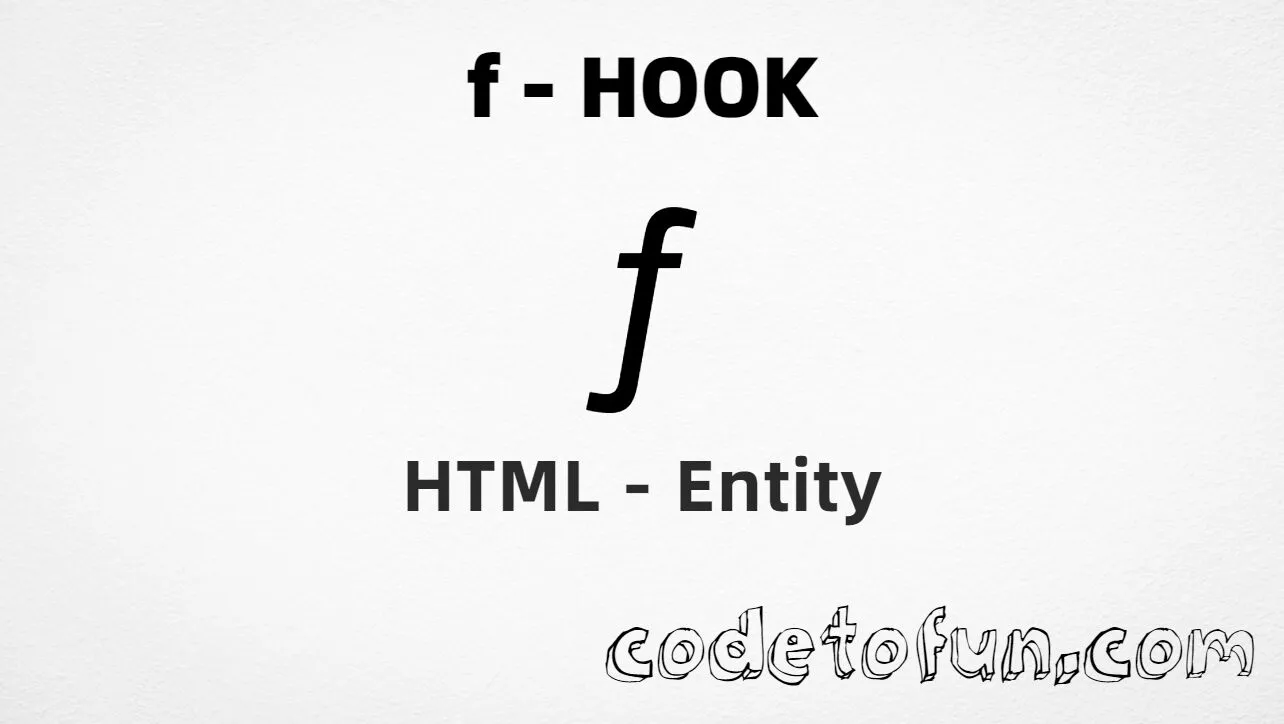
Lowercase f hook (ƒ) is the Unicode character at U+0192 in Latin Extended-B. Official name: LATIN SMALL LETTER F WITH HOOK. It is commonly used as a function symbol in math-style notation and as the historical florin (guilder) currency sign.
Remember
Character     ƒ
Unicode       U+0192
Named entity  ƒ
Hex entity    ƒ
Decimal       ƒ
CSS escape    \0192
Meaning       lowercase f with hook (florin / function)
Not the same  f (U+0066) · Ƒ (uppercase F hook)
Prefer ƒ in HTML. Alternatives: ƒ, ƒ, or type ƒ in a UTF-8 document.
Built with Named: ƒ
Built with Hex: ƒ
Built with Decimal: ƒ
Built with CSS: ƒ
Typed: ƒ
Notation: ƒ(x) = x² + 1
How It Works
1. Named:ƒ is the HTML5 name for U+0192 → ƒ. Prefer this in markup.
2. Hex:ƒ inserts the same code point. Same visual as named.
3. Decimal: same code point as 402 → ƒ.
4. CSS: use \0192 in content (not an HTML entity). #point::after appends ƒ.
5. Typed: paste ƒ in a UTF-8 document when you need the hooked f / florin glyph. Use ² for the squared exponent in the sample equation.
Pitfalls & Tips
Common mistakes when working with the lowercase f hook.
Name
Prefer ƒ
The named entity is clearer than inventing &function; or &florin; — those are not HTML5 names for U+0192.
f
Not plain f
Plain f is U+0066. Use ƒ only when you need the hooked form for function or florin contexts.
Case
Uppercase is different
Uppercase F with hook is Ƒ (U+0191) and has no named entity. Do not use ƒ for the capital form.
CSS
Pad the CSS escape
Prefer \0192 (four hex digits). A short \192 can swallow the next hex digit if one follows immediately.
CSS vs HTML
Do not mix escapes
\0192 belongs in CSS strings. ƒ / ƒ / ƒ belong in HTML.
a11y
Add accessible text
Screen readers may say “f” or skip ƒ. Prefer aria-label or nearby prose for important equations or prices.
Semicolon
End references
Always finish entities with ; — write ƒ, not &fnof.
Compatibility
Browser Support
Lowercase f hook (U+0192) and its entity forms (ƒ, ƒ, ƒ, CSS \\0192) are supported in all mainstream browsers. Visible glyphs depend on Latin Extended-B font coverage.
✓ Universal support
Lowercase F Hook (ƒ)
Encode with named, hex, decimal, CSS escape, or type the character — same code point everywhere encoding is supported.
100%Browser coverage
Google ChromeSupported
Yes
Microsoft EdgeSupported
Yes
Mozilla FirefoxSupported
Yes
Apple SafariSupported
Yes
OperaSupported
Yes
Internet ExplorerAll versions
Yes
U+0192Full support
Bottom line: Prefer ƒ in HTML. Use ƒ / ƒ when numeric form is required, and \\0192 only inside CSS content.
Remember
Key Takeaways
Unicode: lowercase f hook is U+0192 (decimal 402) — glyph ƒ.
HTML: prefer ƒ — also ƒ / ƒ / type ƒ.
Prefer ƒ (named). You can also use ƒ (hex), ƒ (decimal), type ƒ in UTF-8, or the CSS escape \0192 in content.
U+0192 (LATIN SMALL LETTER F WITH HOOK). Hex 192, decimal 402. It belongs to Latin Extended-B (U+0180–U+024F).
Yes. HTML5 defines ƒ for U+0192. Prefer it over numeric forms when you want readable markup.
Use it for function notation (ƒ(x)), the florin/guilder currency symbol, or text that needs Latin small letter f with hook. Prefer plain f for ordinary English words.
HTML entities (ƒ, ƒ, or ƒ) go in markup. The CSS escape \0192 goes in stylesheet strings (usually content on ::before/::after).
No. Plain f is U+0066. U+0192 (ƒ, ƒ) is a distinct hooked form used for florin and function-style notation.
🤔
Did you know?
Lowercase f hook is Unicode U+0192 (decimal 402) — glyph ƒ (LATIN SMALL LETTER F WITH HOOK) in Latin Extended-B. HTML5 named entity: ƒ. Also used as the florin (guilder) currency symbol and in math for function names. Prefer ƒ in HTML; use hex/decimal when named entities are unavailable.