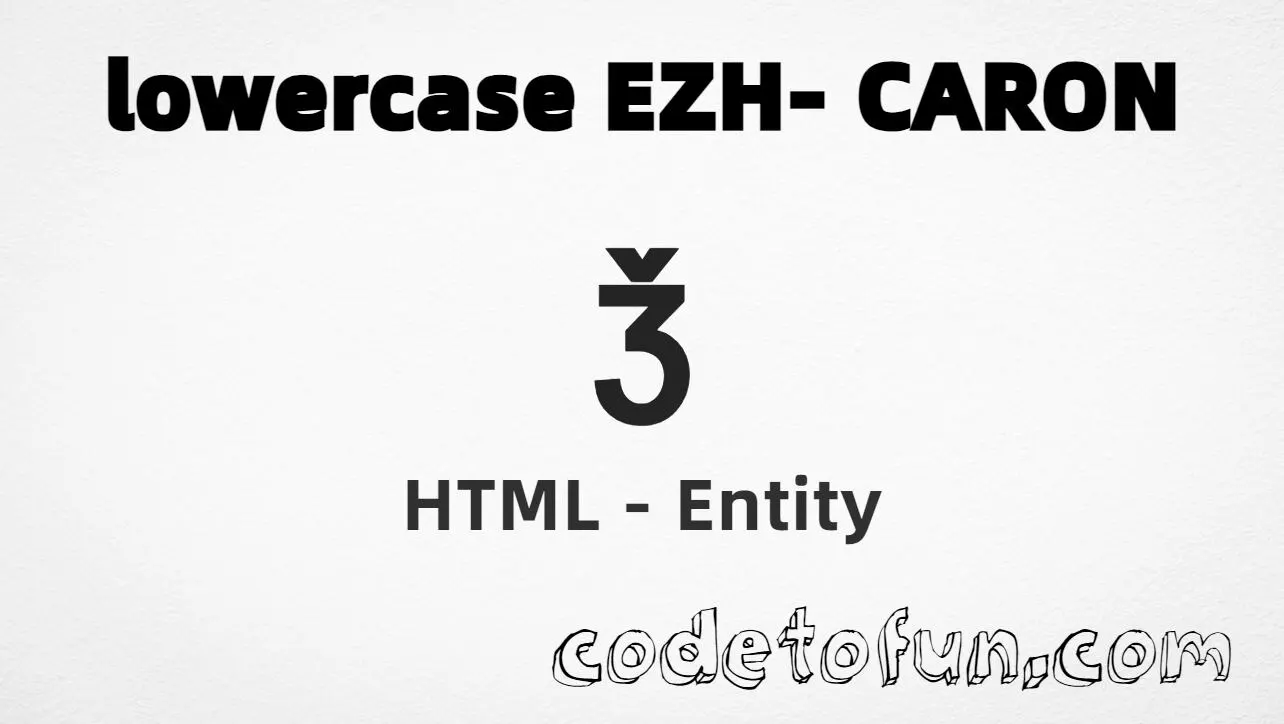
Lowercase Ezh Caron (ǯ) is the Latin Extended-B character at Unicode U+01EF (LATIN SMALL LETTER EZH WITH CARON). There is no named HTML entity. Use hex or decimal codes for Skolt Sami and related Uralic orthographies.
Remember
Character     ǯ
Unicode       U+01EF
Named entity  (none)
Hex entity    ǯ
Decimal       ǯ
CSS escape    \01EF
Not the same  Ǯ (uppercase) · ʒ (IPA) · ƹ
Hex, decimal, CSS, and a typed character all produce the same glyph: ǯ. Prefer ǯ in HTML markup. For the uppercase pair see uppercase ezh caron (U+01EE); for IPA ezh see ezh (U+0292).
Built with Hex: ǯ
Built with Decimal: ǯ
Built with CSS: ǯ
Typed: ǯ
Case pair: Ǯ / ǯ
How It Works
1. Hex:ǯ inserts Unicode U+01EF → ǯ. Prefer this when there is no named entity.
2. Decimal: same code point as 495 → ǯ. Same visual as hex.
3. CSS: use \01EF in content (not an HTML entity). #point::after appends ǯ.
4. Typed: paste ǯ in a UTF-8 document, or write Case pair: Ǯ / ǯ.
Pitfalls & Tips
Common mistakes when working with Lowercase Ezh Caron.
Named
No named entity
Do not invent names like &ezhcaron;. Use ǯ or ǯ only.
Look-alikes
ǯ ≠ Ǯ ≠ ʒ ≠ ƹ
Ezh with caron is ǯ. Uppercase is U+01EE. IPA ezh is U+0292. Reverse ezh is U+01B9. Match the orthography you need.
A11y
Prefer precomposed
Use U+01EF rather than stacking ezh plus a combining caron when possible. One code point is clearer for search and screen readers.
Fonts
Glyph coverage
Latin Extended-B coverage varies. Prefer fonts with linguistic / Uralic-script support and test on mobile.
CSS vs HTML
Do not mix escapes
\01EF belongs in CSS. ǯ / ǯ belong in HTML. Prefer the four-digit form \01EF.
Semicolon
End references
Always finish with ; — write ǯ, not ǯ.
Compatibility
Browser Support
Lowercase Ezh Caron (U+01EF) and its entity forms (ǯ, ǯ, CSS \\01EF) are supported in all modern browsers. Glyph coverage depends on the font.
✓ Universal encoding
Lowercase Ezh Caron (ǯ)
Encode with hex, decimal, or CSS escape — or type ǯ directly in UTF-8 HTML. Prefer ǯ. No named entity exists.
100%Browser coverage
Google ChromeSupported
Yes
Microsoft EdgeSupported
Yes
Mozilla FirefoxSupported
Yes
Apple SafariSupported
Yes
OperaSupported
Yes
Internet ExplorerIE 9+
Yes*
U+01EFFull support
Bottom line: Prefer ǯ for readable HTML. Use \\01EF only inside CSS content. Do not confuse with uppercase Ǯ, IPA ezh ʒ, or reverse ezh ƹ.
Remember
Key Takeaways
Unicode: this symbol is U+01EF (decimal 495) — Latin small letter ezh with caron.
HTML: use ǯ or ǯ — there is no named entity.
CSS: use \01EF inside content for generated linguistic text.
Watch out: not the same as uppercase Ǯ, IPA ezh ʒ, or reverse ezh ƹ.
One line:U+01EF → ǯ / ǯ / CSS \01EF (no named entity).
Frequently Asked Questions
Use ǯ (hex), ǯ (decimal), or the CSS escape \01EF in the content property. All render ǯ. Prefer ǯ for readable markup. There is no named HTML entity.
U+01EF (LATIN SMALL LETTER EZH WITH CARON). Hex 01EF, decimal 495. It belongs to Latin Extended-B (U+0180–U+024F). There is no named HTML entity.
No. HTML5 does not define a named entity for U+01EF. Use ǯ or ǯ instead. The uppercase pair is U+01EE; IPA ezh is U+0292.
U+01EF is lowercase ezh with caron. U+01EE is the uppercase case pair. U+0292 is IPA/small ezh without caron — a different code point used in phonetics.
Use it for Skolt Sami, related Uralic orthographies, and linguistic text that needs lowercase ezh with caron — not as a substitute for IPA ezh or plain Z.
HTML entities (ǯ or ǯ) go in markup. The CSS escape \01EF is used in stylesheets (usually in the content property of ::before/::after). Both render ǯ.
🤔
Did you know?
Lowercase Ezh Caron is Unicode U+01EF (decimal 495) — glyph ǯ (LATIN SMALL LETTER EZH WITH CARON) in Latin Extended-B. There is no named HTML entity — use ǯ or ǯ. Prefer it for Skolt Sami and related Uralic orthographies. Do not confuse it with uppercase ezh caron (U+01EE), IPA ezh (U+0292), reverse ezh (U+01B9), or ezh with tail (U+01BA).