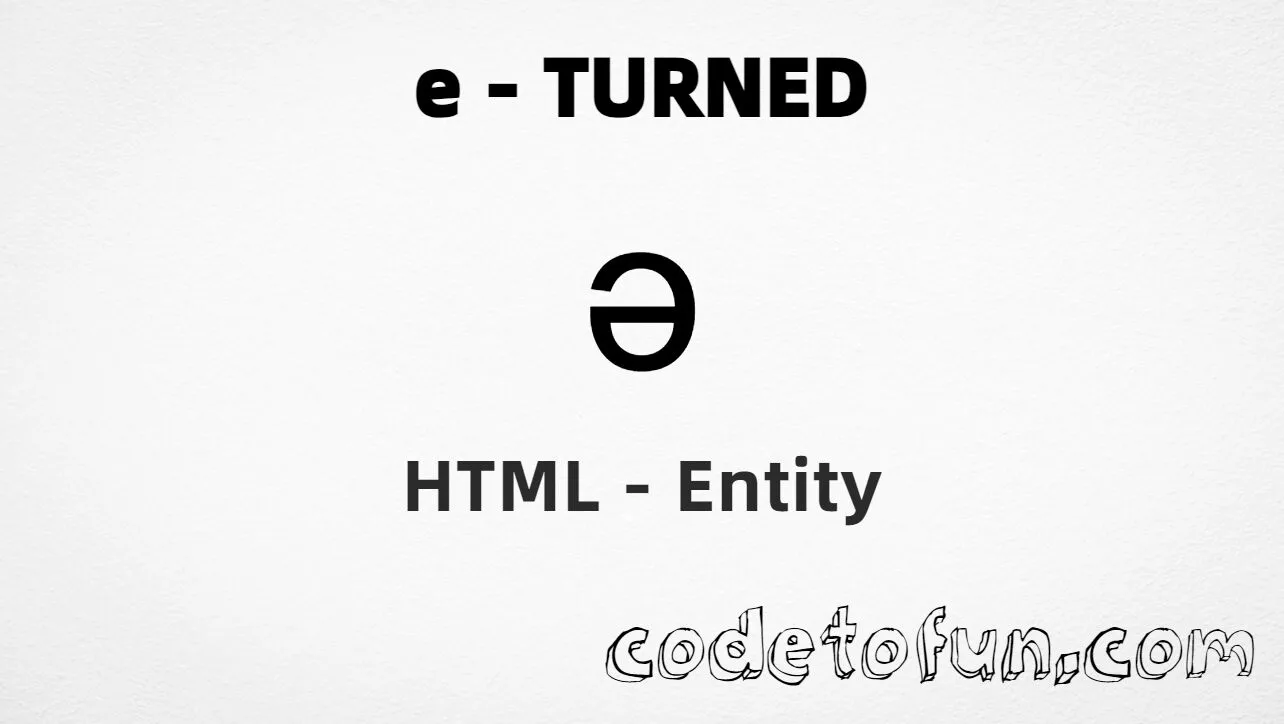
Lowercase E Turned (ǝ) is the Latin Extended-B character at Unicode U+01DD (LATIN SMALL LETTER TURNED E). It looks like the letter e rotated 180° and is used in phonetic notation and some orthographies.
Remember
Character     ǝ
Unicode       U+01DD
Hex entity    ǝ
Decimal       ǝ
CSS escape    \01DD
Named entity  (none)
Hex, decimal, CSS, and a typed character all produce the same glyph: ǝ. Prefer ǝ in HTML source when you need an explicit entity.
Using Hex Code: ǝ
Using HTML Code: ǝ
Using CSS Entity: ǝ
Phonetic: /ǝ/
How It Works
1. Hex:U+01DD → ǝ in HTML. The browser turns it into ǝ.
2. Decimal: same code point as 477 → ǝ. Same result as hex.
3. Named: HTML5 does not define a named entity for this character — use hex or decimal instead.
4. CSS: use \01DD in content (not an HTML entity). #point::after appends that ǝ after the paragraph text.
Pitfalls & Tips
Common mistakes when working with turned e.
Named
No &…; shortcut
HTML5 has no named entity for U+01DD. Use ǝ or ǝ.
Look-alikes
Not ə or ɘ
Schwa ə is U+0259. Reversed e ɘ is U+0258. Turned e is its own Latin Extended-B letter.
CSS rotate
Prefer the real character
Do not fake it with transform: rotate(180deg) on e for text content — use U+01DD for copy, search, and accessibility.
CSS vs HTML
Do not mix escapes
\01DD belongs in CSS. ǝ / ǝ belong in HTML. Prefer the padded CSS form so trailing digits are not misread.
Encoding
Declare UTF-8
If you type ǝ directly, keep <meta charset="UTF-8"> so the file is not misread.
Fonts
Check glyph coverage
Some fonts omit Latin Extended-B. Pick a font that includes U+01DD if the glyph is missing.
Compatibility
Browser Support
Latin small letter turned e (U+01DD) and its entity forms (ǝ, ǝ, CSS \\01DD) are supported in all modern browsers. Glyph display depends on font coverage.
✓ Universal encoding
Lowercase E Turned (ǝ)
Encode with hex, decimal, or CSS escape — or type ǝ directly in UTF-8 HTML.
100%Browser coverage
Google ChromeSupported
Yes
Microsoft EdgeSupported
Yes
Mozilla FirefoxSupported
Yes
Apple SafariSupported
Yes
OperaSupported
Yes
Internet ExplorerIE 9+
Yes*
U+01DDFull support
Bottom line: Prefer ǝ for readable HTML. Use \\01DD only inside CSS content.
Remember
Key Takeaways
Unicode: this character is U+01DD (decimal 477).
HTML: prefer ǝ — or use ǝ (no named entity).
CSS: use \01DD inside content for generated text.
Watch out:ǝ ≠ letter e ≠ schwa ə ≠ reversed e ɘ.
One line:U+01DD → ǝ / ǝ / CSS \01DD (no named entity).
Frequently Asked Questions
Use ǝ (hex), ǝ (decimal), or the CSS escape \01DD in the content property. All render ǝ when the font supports it. There is no named HTML entity.
U+01DD (LATIN SMALL LETTER TURNED E). Hex 1DD, decimal 477. It belongs to Latin Extended-B (U+0180–U+024F).
No. HTML5 does not define a named entity for U+01DD. Use numeric references like ǝ or ǝ.
Use it for phonetic notation, IPA-related transcription, linguistics, and orthographies that need the turned e symbol.
HTML entities (ǝ or ǝ) go in markup. The CSS escape \01DD is used in stylesheets (usually in the content property of ::before/::after). Both render ǝ.
No. Schwa is U+0259 (ə). Reversed e is U+0258 (ɘ). Turned e is U+01DD (ǝ) — a different Latin Extended-B character.
🤔
Did you know?
Lowercase E Turned is Unicode U+01DD (decimal 477) — LATIN SMALL LETTER TURNED E in Latin Extended-B. HTML5 has no named entity — use ǝ or ǝ. It looks like a rotated e. Do not confuse it with schwa ə or reversed e ɘ.