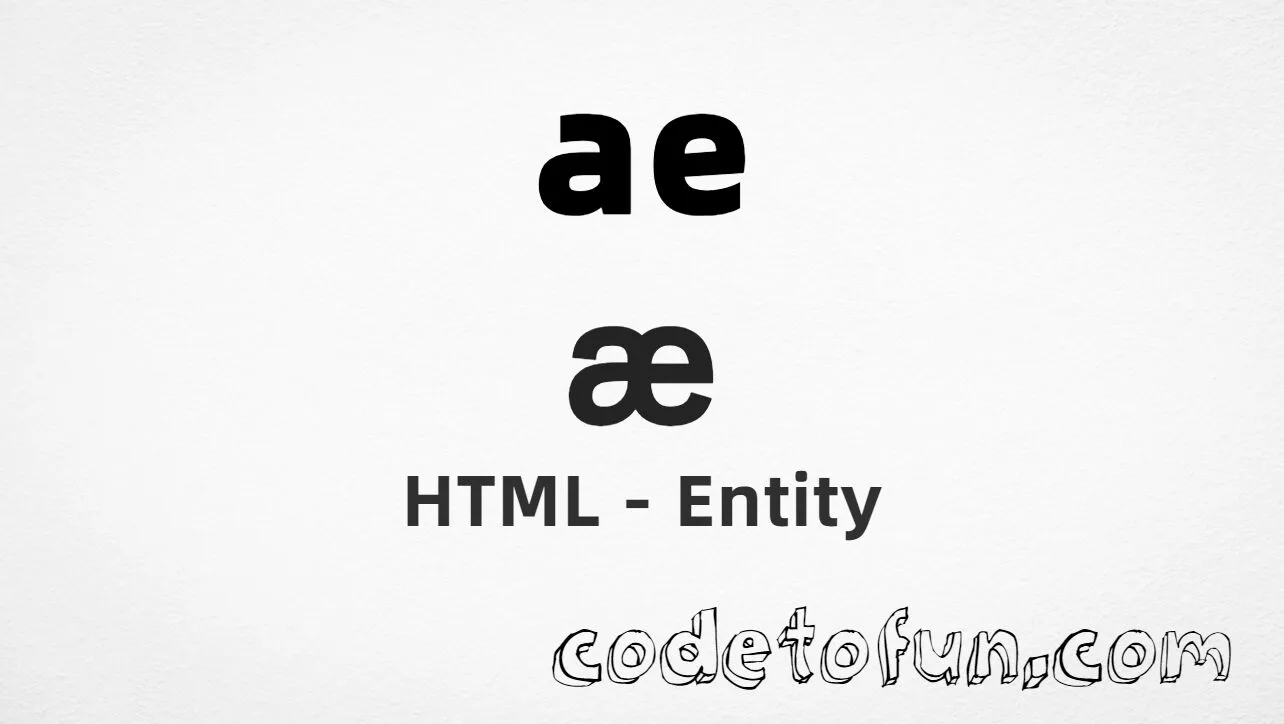
HTML Entity for Lowercase Ae (æ)

What You'll Learn
How to display the lowercase ae ligature (æ) in HTML using named entity, hexadecimal, decimal, and CSS escape methods. Also known as ash in Old English, this character is a letter in Danish and Norwegian and appears in words such as æble (apple) and classical spellings like encyclopædia. It is U+00E6 in the Latin-1 Supplement block.
Render it with æ, æ, æ, or CSS escape \00E6. The named entity æ is often the most readable option in HTML source.
⚡ Quick Reference — Lowercase Ae Entity
U+00E6Latin-1 Supplement
æHexadecimal reference
æDecimal reference
æMost readable option
Name Value
──────────── ──────────
Unicode U+00E6
Hex code æ
HTML code æ
Named entity æ
CSS code \00E6
Meaning Latin small letter ae
Also known as ash (ligature)
Block Latin-1 Supplement (U+0080–U+00FF)Complete HTML Example
A simple example showing the lowercase ae (æ) using hexadecimal code, decimal HTML code, the named entity, and a CSS content escape:
<!DOCTYPE html>
<html>
<head>
<style>
#point:after{
content: "\00E6";
}
</style>
</head>
<body>
<p>Symbol (hex): æ</p>
<p>Symbol (decimal): æ</p>
<p>Symbol (named): æ</p>
<p id="point">Symbol (CSS): </p>
</body>
</html>🌐 Browser Support
The lowercase ae (æ) and the named entity æ are supported in all modern browsers:
👀 Live Preview
See the lowercase ae (æ) in Danish, Norwegian, and classical contexts:
ae (U+0061 U+0065)🧠 How It Works
Hexadecimal Code
æ uses the Unicode hexadecimal value E6 to display the character. The x prefix indicates hexadecimal format.
Decimal HTML Code
æ uses the decimal Unicode value 230 to display the same character. One of the most commonly used methods in HTML.
Named Entity
æ is the standard named entity for æ—readable in source HTML and part of the HTML5 entity set.
CSS Entity
\00E6 is used in CSS stylesheets, particularly in the content property of pseudo-elements like ::before and ::after.
Same visual result
All four methods produce the glyph: æ. Unicode U+00E6 sits in Latin-1 Supplement. æ is a single ligature character—do not confuse with two separate letters ae.
Use Cases
The lowercase ae (æ) is commonly used in:
Correct spelling where æ is a distinct letter (e.g. æble, bærekraft, sære).
Vocabulary, pronunciation guides, and dictionary entries for Danish, Norwegian, and Old English.
Websites and apps targeting Danish or Norwegian audiences.
Traditional spellings such as encyclopædia and æther for style or accuracy.
Anglo-Saxon texts and linguistic content where æ (ash) is a standard character.
Correct rendering so users can find content; æ is distinct from ae.
Name fields, addresses, and user input that may contain Danish or Norwegian characters.
💡 Best Practices
Do
- Use
æin HTML when possible for readability - Serve pages as UTF-8; you can also type æ directly in UTF-8 source
- Set
lang="da"orlang="no"on Danish or Norwegian content - Use fonts that support Latin-1 Supplement characters
- Distinguish æ (ligature) from two letters
ae
Don’t
- Substitute
aewhen æ is required for correct Danish/Norwegian spelling - Confuse æ with other ligatures or accented characters
- Put CSS escape
\00E6in HTML text nodes - Assume all fonts render Latin-1 glyphs identically
- Mix entity styles randomly in one file
Key Takeaways
Four references render æ; named entity is most readable
æ æ æFor CSS stylesheets, use the escape in the content property
\00E6Unicode U+00E6 — LATIN SMALL LETTER AE
Essential for Danish, Norwegian, Old English, and classical typography
Previous: Lowercase A Umlaut (ä) Next: Lowercase Ae Acute
❓ Frequently Asked Questions
æ (named), æ (hex), æ (decimal), or \00E6 in CSS content. All four methods render æ correctly.U+00E6 (LATIN SMALL LETTER AE). Latin-1 Supplement block. Hex E6, decimal 230. Used in Danish, Norwegian, Old English, and classical typography.æ or æ) or the named entity æ is used in HTML content. The CSS entity (\00E6) is used in CSS, e.g. in the content property of pseudo-elements. Both produce æ but in different contexts.æ is easier to read and maintain in hand-written HTML. Numeric codes (æ or æ) are useful when generating HTML programmatically. All produce the same character æ.Explore More HTML Entities!
Discover 1500+ HTML character references — accented letters, ligatures, and more.
8 people found this page helpful