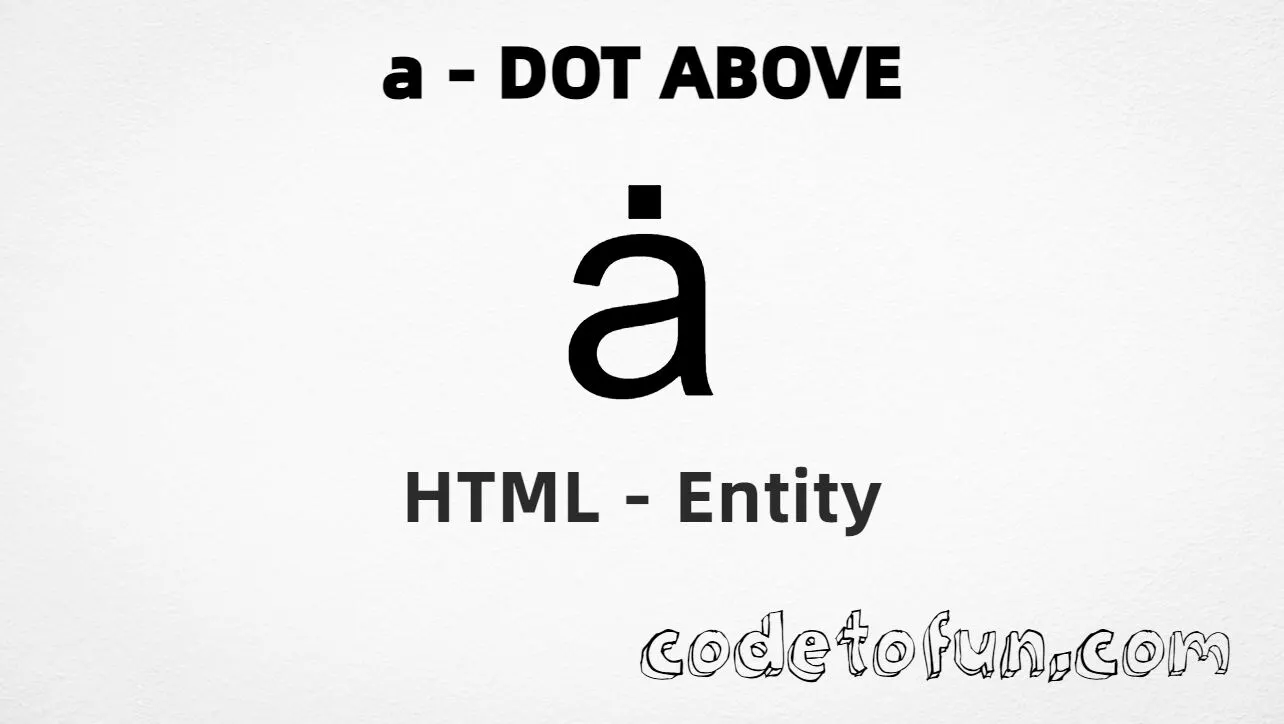
Lowercase a dot above (ȧ) is the Latin Extended-B character at Unicode U+0227 (LATIN SMALL LETTER A WITH DOT ABOVE). It is the letter a with a single dot above — used in linguistics and specialized orthographies.
Remember
Character     ȧ
Unicode       U+0227
Hex entity    ȧ
Decimal       ȧ
CSS escape    \0227
Named entity  (none)
Capital       Ȧ (U+0226)
Hex, decimal, CSS, and a typed character all produce the same glyph: ȧ. Prefer ȧ in HTML source when you need an explicit entity.
\0227 belongs in CSS. ȧ / ȧ belong in HTML.
Encoding
Declare UTF-8
If you type ȧ directly, keep <meta charset="UTF-8"> so the file is not misread.
Fonts
Check glyph coverage
Some fonts omit Latin Extended-B. Pick a font that includes U+0227 if the glyph is missing.
Compatibility
Browser Support
Lowercase a dot above (U+0227) and its entity forms (ȧ, ȧ, CSS \\0227) are supported in all modern browsers. Glyph display depends on font coverage.
✓ Universal encoding
Lowercase A Dot Above (ȧ)
Encode with hex, decimal, or CSS escape — or type ȧ directly in UTF-8 HTML.
100%Browser coverage
Google ChromeSupported
Yes
Microsoft EdgeSupported
Yes
Mozilla FirefoxSupported
Yes
Apple SafariSupported
Yes
OperaSupported
Yes
Internet ExplorerIE 9+
Yes*
U+0227Full support
Bottom line: Prefer ȧ for readable HTML. Use \\0227 only inside CSS content.
Remember
Key Takeaways
Unicode: this character is U+0227 (decimal 551).
HTML: prefer ȧ — or use ȧ (no named entity).
CSS: use \0227 inside content for generated text.
Watch out:ȧ ≠ capital Ȧ (Ȧ) ≠ combining dot (U+0307).
One line:U+0227 → ȧ / ȧ / CSS \0227 (no named entity).
Frequently Asked Questions
Use ȧ (hex), ȧ (decimal), or the CSS escape \0227 in the content property. All render ȧ when the font supports Latin Extended-B. There is no named HTML entity.
U+0227 (LATIN SMALL LETTER A WITH DOT ABOVE). Hex 227, decimal 551. It belongs to Latin Extended-B (U+0180–U+024F).
No. HTML5 does not define a named entity for U+0227. Use numeric references like ȧ or ȧ.
Use it for linguistics, phonetic transcription, language documentation, and specialized orthographies that need ȧ.
HTML entities (ȧ or ȧ) go in markup. The CSS escape \0227 is used in stylesheets (usually in the content property of ::before/::after). Both render ȧ.
Visually similar, but U+0227 is a precomposed character. Combining dot above is U+0307 after a base letter. Prefer the precomposed ȧ when available.
🤔
Did you know?
Lowercase a dot above is Unicode U+0227 (decimal 551) — LATIN SMALL LETTER A WITH DOT ABOVE in Latin Extended-B. HTML5 has no named entity — use ȧ or ȧ. Capital is Ȧ (U+0226). Used in linguistics, phonetic transcription, and specialized orthographies.